

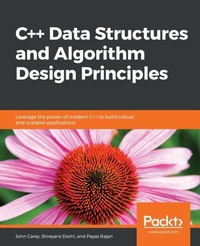
C++ Data Structures and Algorithm Design Principles
Leverage the power of modern C++ to build robust and scalable applications
Published on 31. October 2019
Book
Paperback/Softback
626 pages
978-1-83882-884-4 (ISBN)
Description
Get started with C++ programming by learning how to build applications using its data structures and algorithms
Key Features
Explore data structures such as arrays, stacks, and graphs with real-world examples
Study the trade-offs between algorithms and data structures and discover what works and what doesn't
Discover how techniques such as bloom filters and multi-way heaps boost real-world applications
Book DescriptionC++ is a mature multi-paradigm programming language that enables you to write high-level code with a high degree of control over the hardware. Today, significant parts of software infrastructure, including databases, browsers, multimedia frameworks, and GUI toolkits, are written in C++.
This book starts by introducing C++ data structures and how to store data using linked lists, arrays, stacks, and queues. In later chapters, the book explains the basic algorithm design paradigms, such as the greedy approach and the divide-and-conquer approach, which are used to solve a large variety of computational problems. Finally, you will learn the advanced technique of dynamic programming to develop optimized implementations of several algorithms discussed in the book.
By the end of this book, you will have learned how to implement standard data structures and algorithms in efficient and scalable C++ 14 code.
What you will learn
Build applications using hash tables, dictionaries, and sets
Explore how modern hardware affects the actual run-time performance of programs
Apply common algorithms such as heapsort and merge sort for string data types
Use C++ template metaprogramming to write code libraries
Implement a URL shortening service using a bloom filter
Use appropriate modern C++ idioms such as std:: array instead of C-style arrays
Who this book is forThis book is for developers or students who want to revisit basic data structures and algorithm design techniques. Although no mathematical background is required, basic knowledge of complexity classes and Big O notation along with a qualification in an algorithms course will help you get the most out of this book. Familiarity with C++ 14 standard is assumed.
Key Features
Explore data structures such as arrays, stacks, and graphs with real-world examples
Study the trade-offs between algorithms and data structures and discover what works and what doesn't
Discover how techniques such as bloom filters and multi-way heaps boost real-world applications
Book DescriptionC++ is a mature multi-paradigm programming language that enables you to write high-level code with a high degree of control over the hardware. Today, significant parts of software infrastructure, including databases, browsers, multimedia frameworks, and GUI toolkits, are written in C++.
This book starts by introducing C++ data structures and how to store data using linked lists, arrays, stacks, and queues. In later chapters, the book explains the basic algorithm design paradigms, such as the greedy approach and the divide-and-conquer approach, which are used to solve a large variety of computational problems. Finally, you will learn the advanced technique of dynamic programming to develop optimized implementations of several algorithms discussed in the book.
By the end of this book, you will have learned how to implement standard data structures and algorithms in efficient and scalable C++ 14 code.
What you will learn
Build applications using hash tables, dictionaries, and sets
Explore how modern hardware affects the actual run-time performance of programs
Apply common algorithms such as heapsort and merge sort for string data types
Use C++ template metaprogramming to write code libraries
Implement a URL shortening service using a bloom filter
Use appropriate modern C++ idioms such as std:: array instead of C-style arrays
Who this book is forThis book is for developers or students who want to revisit basic data structures and algorithm design techniques. Although no mathematical background is required, basic knowledge of complexity classes and Big O notation along with a qualification in an algorithms course will help you get the most out of this book. Familiarity with C++ 14 standard is assumed.
More details
Language
English
Place of publication
Birmingham
United Kingdom
Target group
Professional and scholarly
Dimensions
Height: 235 mm
Width: 191 mm
Thickness: 34 mm
Weight
1151 gr
ISBN-13
978-1-83882-884-4 (9781838828844)
Copyright in bibliographic data and cover images is held by Nielsen Book Services Limited or by the publishers or by their respective licensors: all rights reserved.
Schweitzer Classification
Other editions
Additional editions
John Carey | Anil Achary
C++ Data Structures and Algorithm Design Principles
Leverage the power of modern C++ to build robust and scalable applications
E-Book
10/2019
Packt Publishing
€29.99
Available for download
Persons
A composer and pianist, John Carey's formal education is almost exclusively based within the musical realm. Having used computers and other forms of technology extensively in his artistic endeavors, he invested years of self-study in the subjects of programming and mathematics and now works professionally as a software engineer. He believes his unusual background provides him with a unique and relatively non-academic perspective on the topic of software development. He currently works for Hydratec Industries, a company that primarily develops CAD software for fire sprinkler system designers that is used to perform hydraulic calculations on proposed designs so as to determine their efficacy and legality. Shreyans Doshi graduated with a Bachelor of Technology degree in computer engineering from Nirma University, Ahmedabad. After graduation, he joined the finance industry to work on ultra-low latency trading systems using cutting-edge C++ applications. For the past three years, he has been designing trading infrastructure in C++. Payas Rajan graduated with a Bachelor of Technology degree in computer science from NIT Allahabad. Later, he joined Samsung Research India, where he helped develop the multimedia framework for Tizen devices. Currently, he is working as a teaching and research assistant while pursuing a Ph.D. specializing in geospatial databases and route planning algorithms at the University of California Riverside. He has been creating applications using C++ for a decade.
Content
Table of Contents
Lists, Stacks, and Queues
Trees, Heaps, and Graphs
Hash Tables and Bloom Filters
Divide and Conquer
Greedy Algorithms
Graph Algorithms I
Graph Algorithms II
Dynamic Programming I
Dynamic Programming II
Lists, Stacks, and Queues
Trees, Heaps, and Graphs
Hash Tables and Bloom Filters
Divide and Conquer
Greedy Algorithms
Graph Algorithms I
Graph Algorithms II
Dynamic Programming I
Dynamic Programming II