

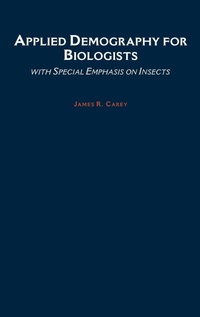
Applied Demography for Biologists
With Special Emphasis on Insects
Published on 3. June 1993
Book
Hardback
224 pages
978-0-19-506687-6 (ISBN)
Description
Many important biological problems are concerned with birth, death, and population change - the basis of classical demographic research. Yet few biologists are aware that the well-developed principles of human demography can be applied to biological problems. This book introduces biologists to population studies and shows how to apply demographic principles and techniques in research. It outlines general principles - life tables, growth models, stable population theory - and provides examples from entomology. The book is based on the author's insect demography course at the University of California, Davis. It is intended as a reference handbook for ecologists, population biologists, and entomologists, and as a graduate text in basic demography for advanced biology and ecology students.
Reviews / Votes
'there is much of interest in this book to insect ecologists ... an interesting book that should be studied by anyone involved in the experimental study of insect populations'H.C.J. Godfray, TREE vol. 9, no. 8 August 1994
More details
Language
English
Place of publication
New York
United States
Target group
Professional and scholarly
Illustrations
line figures, tables
Dimensions
Height: 240 mm
Width: 161 mm
Thickness: 17 mm
Weight
505 gr
ISBN-13
978-0-19-506687-6 (9780195066876)
Copyright in bibliographic data and cover images is held by Nielsen Book Services Limited or by the publishers or by their respective licensors: all rights reserved.
Schweitzer Classification
Other editions
Additional editions
E-Book
06/1993
1st Edition
Oxford University Press, UK
€148.09
Available for download
Person
James R. Carey is Professor of Entomology at the University of California, Davis and member of the Graduate Group in Demography at the University of California, Berkeley. Professor Carey is recognized nationally and internationally as a leading expert in arthropod demography and has authored nearly 50 publications in this area including papers in Science, Theoretical Population Biology, Occologia, Journal of Animal Ecology and numerous entomology
journals. He is Principle Investigator of a 4-year study funded by the National Institute of Aging to gather and analyze data for the largest life table ever constructed for a non-human organism.
journals. He is Principle Investigator of a 4-year study funded by the National Institute of Aging to gather and analyze data for the largest life table ever constructed for a non-human organism.
Content
1. Introduction ; 1.1 Formalization ; 1.2 Elementary Characteristics of Populations ; 2. Life Tables ; 2.1 General Concepts ; 2.2 The Single Decrement Life Tables ; 2.3 The Abridged Life Table ; 2.4 The Multiple Decrement Life Table ; 2.5 Selected Properties of Model Life Tables ; 3. Reproduction ; 3.1 General Background ; 3.2 Per Capita Reproductive Rates ; 3.3 Reproductive Heterogeneity ; 3.4 Generalizations ; 4. Population I. Basic Concepts and Models ; 4.1 Background ; 4.2 The Stable Population Model ; 4.3 Population Projection ; 4.4 Fundamental Properties of Populations ; 5. Population II. Extensions of Stable Theory ; 5.1 Two-Sex Models ; 5.2 Stochastic Demography ; 5.3 Multiregional Demography ; 5.4 Demographic Theory of Social Insects: The Honeybee ; 5.5 The Unity of Demographic Population Models ; 6. Demographic Applications ; 6.1 Estimation ; 6.2 Curve Fitting ; 6.3 Mass Rearing: Basic Harvesting Concepts ; 6.4 Parasitoid Mass Rearing ; 6.5 Pros and Cons of Demographic Modeling