

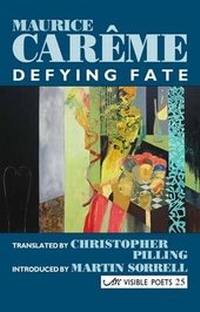
Defying Fate
Published on 17. April 2009
Book
Paperback/Softback
160 pages
978-1-904614-48-7 (ISBN)
Description
Translated by Christopher Pilling.
Defying Fate, like most of Maurice Careme's poetry, is marked by its fluency and ease of access. Here are poems that charm at first sight, short, seductive to the eye and ear, satisfyingly metrical and given to rhyme. Their subject matter is generally familiar to us - children, silence, death, God, the troubled mind - and is argued and developed in ways we can follow with sympathy; this is poetry to identify with, poetry of shared emotion and aesthetic satisfaction.
In his introduction, Martin Sorrell calls Careme "A poet of tact. What he says may be disturbing, but the way in which he says it remains well-mannered", and Christopher Pilling, in his sensitive and resourceful translation, conveys this absolutely. Defying Fate, which, incidentally was published posthumously, is a fascinating introduction to this intriguing Belgian poet.
"Careme demonstrates over and over of how he 'believe(s) more in the heart's dark shadow than the light of intelligence.'"
Marcus Smith, Envoi
Maurice Careme was born in 1899 in Wavre, a small town in Brabant-Wallon, Belgium. In 1918, he left Wavre to become a primary school teacher in Brussels and married a fellow-teacher, Andree Gobron in 1924. He gave up teaching to write full-time in 1943. Author of some ninety books, novels, short stories, fables and essays, as well as poems, he published a collection of poems nearly every year from 1947 to 1975. He won numerous prizes in Belgium and abroad and, in Paris in 1972, was elected "Prince des poetes" to succeed Jean Cocteau. He died in 1978 (working till his final afternoon) and Defying Fate appeared in 1987.
Defying Fate, like most of Maurice Careme's poetry, is marked by its fluency and ease of access. Here are poems that charm at first sight, short, seductive to the eye and ear, satisfyingly metrical and given to rhyme. Their subject matter is generally familiar to us - children, silence, death, God, the troubled mind - and is argued and developed in ways we can follow with sympathy; this is poetry to identify with, poetry of shared emotion and aesthetic satisfaction.
In his introduction, Martin Sorrell calls Careme "A poet of tact. What he says may be disturbing, but the way in which he says it remains well-mannered", and Christopher Pilling, in his sensitive and resourceful translation, conveys this absolutely. Defying Fate, which, incidentally was published posthumously, is a fascinating introduction to this intriguing Belgian poet.
"Careme demonstrates over and over of how he 'believe(s) more in the heart's dark shadow than the light of intelligence.'"
Marcus Smith, Envoi
Maurice Careme was born in 1899 in Wavre, a small town in Brabant-Wallon, Belgium. In 1918, he left Wavre to become a primary school teacher in Brussels and married a fellow-teacher, Andree Gobron in 1924. He gave up teaching to write full-time in 1943. Author of some ninety books, novels, short stories, fables and essays, as well as poems, he published a collection of poems nearly every year from 1947 to 1975. He won numerous prizes in Belgium and abroad and, in Paris in 1972, was elected "Prince des poetes" to succeed Jean Cocteau. He died in 1978 (working till his final afternoon) and Defying Fate appeared in 1987.
More details
Series
Language
English
Place of publication
Lancs
United Kingdom
Dimensions
Height: 216 mm
Width: 138 mm
Weight
220 gr
ISBN-13
978-1-904614-48-7 (9781904614487)
Copyright in bibliographic data and cover images is held by Nielsen Book Services Limited or by the publishers or by their respective licensors: all rights reserved.
Schweitzer Classification
Persons
MAURICE CAREME (author) was born on 12 May 1899 in Wavre, a small town in Brabant-Wallon, Belgium, where his father Joseph was a painter and decorator and his mother, Henriette Art, ran a small grocery shop cum general store. One of his grandfathers sold goods from a gypsy caravan. His elder sister, born in 1898, only lived a day, his other sister, Germaine, was born in 1901; his younger brothers, Georges and Marcel, were born in 1904 and 1907 but Marcel only lived for eight months. Maurice had a very happy country childhood, which he often brought back to life in his poems. His first ones, written in 1914, were inspired by Bertha Detry, his childhood girlfriend. In the same year he won a scholarship to a teacher training college, the Ecole Normale de Tirlemont. Julien Kuypers was the teacher who encouraged him to write and introduced him to contemporary poetry. In 1918 Careme left Wavre to become a primary school teacher in Brussels and in 1924 married Andree Gobron, a fellow teacher (Caprine in his poems). The Brabant-style house he had built in Avenue Nellie Melba, is where they lived from 1933. It was known as 'la Maison Blanche' and became the seat of the Fondation Maurice Careme in 1975 and the Musee Maurice Careme on his death in 1978. He was 78. Careme gave up teaching to write full-time in 1943. Author of some ninety books, novels, short stories, fables and essays, as well as poems, he published a collection of poems nearly every year from 1947 until 1975. 'Mere' (1935) won the Prix Triennal de Poesie and 'La maison blanche' (1949) the Prix de l'Academie Francaise. Where 'Chansons pour Caprine' (1930) reflected quite a painful married life, his love poems were more discreet in Femme (1946) and, when inspired by Jeannine Burny, full of youthful vigour in 'La bien-aimee' (1965). In Paris in 1972 he was elected 'Prince des poetes' to succeed Jean Cocteau. He won numerous other prizes in Belgium and abroad, including one for his translation of Flemish poets. Even as a very weak 78 year old, he worked till the very last minute of his final afternoon, 13 January 1978. 'Defier le destin' appeared in 1987 and includes a selection of the poems he felt were finished. He had asked Jeannine (his friend and assistant since 1943 and now the President of the Fondation) to arrange the poems she was sure he had finished and for the cover of this collection she called on their friend, the artist Paul Delvaux. A subsequent collection, rather darker in tone, 'De plus loin que la nuit', appeared in 1992, and after a collection for the Gallimard Jeunesse series, 'L'oiseleur et autres poemes', (2003), another, 'Et puis apres', in 2004, and yet another 'Etre ou ne pas etre' in 2008. CHRISTOPHER PILLING (translator) was born in Birmingham and taught French and P.E on the Wirral, in a Quaker boarding school and a large Comprehensive in Yorkshire before moving to Keswick, Cumbria, where he taught French, German and Latin. He was a prize-winner in the National Poetry Competition and has published nine collections of his own poetry, as well as translations of poems by Tristan Corbiere (a Book of the Year for the Sunday Telegraph and the World Service of the BBC in 1995), Max Jacob and Lucien Becker (a PBS Recommended Translation in 2004). He has also written a number of plays. With William Scammell, he founded a Cumbrian Poets' workshop which has run for thirty years, and has seen two of his plays performed at Theatre by the Lake in Keswick. In 2006, Christopher Pilling won first prize in the John Dryden Translation Competition, one of the UK's most prestigious translation awards. MARTIN SORRELL (introducer) is Emeritus Professor of French and Literary Translation at the University of Exeter. He has published extensively. Among his books are 'Elles: A Bilingual Anthology of French Poetry by Women' (1995) and, in Oxford University Press's 'World Classics' series, 'Paul Verlaine: Selected Poems' (1999), 'Arthur Rimbaud: Collected Poems' (2001) and 'Frederico Garcia Lorca: Selected Poems' (2007). Martin Sorrell has also written radio plays and stories for the BBC. He has won two translation prizes and his most recent radio play received a national award.
Content
Translator's preface, Introduction. Le coeur pur / The pure in heart, Il avait du ciel / He had sky, L'homme / The man, Il voulut dire... / He wanted to say..., La liberte / Freedom, Le cri de la grive / The cry of the thrush, Les illusions / The illusions, Il parlait pour tuer le temps / He talked to kill time, La meme allee / The same way, La banniere / The banner, L'incredule / The non-believer, On s'habitue a tout / You can get used to owt, La rue deserte / The empty street, Dieu et le diable / God and the Devil, Ce rien de ciel / This dab of sky, La maison / The house, Les navires / Certain ships, Les chaines / Chains, Le peuplier / The poplar, La tete / In the head, Que cherchait-il... / What was he looking for..., La voix / The voice, Le monde est beau / The world is beautiful, L'indigent / The pauper, Le suicide / The suicide, Les deux gamins / The two strapping lads, Le misanthrope / The misanthropist, Sous le ciel noir / Under the threatening sky, Le mort et l'enfant / The dead man and the child, La marche d'escalier / One in a flight, La charrette arretee / The cart's held up, Devant l'hotel / Outside the hotel, Il riait / He laughed, Que cherchait-il? / What was he seeking?, La mort de Marie / The death of Marie, Son meilleur ami / His best friend, Le collectionneur / The collector, Il se sentit devenir... / He felt himself becoming..., Le chasseur / The huntsman, Je ne sais pas si Dieu / I don't know whether God, Le soir tombait / Night was falling, La reine morte / The dead queen, Le sculpteur / The sculptor, Le portrait / The portrait, L'indecis / The haverer, La voute des cieux / The heavenly vault, Sur le quai / On the quay, Les cimetieres / Cemeteries, A quoi bon s'en faire! / What's the good of worrying!, La fermiere / The farmer's wife, Il avait... / What he had, On le laissait dire / They let him say it, Le mot / The word, Il se souvint / He remembered, L'envie / The desire, Il se depechait de rire / He was quick to laugh, Il se demanda pourquoi / He wondered why, Au cadran de l'eternite / On eternity's clockface, Avec les yeux du cA ur / With the eyes of his heart, Celui qu'il attendait / The one he was waiting for, L'ecrivain / The writer, Rien dans les mains / With nothing in his hands, Melanie / Melanie, Les cieux / The heavens, L'angoisse / Man in anguish, La troupe d'anges / The band of angels, L'aube / Dawn, Baptiste / Baptiste, Le tiroir / The drawer, Le mur blanc / The white wall, Vous moquez-vous? / You pulling my leg?, On disait / What they said, Faut-il s'etonner? / Should we be surprised?, Il ne parlait que du ciel / All he talked of..., Il mit son coeur / He put his heart, Il se revoyait / He saw himself, Le canot / The rowing boat, Le voyageur / The traveller, Le debonnaire / Seeing the good, Il s'assit / He sat, Le mendiant / The beggar, A force de le repeter / By dint of repeating it, Il disait oui / He said yes, Regardez... / Look..., Les choses / Things, Dans la nuit / In the night, Il avait eu beau... / In vain..., La faim / Hunger, Que toute une allee... / That a whole line..., L'affame / The hungry man, Ce petit rien / A little something, L'homme et la mort / The man and death, L'innocent du village / The village innocent, L'artiste / The artist, Il aimait caresser / He loved stroking, C'etait si simple / It was so simple, Le tas de cendress / The pile of ash, Il chercha Dieu / He searched for God, L'animal / The animal, Ils reclamaient / They were appealing, Il viendra / He will come. Biographical notes.