

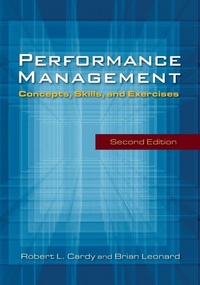
Performance Management:
Concepts, Skills and Exercises
2nd Edition
Published on 15. May 2011
Book
Paperback/Softback
280 pages
978-0-7656-2658-5 (ISBN)
Description
This comprehensive text provides an engaging examination of the entire process of performance management. It balances concepts with practical skill-based exercises, and gives readers both an understanding of performance management and the ability to manage performance. An online Instructor's Manual is available to adopters, and free PPTs are available through the author's website.
More details
Edition
2nd edition
Language
English
Place of publication
London
United Kingdom
Publishing group
Taylor & Francis Ltd
Target group
College/higher education
Illustrations
ill
Dimensions
Height: 254 mm
Width: 178 mm
Thickness: 15 mm
Weight
532 gr
ISBN-13
978-0-7656-2658-5 (9780765626585)
Copyright in bibliographic data and cover images is held by Nielsen Book Services Limited or by the publishers or by their respective licensors: all rights reserved.
Schweitzer Classification
Other editions
Additional editions

E-Book
12/2014
2nd Edition
Routledge
€86.99
Available for download

E-Book
12/2014
2nd Edition
Routledge
€86.99
Available for download
Book
05/2011
2nd Edition
Routledge
€311.60
Shipment within 15-20 days
Previous edition

Robert Cardy | Brian Leonard
Performance Management: Concepts, Skills and Exercises
Concepts, Skills and Exercises
Book
01/2004
M.E. Sharpe
€63.32
Article exhausted; check for reprint
Persons
Robert Cardy, PhD, is a professor of management and chair of the Department of Management in the College of Business at the University of Texas at San Antonio. His research and teaching interests have been in human resource management, particularly in the areas of performance appraisal and the design of effective management systems. Initially focused on narrow issues regarding the accuracy of performance evaluations, his work has broadened to the effective management of people in the contemporary organizational environment.He has published research studies in numerous journals, including Journal of Applied Psychology, Organizational Behavior and Human Decision Processes, Journal of Management, and HR Magazine. He cofounded and edited the Journal of Quality Management, and he has cowritten and edited such books as Performance Appraisal: Alternative Perspectives and Managing Human Resources.His recent focus has been on retention. The retention of employees, for example, can make a critical difference to organizations and to individuals. A cohesive retention framework can help managers to effectively address retention issues. Further, application of retention concepts to school settings can help to improve student retention. He hopes to continue to work on the development and application of retention concepts.Robert Cardy currently lives in the San Antonio area. His hobbies include working with stained glass and woodworking, as time permits. He occasionally does consulting for organizations regarding performance management.,
Brian Leonard is an established corporate strategist, trainer, coach, facilitator, and implementation specialist, with more than a decade of experience creating organizational structure and business process improvements in companies of every size in various industries. He performs comprehensive industry-specific benchmarking analyses for businesses and then designs and implements customized programs for improvement that allow each company to reach
Brian Leonard is an established corporate strategist, trainer, coach, facilitator, and implementation specialist, with more than a decade of experience creating organizational structure and business process improvements in companies of every size in various industries. He performs comprehensive industry-specific benchmarking analyses for businesses and then designs and implements customized programs for improvement that allow each company to reach
Content
Chapter 1 The Performance Management Process; Chapter 2 Organizational Context; Chapter 3 Performance; Chapter 4 Diagnosis; Chapter 5 Evaluation; Chapter 6 Feedback; Chapter 7 Dealing with Feedback; Chapter 8 Improving Performance; Epilogue Epilogue Final Thoughts;