

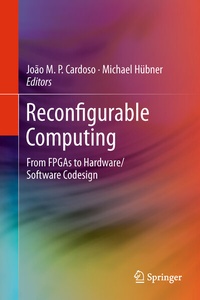
Reconfigurable Computing
From FPGAs to Hardware/Software Codesign
Published on 17. August 2011
Book
Hardback
XV, 296 pages
978-1-4614-0060-8 (ISBN)
Description
As the complexity of modern embedded systems increases, it becomes less practical to design monolithic processing platforms. As a result, reconfigurable computing is being adopted widely for more flexible design. Reconfigurable Computers offer the spatial parallelism and fine-grained customizability of application-specific circuits with the postfabrication programmability of software. To make the most of this unique combination of performance and flexibility, designers need to be aware of both hardware and software issues. FPGA users must think not only about the gates needed to perform a computation but also about the software flow that supports the design process. The goal of this book is to help designers become comfortable with these issues, and thus be able to exploit the vast opportunities possible with reconfigurable logic.
More details
Edition
2011 ed.
Language
English
Place of publication
New York
United States
Target group
Professional and scholarly
Research
Product notice
sewn/stitched
Cloth over boards
Illustrations
XV, 296 p.
Dimensions
Height: 245 mm
Width: 162 mm
Thickness: 23 mm
Weight
630 gr
ISBN-13
978-1-4614-0060-8 (9781461400608)
DOI
10.1007/978-1-4614-0061-5
Schweitzer Classification
Other editions
Additional editions
Book
11/2014
Springer
€117.69
Shipment within 15-20 days
E-Book
08/2011
1st Edition
Springer
€106.99
Available for download
Content
Introduction.- The Relevance of Reconfigurable Computing.- HiPEAC: Upcoming Challenges in Reconfigurable Computing.- MORPHEUS: Exploitation of Reconfiguration for Increased Run-time Flexibility and Self-adaptive Capabilities in Future SoCs.- hArtes: Holistic Approach to Reconfigurable Real-time Embedded Systems.- Smart Chips for Smart Surroundings.- AETHER: Self-adaptive Networked Entities: Autonomous Computing Elements for Future Pervasive Applications and Technologies.- ANDRES: Analysis and Design of Run-time Reconfigurable, Heterogeneous Systems.- CRISP: Cutting Edge Reconfigurable ICs for Stream Processing.- ERA: Embedded Reconfigurable Architectures.- REFLECT: Rendering FGGAs to Multi-core Embedded Computing.- Conclusion.