

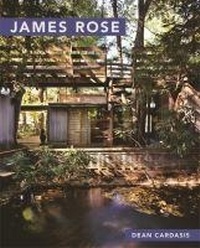
James Rose
Will be published approx. on 1. March 2017
Book
Paperback/Softback
256 pages
978-0-8203-5095-0 (ISBN)
Description
The first biography of this important landscape architect, James Rose examines the work of one of the most radical figures in the history of mid-century modernist American landscape design. An artist who explored his profession with words and built works, Rose fearlessly critiqued the developing patterns of land use he witnessed during a period of rapid suburban development. The alternatives he offered in his designs for hundreds of gardens were based on innovative and iconoclastic environmental and philosophic principles, some of which have become mainstream today.
A classmate of Garrett Eckbo and Dan Kiley at Harvard, Rose was expelled in 1937 for refusing to design landscapes in the Beaux-Arts method. In 1940, the year before he received his first commission, Rose also published the last of his influential articles for Architectural Record, a series of essays written with Eckbo and Kiley that would become a manifesto for developing a modernist landscape architecture. Over the next four decades, Rose articulated his philosophy in four major books. His writings foreshadowed many principles since embraced by the profession, including the concept of sustainability and the wisdom of accommodating growth and change.
James Rose includes new scholarship on many important works, including the Dickenson Garden in Pasadena and the Averett House in Columbus, Georgia, as well as unpublished correspondence. Throughout his career Rose refined his conservation ethic, finding opportunities to create landscapes for contemplation, self-discovery, and pleasure. At a time when issues of economy and environmentalism are even more pressing, Rose's writings and projects are both relevant and revelatory.
A classmate of Garrett Eckbo and Dan Kiley at Harvard, Rose was expelled in 1937 for refusing to design landscapes in the Beaux-Arts method. In 1940, the year before he received his first commission, Rose also published the last of his influential articles for Architectural Record, a series of essays written with Eckbo and Kiley that would become a manifesto for developing a modernist landscape architecture. Over the next four decades, Rose articulated his philosophy in four major books. His writings foreshadowed many principles since embraced by the profession, including the concept of sustainability and the wisdom of accommodating growth and change.
James Rose includes new scholarship on many important works, including the Dickenson Garden in Pasadena and the Averett House in Columbus, Georgia, as well as unpublished correspondence. Throughout his career Rose refined his conservation ethic, finding opportunities to create landscapes for contemplation, self-discovery, and pleasure. At a time when issues of economy and environmentalism are even more pressing, Rose's writings and projects are both relevant and revelatory.
Reviews / Votes
This is the book that the history of a half-century of American landscape architecture is missing. We all owe a great debt to Cardasis for his decades-long work to protect and extend the legacy of James Rose. -- Patrick Condon * University of British Columbia *More details
Series
Language
English
Place of publication
Georgia
United States
Target group
Professional and scholarly
Product notice
With flaps
Illustrations
140 color and b&w photos
Dimensions
Height: 229 mm
Width: 183 mm
Thickness: 19 mm
Weight
846 gr
ISBN-13
978-0-8203-5095-0 (9780820350950)
Copyright in bibliographic data and cover images is held by Nielsen Book Services Limited or by the publishers or by their respective licensors: all rights reserved.
Schweitzer Classification
Person
DEAN CARDASIS, FASLA, is professor of landscape architecture at Rutgers, the State University of New Jersey, and director of the James Rose Center for Landscape Architectural Research and Design in Ridgewood, New Jersey.