

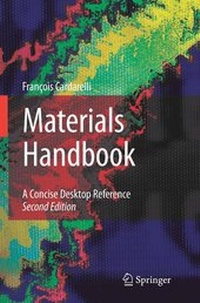
Materials Handbook
A Concise Desktop Reference
2nd Edition
Published on 27. March 2008
Book
Hardback
LXXVI, 1339 pages
978-1-84628-668-1 (ISBN)
Description
Despite the wide availability of several comprehensive series in materials sciences and metallurgy, it is difficult to find grouped properties either on metals and alloys, traditional and advanced ceramics, refractories, polymers and elastomers, composites, m- erals and rocks, soils, woods, cement, and building materials in a single-volume source book. Actually, the purpose of this practical and concise reference book is to provide key scientific and technical materials properties and data to materials scientists, metallurgists, engineers, chemists, and physicists as well as to professors, technicians, and students wo- ing in a broad range of scientific and technical fields. The classes of materials described in this handbook are as follows: (i) metals and their alloys; (ii) semiconductors; (iii) superconductors; (iv) magnetic materials; (v) dielectrics and insulators; (vi) miscellaneous electrical materials (e.g., resistors, ther- couples, and industrial electrode materials); (vii) ceramics, refractories, and glasses; (viii) polymers and elastomers; (ix) minerals, ores, and gemstones; (x) rocks and meteorites; (xi) soils and fertilizers; (xii) timbers and woods; (xiii) cement and concrete; (xiv) building materials; (xv) fuels, propellants, and explosives; xxxviii Introduction (xvi) composites; (xvii) gases; (xviii) liquids.
Reviews / Votes
From the reviews of the second edition:
"This handbook contains practical and concise information on key scientific and technical material properties for the most commonly used industrial materials . . Compared with many other handbooks on material properties, this handbook presents more background information on how to use the data presented. . Those looking for a materials reference handbook on commonly used industrial materials, especially those who need to have a better understanding of material property fundamentals, will find this an interesting and very useful handbook." (IEEE Electrical Insulation Magazine, 2009)
"This desktop reference on materials will be useful for engineers, physicists, chemists, and materials scientists who are looking for typical numbers on the physical properties of materials. . the index is very complete, it will be easy to find the property of interest. . The book also contains nine useful appendices. . The size of the volume and its 1300 pages make this handbook a real 'desk' reference. . whoever does pay will have bought a nicely bound and durable handbook." (Fernande Grandjean and Gary J. Long, Belgian Physical Society Magazine, Issue 1, 2010)More details
Edition
2nd ed. 2008
Language
English
Place of publication
London
United Kingdom
Target group
College/higher education
Professional and scholarly
Research
Edition type
Revised edition
Illustrations
531 s/w Tabellen
531 Tables, black and white; LXXVI, 1339 p. In 2 volumes, not available separately.
Dimensions
Height: 23.5 cm
Width: 15.5 cm
Weight
2445 gr
ISBN-13
978-1-84628-668-1 (9781846286681)
DOI
10.1007/978-1-84628-669-8
Schweitzer Classification
Other editions
New editions
Book
09/2018
3rd Edition
Springer
€481.49
Shipment within 10-15 days
Additional editions
E-Book
03/2008
2nd Edition
Springer
€319.93
Available for download
Previous edition
Book
06/2001
Springer
€85.59
Article exhausted; check for reprint
Person
François Cardarelli has had wide-ranging commercial and industrial experience of materials, commodities and processes:
at CNRS in Paris he designed and used electrochemical sensors for pollution control;
as a research scientist at Électricité de France he helped to invent methods of preparation of industrial titanium and tantalum electrodes;
as a registered professional consultant in Toulouse, he solved problems in electrochemical engineering, the selection of electrode materials, corrosion and high-temperature operation;
at the Avestor Corporation, he worked as an industrial electrochemist and materials expert in charge of strategic raw materials, scientific and technical support for lithium processing and, as Battery Product Leader, in charge of lithium polymer batteries for electric vehicles, down-hole drilling anf telecommunications he defined battery requirements and specifications and invented pyrometallurgical and hydrometallurgical processing for spent lithium batteries;
at Rio Tinto Iron and Titanium, he was principal chemist for Materials at Sorel-Tracy in Quebéc dealing with valorization processes for industrial residues and refactory benchmarking and electrowinning of metallic titanium.
at the Material and Electrochemical Research (MER) Corp., Tucson (Arizona, USA) he was principal electrochemist working on the electrowinning of titanium metal powder from composite anodes and other materials-related projects.
following a period as Manager of Recycling at 5NPlus Inc in Saint-Laurent Quebéc he has started his own company, Electrochem Technologies & Materials, providing professional services and promoting his own patented electrochemical technologies on a commercial basis.
Doctor Cardarelli is also the author of Encyclopaedia of Scientific Units, Weights and Measures for Springer (ISBN: 1-85233-682-X).
Content
Ferrous Metals and Their Alloys: Iron and Steels.- Nickel and Nickel Alloys.- Cobalt and Cobalt Alloys.- Manganese and Manganese Alloys.- Common Nonferrous Metals: Aluminium and Aluminium Alloys.- Copper and Copper Alloys.- Zinc and Zinc Alloys.- Lead and Lead Alloys.- Tin and Tin Alloys.- Less Common Nonferrous Metals: Alkali Metals.- Alkaline-Earth Metals.- Refractory and Reactive Metals.- Precious and Noble Metals.- Platinum Group Metals.- Rare Earth Metals.- Uranides.- Semiconductors: Bibliogrphical References.- Band Theory of Bonding in Crystalline Solids.- Electrical Classification of Solids.- Semiconductor Classes.- Semiconductors Physical Quantities.- Transport Properties.- Physical Properties of Semiconductors.- Applications of Semiconductors.- Selected Monographies.- Semiconductor Wafer Processing.- The P-N Junction.- Superconductors: Bibliographical References.- General Description.- Superconductor Types.- Basic Theory.- The Meissner-Ochsenfeld Effect.- History.- Industrial Uses and Applications.- Magnetic Materials: Bibliographical References.- Magnetic Physical Quantities.- Classification of Magnetic Materials.- Ferromagnetic Materials.- Insulators and Dielectrics: Bibliographical References.- Physical Quantities of Dielectrics.- Physical Properties of Insulators.- Dielectric Behavior.- Dielectric Breakdown Mechanisms.- Electro-Mechanical Coupling.- Piezoelectricity.- Ferroelectrics.- Aging of Ferroelectrics.- Industrial Dielectrics Classification.- Selected Properties of Insulators and Dielectric Materials.- Miscellaneous Electrical Materials: Thermocouple Materials.- Electron-emitting Materials.- Photocathode Materials.- Secondary Emission.- Electrode Materials.- Industrial Anode Materials.- Electrodes for Corrosion Protection and Control.- Ceramics and Glasses: Ceramics and Refractories.- Definitions.- Basic Classification.- Glasses.- Refractories.- Advanced Ceramics.- Polymers and Elastomers: Fundamentals and Definistions.- Properties and Characteristics of Polymers.- Thermoplastics.- Thermosets.- Rubbers and Elastomers.- Physical Properties of Polymers.- IUPAC Abbreviation Names of Polymers and Elastomers.- Further Reading.- Minerals, Ores and Gemstones: Bibliographical References.- Definitions.- Mineralogical, Physical and Chemical Properties.- Strunz Classification of Minerals.- Mineral Properties Table.- Minerals Synonyms.- Rocks and Meteorites: Bibliographical References.- Introduction.- Different Types of Rocks.- Igneous Rocks.- Sedimentary Rocks.- Metamorphic Rocks.- Meteorites.- Physical Properties of Common Rocks.- Timbers and Woods: General Descriprion.- Properties of Woods.- Applications.- Wood Performance in Various Corrosives.- Building and Construction Materials: Portland Cement.- Aggregates.- Mortars and Concrete.- Ceramics for Construction.- Building Stones.- Composite Materials: Basic Definitions and Equations.- Polymer Matrix Composites.- Metal Matrix Composites.- Ceramic Matrix Composites.- Gases and Liquids: Properties of Gases.- Properties of Liquids.- Nuclear Materials: Introduction.- Types of Nuclear Reactors.- Nuclear Fuels.- Moderator Materials.- Coolants or Heat Transfer Fluids.- Cladding Materials.- Control Materials.- Shielding Materials.- Appendices: Periodic Chart of the Elements.- Selected Physical Properties of the Elements.- Earth Crust and Sea Water Abundance of the Elements.- Resources, Reserve, Reserve Base and McElvey Diagram.- Geochemical Classification of the Elements.- Historical Names of the Elements.- Natural Radioactivity.- Names of Transfermium Elements.- Physical Properties of Water.- Physical Properties of Ice.- Crystallography and Crystallochemistry.- Propertie