

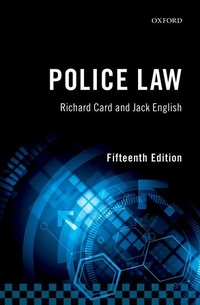
Police Law
15th Edition
Published on 19. January 2017
Book
Paperback/Softback
1040 pages
978-0-19-878680-1 (ISBN)
Description
Now in its fifteenth edition, this well-respected and highly regarded book covers all areas of law and legal procedure which are of interest to police officers.
Updated to include new legislation such as the Counter-Terrorism and Security Act 2015, the Criminal Justice and Courts Act 2015, the Deregulation Act 2015, the Modern Slavery Act 2015, the Serious Crime Act 2015 and the Psychoactive Substances Act 2016. There is also discussion of important changes to PACE Codes A, and E, new case law and a revised structure reflecting the changing nature of policing and the challenges officers face.
Comprehensive and easy to understand, Police Law is an indispensable everyday reference book for police officers, and is the only book covering all areas of police law. The book also provides a good source of information for members of the public who wish to refer to a legal text written in an accessible way. Police Law is accompanied by a useful companion website containing regular updates on changes in the law throughout the life of the print edition.
Updated to include new legislation such as the Counter-Terrorism and Security Act 2015, the Criminal Justice and Courts Act 2015, the Deregulation Act 2015, the Modern Slavery Act 2015, the Serious Crime Act 2015 and the Psychoactive Substances Act 2016. There is also discussion of important changes to PACE Codes A, and E, new case law and a revised structure reflecting the changing nature of policing and the challenges officers face.
Comprehensive and easy to understand, Police Law is an indispensable everyday reference book for police officers, and is the only book covering all areas of police law. The book also provides a good source of information for members of the public who wish to refer to a legal text written in an accessible way. Police Law is accompanied by a useful companion website containing regular updates on changes in the law throughout the life of the print edition.
Reviews / Votes
Police Law is used by every Citizens Advice Bureau in England and Wales. It covers a range of problems faced by our clients and is invaluable when Citizens Advice Bureau advisers need to know, for example, the extent of police powers. The book is clearly set out and easy to read.' * Citizens Advice Information Department * It is a very easy to use comprehensive book. When giving advice to clients it is important for us as advisors to have access to information quickly and that it be clear and concise. This book does the job - what more can I say! * Julie Plisner Haines, Citizens Advice Bureau, Essex * This publication is an institution. It is very well known and has a fantastic reputation for doing exactly what it says on the tin. * DCI Stephen Tunks, Avon & Somerset Police * I would recommend this book to Law students and Student police officers to gain an in-depth knowledge of Police Law. * Kayleigh Rhodes, BSc Policing Student, Wolverhampton University * This books needs to be freely accessible to every operational police officer at the 'coal-face' of policing, as a basic tool in his everyday work. * Simon Dell - after 37 years operational policing * Police Law is simply a wonderful police law book. It excels in its comprehensiveness, its use of simple language without footnotes; and its style of writing which makes one want to read it from end to end because of its logical, well-ordered presentation, sound research and authorativeness. Not many law books can boast of those qualities. It is simply the best, thanks to Oxford University Press. * Sally Ramage, The Criminal Lawyer *More details
Edition
15th Revised edition
Language
English
Place of publication
Oxford
United Kingdom
Target group
College/higher education
Professional and scholarly
Edition type
Revised edition
Dimensions
Height: 233 mm
Width: 153 mm
Thickness: 53 mm
Weight
1534 gr
ISBN-13
978-0-19-878680-1 (9780198786801)
Copyright in bibliographic data and cover images is held by Nielsen Book Services Limited or by the publishers or by their respective licensors: all rights reserved.
Schweitzer Classification
Persons
Richard Card is Emeritus Professor of law at De Monfort University, Leicester. He has written and lectured extensively in a number of areas of law, particularly criminal law, and is the sole author of Card, Cross, and Jones' Criminal Law.
Content
1: General Principles
2: Elements of Criminal Procedure
3: Police Powers
4: Police Questioning and the Rights of Suspects
5: Treatment, Charging and Bail of Detainees
6: Identification Methods
7: The Law of Criminal Evidence
8: The Police
9: Traffic: General Provisions
10: Use of Vehicles
11: Control of Vehicles
12: Lights and Vehicles
13: Traffic Accidents
14: Driving Offences
15: Drinking or Drug-Taking and Driving
16: Children and Young Persons
17: Licensed Premises, Licensed Persons, Clubs, Places of Entertainment, and Offences of Drunkenness
18: Dogs
19: Firearms and Weapons
20: Explosives
21: Railways
22: Nuisances, Collections, Vagrancy, Peddling, and Scrap Metal
23: Non-Fatal Offences Against the Person
24: Disputes
25: Homicide and Related Offences
26: Public Order other than Those Offences Related to Sporting Events or Industrial Disputes
27: Public Order Offences Related to Sporting Events and Those Connected with Industrial Disputes
28: Terrorism Generally
29: Sexual Offences
30: Offences Relating to Prostitution, Obscenity, and Indecent Photographs
31: Drugs
32: Theft and Related Offences, Robbery, and Blackmail
33: Burglary
34: Offences of Fraud and Bribery
35: Handling Stolen Goods and Related Offences
36: Forgery and Counterfeiting
37: Criminal Damage and Computer Misuse
38: Offences against Administration of Justice
39: Preventive Justice
2: Elements of Criminal Procedure
3: Police Powers
4: Police Questioning and the Rights of Suspects
5: Treatment, Charging and Bail of Detainees
6: Identification Methods
7: The Law of Criminal Evidence
8: The Police
9: Traffic: General Provisions
10: Use of Vehicles
11: Control of Vehicles
12: Lights and Vehicles
13: Traffic Accidents
14: Driving Offences
15: Drinking or Drug-Taking and Driving
16: Children and Young Persons
17: Licensed Premises, Licensed Persons, Clubs, Places of Entertainment, and Offences of Drunkenness
18: Dogs
19: Firearms and Weapons
20: Explosives
21: Railways
22: Nuisances, Collections, Vagrancy, Peddling, and Scrap Metal
23: Non-Fatal Offences Against the Person
24: Disputes
25: Homicide and Related Offences
26: Public Order other than Those Offences Related to Sporting Events or Industrial Disputes
27: Public Order Offences Related to Sporting Events and Those Connected with Industrial Disputes
28: Terrorism Generally
29: Sexual Offences
30: Offences Relating to Prostitution, Obscenity, and Indecent Photographs
31: Drugs
32: Theft and Related Offences, Robbery, and Blackmail
33: Burglary
34: Offences of Fraud and Bribery
35: Handling Stolen Goods and Related Offences
36: Forgery and Counterfeiting
37: Criminal Damage and Computer Misuse
38: Offences against Administration of Justice
39: Preventive Justice