

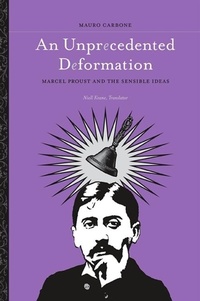
An Unprecedented Deformation
Marcel Proust and the Sensible Ideas
Published on 2. July 2011
Book
Paperback/Softback
121 pages
978-1-4384-3020-1 (ISBN)
Description
Philosophical interpretation of Proust based on the work of Merleau-Ponty and Deleuze.
French novelist Marcel Proust made famous "involuntary memory," a peculiar kind of memory that works whether one is willing or not and that gives a transformed recollection of past experience. More than a century later, the Proustian notion of involuntary memory has not been fully explored nor its implications understood. By providing clarifying examples taken from Proust's novel and by commenting on them using the work of French philosophers Maurice Merleau-Ponty and Gilles Deleuze, Italian philosopher Mauro Carbone interprets involuntary memory as the human faculty providing the involuntary creation of our ideas through the transformation of past experience. This rethinking of the traditional way of conceiving ideas and their genesis as separated from sensible experience-as has been done in Western thought since Plato-allows the author to promote a new theory of knowledge, one which is best exemplified via literature and art much more than philosophy.
French novelist Marcel Proust made famous "involuntary memory," a peculiar kind of memory that works whether one is willing or not and that gives a transformed recollection of past experience. More than a century later, the Proustian notion of involuntary memory has not been fully explored nor its implications understood. By providing clarifying examples taken from Proust's novel and by commenting on them using the work of French philosophers Maurice Merleau-Ponty and Gilles Deleuze, Italian philosopher Mauro Carbone interprets involuntary memory as the human faculty providing the involuntary creation of our ideas through the transformation of past experience. This rethinking of the traditional way of conceiving ideas and their genesis as separated from sensible experience-as has been done in Western thought since Plato-allows the author to promote a new theory of knowledge, one which is best exemplified via literature and art much more than philosophy.
Reviews / Votes
"An Unprecedented Deformation is an excellent integration of a series of essays that Carbone has dedicated to the theme of sensible ideas in recent years." - Symposium"...Carbone has written a brilliant and innovative work. More than a philosophical interpretation of Proust based on the work of Maurice Merleau-Ponty and Gilles Deleuze, the study treads new ground for epistemology, offering a new theory of ideas ... This is an important book for philosophy as well as literature ... Highly recommended." - CHOICE
More details
Series
Language
English
Place of publication
Albany, NY
United States
Target group
Professional and scholarly
US School Grade: College Graduate Student and over
Product notice
Paperback (trade)
Dimensions
Height: 226 mm
Width: 150 mm
Thickness: 13 mm
Weight
181 gr
ISBN-13
978-1-4384-3020-1 (9781438430201)
Copyright in bibliographic data and cover images is held by Nielsen Book Services Limited or by the publishers or by their respective licensors: all rights reserved.
Schweitzer Classification
Other editions
Additional editions
E-Book
07/2011
1st Edition
De Gruyter
from
€76.99
Available for download
Persons
Mauro Carbone is Professor of Aesthetics at the University of Lyon III, France. He is the author of several books, including The Thinking of the Sensible: Merleau-Ponty's A-Philosophy. Niall Keane is a postdoctoral researcher at the Husserl-Archives: Centre for Phenomenology in Leuven, Belgium.
Content
Abbreviations
Introduction - "Seek? More Than That: Create"
1. Nature: Variations on the Theme
2. The Mythical Time of the Ideas
3. Deformation and Recognition
4. The Words of the Oracle
5. How Can One Recognize What One Did Not Know?
Appendix
Love and Music
Notes
Index
Introduction - "Seek? More Than That: Create"
1. Nature: Variations on the Theme
2. The Mythical Time of the Ideas
3. Deformation and Recognition
4. The Words of the Oracle
5. How Can One Recognize What One Did Not Know?
Appendix
Love and Music
Notes
Index