

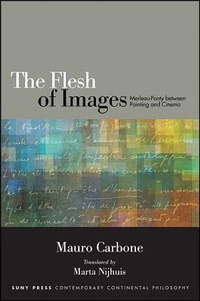
The Flesh of Images
Merleau-Ponty between Painting and Cinema
Published on 1. October 2015
Book
Hardback
128 pages
978-1-4384-5879-3 (ISBN)
Description
Highlights Merleau-Ponty's interest in film and connects it to his aesthetic theory.
In The Flesh of Images, Mauro Carbone begins with the point that Merleau-Ponty's often misunderstood notion of "flesh" was another way to signify what he also called "Visibility." Considering vision as creative voyance, in the visionary sense of creating as a particular presence something which, as such, had not been present before, Carbone proposes original connections between Merleau-Ponty and Paul Gauguin, and articulates his own further development of the "new idea of light" that the French philosopher was beginning to elaborate at the time of his sudden death. Carbone connects these ideas to Merleau-Ponty's continuous interest in cinema-an interest that has been traditionally neglected or circumscribed. Focusing on Merleau-Ponty's later writings, including unpublished course notes and documents not yet available in English, Carbone demonstrates both that Merleau-Ponty's interest in film was sustained and philosophically crucial, and also that his thinking provides an important resource for illuminating our contemporary relationship to images, with profound implications for the future of philosophy and aesthetics. Building on his earlier work on Marcel Proust and considering ongoing developments in optical and media technologies, Carbone adds his own philosophical insight into understanding the visual today.
In The Flesh of Images, Mauro Carbone begins with the point that Merleau-Ponty's often misunderstood notion of "flesh" was another way to signify what he also called "Visibility." Considering vision as creative voyance, in the visionary sense of creating as a particular presence something which, as such, had not been present before, Carbone proposes original connections between Merleau-Ponty and Paul Gauguin, and articulates his own further development of the "new idea of light" that the French philosopher was beginning to elaborate at the time of his sudden death. Carbone connects these ideas to Merleau-Ponty's continuous interest in cinema-an interest that has been traditionally neglected or circumscribed. Focusing on Merleau-Ponty's later writings, including unpublished course notes and documents not yet available in English, Carbone demonstrates both that Merleau-Ponty's interest in film was sustained and philosophically crucial, and also that his thinking provides an important resource for illuminating our contemporary relationship to images, with profound implications for the future of philosophy and aesthetics. Building on his earlier work on Marcel Proust and considering ongoing developments in optical and media technologies, Carbone adds his own philosophical insight into understanding the visual today.
Reviews / Votes
"Carbone reveals the invisible in Merleau-Ponty with musical grace and resonance." - Phenomenological Reviews"The elegant style of Carbone's prose-crafted with a certain cadence and phrasing, an inimitable world of language-nevertheless does not conceal the complexity of his scholarly research." - Notre Dame Philosophical Reviews
More details
Series
Language
English
Place of publication
Albany, NY
United States
Target group
Professional and scholarly
US School Grade: College Graduate Student and over
Product notice
sewn/stitched
Cloth over boards
Dimensions
Height: 234 mm
Width: 163 mm
Thickness: 15 mm
Weight
431 gr
ISBN-13
978-1-4384-5879-3 (9781438458793)
Copyright in bibliographic data and cover images is held by Nielsen Book Services Limited or by the publishers or by their respective licensors: all rights reserved.
Schweitzer Classification
Other editions
Additional editions
E-Book
09/2015
1st Edition
De Gruyter
from
€76.99
Available for download
Persons
Mauro Carbone is Full Professor of Philosophy at the University of Lyon 3 and a senior member of the Institut Universitaire de France. His books include An Unprecedented Deformation: Marcel Proust and the Sensible Ideas (translated by Niall Keane), also published by SUNY Press. Marta Nijhuis is Lecturer in Philosophy and Theory of Images at the University of Lyon 3 and at EAC Lyon.
Content
Acknowledgments
Introduction: The Flesh and the Thinking of the Visual Today
1. Flesh: Toward the History of a Misunderstanding
2. It Takes a Long Time to Become Wild: Gauguin According to Merleau-Ponty, Merleau-Ponty According to Gauguin
3. "Making Visible": Merleau-Ponty and Paul Klee
4. The Philosopher and the Moviemaker: Merleau-Ponty and Cinematic Thinking
5. The Light of the Flesh: Anti-Platonistic Instances and Neoplatonic Traces in the Later Merleau-Ponty's Thinking
6. The Sensible Ideas Between Life and Philosophy
Notes
Index
Introduction: The Flesh and the Thinking of the Visual Today
1. Flesh: Toward the History of a Misunderstanding
2. It Takes a Long Time to Become Wild: Gauguin According to Merleau-Ponty, Merleau-Ponty According to Gauguin
3. "Making Visible": Merleau-Ponty and Paul Klee
4. The Philosopher and the Moviemaker: Merleau-Ponty and Cinematic Thinking
5. The Light of the Flesh: Anti-Platonistic Instances and Neoplatonic Traces in the Later Merleau-Ponty's Thinking
6. The Sensible Ideas Between Life and Philosophy
Notes
Index