

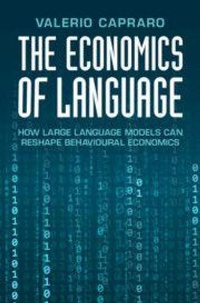
The Economics of Language
How Large Language Models Can Reshape Behavioural Economics
Will be published approx. on 30. April 2026
Book
Paperback/Softback
376 pages
978-1-009-73306-9 (ISBN)
Description
The development of artificial intelligence and machine learning is leading to a revolution in the way we think about economic decisions. The Economics of Language explores how the use of generative AI and large language models (LLMs) can transform the way we think about economic behaviour. It introduces the LENS framework (Linguistic content triggers Emotions and suggests Norms, which shape Strategy choice) and presents empirical evidence that LLMs can predict human behaviour in economic games more accurately than traditional outcome-based models. It draws on years of research to provide a step-by-step development of the theory, combining accessible examples with formal modelling. Offering a roadmap for future research at the intersection of economics, psychology, and AI, this book equips readers with tools to quantify the role of language in decision-making and redefines how we think about utility, rationality, and human choice.
More details
Language
English
Place of publication
Cambridge
United Kingdom
Product notice
Paperback (trade)
Illustrations
Worked examples or Exercises
Dimensions
Height: 229 mm
Width: 152 mm
Thickness: 21 mm
Weight
544 gr
ISBN-13
978-1-009-73306-9 (9781009733069)
Copyright in bibliographic data and cover images is held by Nielsen Book Services Limited or by the publishers or by their respective licensors: all rights reserved.
Schweitzer Classification
Other editions
Additional editions
Valerio Capraro
The Economics of Language
How Large Language Models Can Reshape Behavioural Economics
Book
04/2026
Cambridge University Press
€132.70
Shipment within 15-20 days
Person
Valerio Capraro is a professor in the Department of Psychology at the University of Milan Bicocca. He holds a Ph.D. in mathematics and studies human behaviour by combining mathematical modelling, human experiments, and numerical simulations. His research has been published in leading academic journals and featured in international news outlets.
Content
Introduction; 1. The birth of behavioural economics; 2. Economic consequentialism; 3. A paradigm crisis; 4. The role of Large Language Models: first part; 5. The LENS model; 6. Sentiment analysis; 7. Normative analysis; 8. The role of large language models: Part II: 9. Broader implications and future directions; Conclusion.