

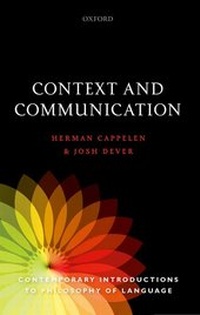
Context and Communication
Published on 7. April 2016
Book
Paperback/Softback
212 pages
978-0-19-873306-5 (ISBN)
Description
Context and Communication offers an introduction to a central theme in the study of language: the various ways in which what we say (or ask, or think) depends on the context of speech and thought. The period since 1970 has produced a vast literature on this topic, both by philosophers and by linguists. It is one of the areas of philosophy (and linguistics) where most progress has been made over the last few decades. This book explores some of the central data, questions, concepts, and theories of context sensitivity. It is written to be accessible to someone with no prior knowledge of the material or, indeed, any prior knowledge of philosophy, and is ideal for use as part of a philosophy of language course by students of philosophy or linguistics.
Context and Communication is the first in the series Contemporary Introductions to Philosophy of Language. Each book in the series provides an introduction to an important topic in philosophy of language. Three more volumes are in preparation, on reference, the metaphysics of meaning, and conceptual analysis and philosophical methodology. These textbooks can be used as a module in a philosophy of language course, for either undergraduate or graduate students.
Context and Communication is the first in the series Contemporary Introductions to Philosophy of Language. Each book in the series provides an introduction to an important topic in philosophy of language. Three more volumes are in preparation, on reference, the metaphysics of meaning, and conceptual analysis and philosophical methodology. These textbooks can be used as a module in a philosophy of language course, for either undergraduate or graduate students.
Reviews / Votes
Cappelen and Dever offer a clear, sustained treatment of one area in the contemporary philosophy of language, namely, the interrelation of linguistic meaning, truth, and the multiplicity of contexts in which language occurs ... the volume is a lively and accessible introductionand beyondto context and communication ... Summing Up: Recommended. Upper-division undergraduates through faculty. * D.B. Boersema , CHOICE *More details
Series
Language
English
Place of publication
Oxford
United Kingdom
Target group
College/higher education
Professional and scholarly
Dimensions
Height: 215 mm
Width: 136 mm
Thickness: 12 mm
Weight
272 gr
ISBN-13
978-0-19-873306-5 (9780198733065)
Copyright in bibliographic data and cover images is held by Nielsen Book Services Limited or by the publishers or by their respective licensors: all rights reserved.
Schweitzer Classification
Other editions
Additional editions
Herman Cappelen | Josh Dever
Context and Communication
E-Book
04/2016
1st Edition
OUP eBook
€16.49
Available for download
Herman Cappelen | Josh Dever
Context and Communication
E-Book
04/2016
1st Edition
OUP eBook
€17.99
Available for download
Persons
Herman Cappelen is a professor of philosophy at the universities of Oslo and St Andrews. He is a Research Director at CSMN (in Oslo), and the Editor-in-Chief of Inquiry. He is the author of six books and many papers.
Josh Dever is a professor of philosophy at the University of Texas at Austin and a professorial fellow at the Arche research centre at the University of St Andrews. He is the author of many papers in philosophy of language and logic, and the co-author with Herman Cappelen of The Inessential Indexical. He is also an associate editor of Semantics and Pragmatics.
Josh Dever is a professor of philosophy at the University of Texas at Austin and a professorial fellow at the Arche research centre at the University of St Andrews. He is the author of many papers in philosophy of language and logic, and the co-author with Herman Cappelen of The Inessential Indexical. He is also an associate editor of Semantics and Pragmatics.
Content
PART I: CONTEXT SENSITIVITY: VARIABILITY VS. STABILITY; PART II: THEORIES OF CONTEXT SENSITIVITY; PART III: CONTEXTS: WHAT THEY ARE AND HOW WE CREATE THEM