

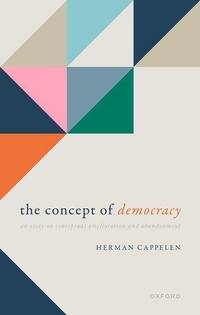
The Concept of Democracy
An Essay on Conceptual Amelioration and Abandonment
Published on 28. August 2023
Book
Hardback
244 pages
978-0-19-888651-8 (ISBN)
Description
This is an open access title available under the terms of a CC BY-NC-ND 4.0 International licence. It is free to read on Oxford Academic and offered as a free PDF download from OUP and selected open access locations.
If we don't know what the words 'democracy' and 'democratic' mean, then we don't know what democracy is. This book defends a radical view: these words mean nothing and should be abandoned. The argument for Abolitionism is simple: those terms are defective and we can easily do better, so let's get rid of them. According to the abolitionist, the switch to alternative devices would be a significant communicative, cognitive, and political advance.
The first part of the book presents a general theory of abandonment: the conditions under which language should be abandoned. The rest of the book applies this general theory to the case of 'democracy' and 'democratic'. Cappelen shows that 'democracy' and 'democratic' are semantically, pragmatically, and communicatively defective.
Abolitionism is not all gloom and doom. It also contains a message of good cheer: we have easy access to conceptual devices that are more effective than 'democracy'. We can do better. These alternative linguistic devices will enable us to ask better questions, provide genuinely fruitful answers, and have more rational discussions. Moreover, those questions and answers better articulate the communicative and cognitive aims of those who use empty terms like 'democracy' and 'democratic'.
If we don't know what the words 'democracy' and 'democratic' mean, then we don't know what democracy is. This book defends a radical view: these words mean nothing and should be abandoned. The argument for Abolitionism is simple: those terms are defective and we can easily do better, so let's get rid of them. According to the abolitionist, the switch to alternative devices would be a significant communicative, cognitive, and political advance.
The first part of the book presents a general theory of abandonment: the conditions under which language should be abandoned. The rest of the book applies this general theory to the case of 'democracy' and 'democratic'. Cappelen shows that 'democracy' and 'democratic' are semantically, pragmatically, and communicatively defective.
Abolitionism is not all gloom and doom. It also contains a message of good cheer: we have easy access to conceptual devices that are more effective than 'democracy'. We can do better. These alternative linguistic devices will enable us to ask better questions, provide genuinely fruitful answers, and have more rational discussions. Moreover, those questions and answers better articulate the communicative and cognitive aims of those who use empty terms like 'democracy' and 'democratic'.
Reviews / Votes
Recommended. Advanced undergraduates through faculty. * Choice * The Concept of Democracy is a substantial step forward in our understanding of "conceptual ethics"-roughly, normative and evaluative thinking about our representational resources. There is a long and diverse tradition in philosophy arguing that we should abandon the use of certain terminology. Remarkably, given that history, this book is the first extended and systematic discussion I know of that considers in general terms when and why we should abandon a piece of terminology. Further, because it is an extended argument for abandoning 'democracy' (and its semantic cognates), it provides a valuable (and novel) model that illustrates neglected possible grounds for abandonment... the book does all of this in Cappelen's characteristic style: the book is rich in exciting arguments and forceful-sometimes pugnacious-in tone. * Tristram McPherson, Asian Journal of Philosophy * The Concept of Democracy is a thought-provoking, well-researched, engaging and extremely clear book that will be of interest to methodologically oriented political philosophers, democratization scholars and comparative political scientists, among others. * Pablo Magana, Political Studies Review *More details
Language
English
Place of publication
Oxford
United Kingdom
Target group
Professional and scholarly
Product notice
sewn/stitched
Cloth over boards
Dimensions
Height: 224 mm
Width: 148 mm
Thickness: 17 mm
Weight
449 gr
ISBN-13
978-0-19-888651-8 (9780198886518)
Copyright in bibliographic data and cover images is held by Nielsen Book Services Limited or by the publishers or by their respective licensors: all rights reserved.
Schweitzer Classification
Other editions
Additional editions
E-Book
05/2024
1st Edition
OUP eBook
€65.99
Available for download
E-Book
07/2023
1st Edition
OUP eBook
€59.49
Available for download
Person
Herman Cappelen is a Chair Professor at the University of Hong Kong, the Co-Director of ConceptLab-HK, and the Director of AI&Humanity-Lab. He works in all areas of systematic philosophy and has written 10 monographs and many influential papers.
Content
Preface & Acknowledgements Part I: A Theory of Abandonment 1: Introduction 2: Arguments for Abandonment 3: Abandonment compared to Elimination, Reduction, Replacement, and Amelioration 4: Abandonment and Communication Part II: Some Data about 'Democracy' 5: The Ordinary Notion of 'Democracy': Methodological Preamble 6: Some Data about 'Democracy' and 'Democratic' Part III: Abandonment of 'Democracy'? 7: Problems with 'Democracy' 8: Better than 'Democracy': A Chapter of Good Cheers 9: Consequences of Abandoning 'Democracy' Part IV: Democracy Ameliorated 10: Ameliorations of 'Democracy' 11: Verbal Disputes about 'Democracy' Part V: Efforts to Defend Democracy 12: Objections and Replies Bibliography