

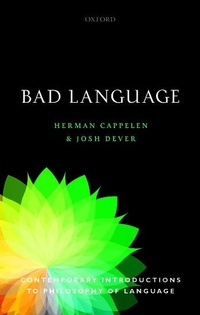
Bad Language
Published on 21. March 2019
Book
Paperback/Softback
240 pages
978-0-19-883965-1 (ISBN)
Description
When theorizing about language, we tend to assume that speakers are cooperative, honest, helpful, and so on. This, of course, isn't remotely true of a lot of real-world language use. Bad Language is the first textbook to explore non-idealized language use, the linguistic behaviour of those who exploit language for malign purposes. Two eminent philosophers of language present a lively and accessible introduction to a wide range of topics including lies and bullshit, slurs and insults, coercion and silencing: Cappelen and Dever offer theoretical frameworks for thinking about these all too common linguistic behaviours. As the text does not assume prior training in philosophy or linguistics, it is ideal for use as part of a philosophy of language course for philosophy students or for linguistics students.
Bad Language belongs to the series Contemporary Introductions to Philosophy of Language, in which each book introduces an important area of the philosophy of language, suitable for students at any level.
Bad Language belongs to the series Contemporary Introductions to Philosophy of Language, in which each book introduces an important area of the philosophy of language, suitable for students at any level.
Reviews / Votes
... it's wonderful to see philosophy of language made so relevant to ethical, social and political concerns. It's a salutary development for the 21st Century. And Cappelen and Dever's newest textbook is a very useful resource for teaching it. I expect the book to be adopted widely. * Robert J. Stainton, Los Angeles Review of Books * Written to appeal to a wide audience, this book provides rigorous, detailed scholarly analysis and evaluation of its subject matter and is at the same time accessible to nonspecialists. It is intended as a textbook, and it includes questions and exercises at the end of each chapter... Recommended * D. B. Boersema, CHOICE *More details
Series
Language
English
Place of publication
Oxford
United Kingdom
Target group
Professional and scholarly
Dimensions
Height: 216 mm
Width: 134 mm
Thickness: 17 mm
Weight
293 gr
ISBN-13
978-0-19-883965-1 (9780198839651)
Copyright in bibliographic data and cover images is held by Nielsen Book Services Limited or by the publishers or by their respective licensors: all rights reserved.
Schweitzer Classification
Other editions
Additional editions
Herman Cappelen | Josh Dever
Bad Language
E-Book
03/2019
1st Edition
OUP eBook
€16.49
Available for download
Herman Cappelen | Josh Dever
Bad Language
E-Book
03/2019
1st Edition
OUP eBook
€16.49
Available for download
Persons
Herman Cappelen is a professor of philosophy at the University of Oslo and at the University of St Andrews. He is a Co-Director at CSMN (in Oslo), and the Editor-in-Chief of Inquiry. He has written, co-authored, or edited more than ten books and many articles. He works in all areas of systematic philosophy.
Josh Dever is a professor of philosophy at the University of Texas at Austin and a professorial fellow at the Arche research centre at the University of St Andrews. He has co-written three books and many articles on the philosophy of language.
Josh Dever is a professor of philosophy at the University of Texas at Austin and a professorial fellow at the Arche research centre at the University of St Andrews. He has co-written three books and many articles on the philosophy of language.
Content
1: Idealized Communication
2: Three Forms of Non-Ideal Language
3: Messing with the Truth
4: Bullshitting and Deep Bullshitting
5: Conceptual Engineering
6: Slurs and Pejoratives
7: Lexical Effects: The Non-Cognitive, Associative, Effects of Words
8: Generics and Defective Reasoning
9: Non-Ideal Speech Acts
10: Linguistic Oppressing and Linguistic Silencing
11: The Speech Act of Consent
12: Thoughts on Ideal vs. Non-Ideal Theories of Language
2: Three Forms of Non-Ideal Language
3: Messing with the Truth
4: Bullshitting and Deep Bullshitting
5: Conceptual Engineering
6: Slurs and Pejoratives
7: Lexical Effects: The Non-Cognitive, Associative, Effects of Words
8: Generics and Defective Reasoning
9: Non-Ideal Speech Acts
10: Linguistic Oppressing and Linguistic Silencing
11: The Speech Act of Consent
12: Thoughts on Ideal vs. Non-Ideal Theories of Language