

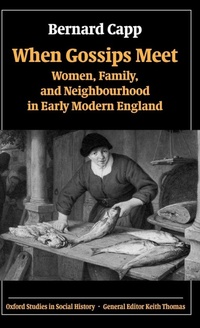
When Gossips Meet
Women, Family, and Neighbourhood in Early Modern England
Published on 16. January 2003
Book
Hardback
408 pages
978-0-19-925598-6 (ISBN)
Description
This book explores how women of the poorer and middling sorts in early modern England negoitated a patriarchal culture in which they were generally excluded, marginalized, or subordinated. It focuses on the networks of close friends ('gossips') which gave them a social identity beyond the narrowly domestic, providing both companionship and practical support in disputes with husbands and with neighbours of either sex. The book also examines the micropolitics of the household, with its internal alliances and feuds, and women's agency in neighbourhood politics, exercised by shaping local public opinion, exerting pressure on parish officials, and through the role of informal female juries. If women did not openly challenge male supremacy, they could often play a significant role in shaping their own lives and the life of the local community.
Reviews / Votes
...a top notch book...is jam-packed with good material and it has a string of well backed-up arguments that the rest of us now need to take on board and work with. * Paul Griffiths, Culutral and Social History * In this lively and meticulously researched monograph, Bernard Capp explores how, and with what success, women negotiated the patriarchal restrictions of early modern England...Capp has mined primary manuscript and printed sources to produce a book packed to the brim with rich detail... essential reading for all students and scholars of early modern women. [Carp] skilfully pieces together a history of women from disparate sources ... The result is that we gain new insights that deepen our understanding of them ... Capp's book is a measured and carefully crafted study of the domestic and neighbourhood politics of gender, family and household. * Continuity and Change * All social and cultural historians of early modern England will find much of interest in Professor Capp's wonderfully written account of the hidden stories of women's accommodation and resistance to patriarchy. * David Turner, H-Net Book Review * However foul it has got, the language of television soaps pales beside the sexual insults traded publicly on the streets of Britain for three centuries, according to [this] new book. * The Guardian * This is an important and extremely readable book which distils an enormous amount of research. Though not stridently argumentative it is exceedingly original in its approach and in its conclusions. As an attempt to uncover the strategies used by women in early modern England to negotiate the constraints imposed on them by a male-dominated society Capp has put us all in his debt. He has made a significant contribution to depicting women's roles and their place in the functioning of local communities. * Social History Society Bulletin * Capp parades an apparently inexhaustible supply of individual case histories. The result is a fascinating and richly textured study. * Social History Society Bulletin * [Capp] draws on the records of the church courts, supplemented by a wide variety of other sources, to make up a penetrating, sensitive and brilliantly vivid picture of the prejudices and problems with which contemporary women were faced and the strategies they developed in coping with them. * Adam Fox, Times Literary Supplement *More details
Series
Language
English
Place of publication
Oxford
United Kingdom
Target group
Professional and scholarly
Dimensions
Height: 222 mm
Width: 145 mm
Thickness: 28 mm
Weight
710 gr
ISBN-13
978-0-19-925598-6 (9780199255986)
Copyright in bibliographic data and cover images is held by Nielsen Book Services Limited or by the publishers or by their respective licensors: all rights reserved.
Schweitzer Classification
Other editions
Additional editions
Book
07/2004
Oxford University Press
€110.80
Shipment within 15-20 days
E-Book
01/2003
1st Edition
Oxford University Press
€373.03
Available for download
Person
Content
1. Introduction ; 2. Patriarchy and the World of Gossips ; 3. Families and Gossips: The Experience of Marriage ; 4. Maidservants and the Politics of the Household ; 5. Women and Neighbours: Female Disputes ; 6. Women and Neighbours: Disputes with Men ; 7. Women as Citizens: Public and Political Life ; 8. Recreation, Religion, and Female Culture ; 9. Conclusion ; Bibliography of Unpublished Sources ; Index