

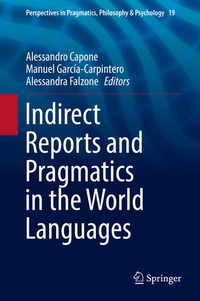
Indirect Reports and Pragmatics in the World Languages
Published on 29. June 2018
Book
Hardback
X, 453 pages
978-3-319-78770-1 (ISBN)
Description
This volume addresses the intriguing issue of indirect reports from an interdisciplinary perspective. The contributors include philosophers, theoretical linguists, socio-pragmaticians, and cognitive scientists. The book is divided into four sections following the provenance of the authors. Combining the voices from leading and emerging authors in the field, it offers a detailed picture of indirect reports in the world's languages and their significance for theoretical linguistics. Building on the previous book on indirect reports in this series, this volume adds an empirical and cross-linguistic approach that covers an impressive range of languages, such as Cantonese, Japanese, Hebrew, Persian, Dutch, Spanish, Catalan, Armenian, Italian, English, Hungarian, German, Rumanian, and Basque.
More details
Series
Edition
2019 ed.
Language
English
Place of publication
Cham
Switzerland
Publishing group
Springer International Publishing
Target group
Professional and scholarly
Illustrations
13 s/w Abbildungen
X, 453 p. 13 illus.
Dimensions
Height: 241 mm
Width: 160 mm
Thickness: 31 mm
Weight
857 gr
ISBN-13
978-3-319-78770-1 (9783319787701)
DOI
10.1007/978-3-319-78771-8
Schweitzer Classification
Other editions
Additional editions
Alessandro Capone | Manuel García-Carpintero | Alessandra Falzone
Indirect Reports and Pragmatics in the World Languages
Book
01/2019
Springer
€160.49
Shipment within 7-9 days
Alessandro Capone | Manuel García-Carpintero | Alessandra Falzone
Indirect Reports and Pragmatics in the World Languages
E-Book
06/2018
1st Edition
Springer
€149.79
Available for download
Persons
Content
Introduction.- Part I: Philosophical Approaches.- On the social praxis of indirect reporting; Alessandro Capone.- semantics and what's said; Una Stojnic, Ernie Lepore.- Immunity to Error through Misidentification and (Direct and Indirect) Experience Reports; Denis Delfitto, Anne Reboul, Gaetano Fiorin.- Representing Representations: The Priority of the De Re; Kenneth Taylor.- Intuitions and the semantics of indirect reports; Jonathan Berg.- Irony as indirectness cross-linguistically: On the scope of generic mechanisms; Herbert Colston.- When a speaker is reported as having said so; Sanford Goldberg.- Topics are (implicit) indirect reports; Edoardo Lombardo Vallauri.- Part II: Linguistic Applications.- Direct and indirect speech revised: Semantic universals and semantic diversity; Anna Wierzbicka, Cliff Goddard.- Reporting conditionals; Magdalena Sztencel, Sarah E. Duffy.- On the social praxis of indirect reporting: pronominals and presuppositions in that-clauses; Alessandro Capone, Alessandra Falzone.- Discourse Markers in Different Types of Reporting; Péter Furkó, András Kertész, Agnes Abuczki.- Indirect reports in Modern Eastern Armenian; Alessandra Giorgi, Sona Haroutyunian.- Relinquishing control: what Romanian de se attitude reports teach us about Immunity to Error through Misidentification; Marina Folescu.- Accuracy in reported speech: Evidence from masculine and feminine Japanese language; Hiroko Itakura; The Grammaticalization of Indirect Reports: The Cantonese Discourse Particle wo5; John Wakefield, Hung Yuk Abby Lee.- Context-shift in Indirect Reports in Dhaasanac; Sumiyo Nishiguchi.- Part III: Discourse Analysis and Pragmatics.- Law and Indirect Reports: Citation and Precedent; Brian Butler.- The Translatorial Middle Between Direct and Indirect Reports; Douglas Robinson.- Historical Trends in the Pragmatics of Indirect Reports in Dutch Crime News Stories; Kobie van Krieken, José Sanders.- Indirect speech in dialogues with schizophrenics. Analysis of the dialogues of the CIPPS corpus; Grazia Basile.- Pragmatic disorders and indirect reports in psychotic language; Antonino Bucca.