

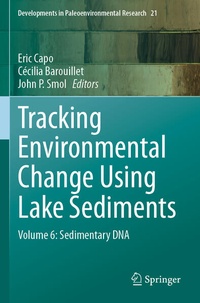
Tracking Environmental Change Using Lake Sediments
Volume 6: Sedimentary DNA
Published on 20. December 2024
Book
Paperback/Softback
XXIII, 437 pages
978-3-031-43801-1 (ISBN)
Description
This book, entitled Tracking Environmental Change Using Lake Sediments: Volume 6 - Sedimentary DNA, provides an overview of the applications of sedimentary DNA-based approaches to paleolimnological studies. These approaches have shown considerable potential in providing information about the long-term changes of overall biodiversity in lakes and their watersheds in response to natural and anthropogenic changes, as well as tracking human migrations over the last thousands of years.
Although the first studies investigating the preservation of these molecular proxies in sediments originate from the late-1990s, the number of scientific publications on this topic has increased greatly over the last five years. Alongside numerous ecological findings, several sedimentary DNA studies have been dedicated to understanding the reliability of this approach to reconstruct past ecosystem changes. Despite the major surge of interest, a comprehensive compilation of sedimentary DNA approaches and applications has yet to be attempted. The overall aim of this DPER volume is to fill this knowledge gap.
Although the first studies investigating the preservation of these molecular proxies in sediments originate from the late-1990s, the number of scientific publications on this topic has increased greatly over the last five years. Alongside numerous ecological findings, several sedimentary DNA studies have been dedicated to understanding the reliability of this approach to reconstruct past ecosystem changes. Despite the major surge of interest, a comprehensive compilation of sedimentary DNA approaches and applications has yet to be attempted. The overall aim of this DPER volume is to fill this knowledge gap.
More details
Series
Language
English
Place of publication
Cham
Switzerland
Publishing group
Springer International Publishing
Target group
Professional and scholarly
Illustrations
2 s/w Abbildungen, 45 farbige Abbildungen
XXIII, 437 p. 47 illus., 45 illus. in color.
Dimensions
Height: 235 mm
Width: 155 mm
Thickness: 25 mm
Weight
698 gr
ISBN-13
978-3-031-43801-1 (9783031438011)
DOI
10.1007/978-3-031-43799-1
Schweitzer Classification
Other editions
Additional editions
Eric Capo | Cécilia Barouillet | John P. Smol
Tracking Environmental Change Using Lake Sediments
Volume 6: Sedimentary DNA
Book
12/2023
Springer
€192.59
Shipment within 15-20 days
Persons
Eric Capo is an Assistant Professor at the Department of Ecology and Environmental Science at Umeå University (Umeå, Sweden). Dr. Capo is the founder and the coordinator of the
sedaDNA Scientific Society.
Cécilia Barouillet is a postdoctoral researcher at UMR CARRTEL INRAE (Thonon-les-Bains, France). Dr. Barouillet is vice-president - communication of the International Society of Limnology (SIL) and on the board of the sedaDNA Scientific Society.
John P. Smol is a Distinguished University Professor at the Department of Biology at Queen's University (Kingston, Ontario, Canada), with a cross-appointment at the School of Environmental Studies. He co-directs the Paleoecological Environmental Assessment and Research Lab (PEARL). Prof. Smol is editor of the journal Environmental Reviews and is the founding editor of the Journal of Paleolimnology.
Cécilia Barouillet is a postdoctoral researcher at UMR CARRTEL INRAE (Thonon-les-Bains, France). Dr. Barouillet is vice-president - communication of the International Society of Limnology (SIL) and on the board of the sedaDNA Scientific Society.
John P. Smol is a Distinguished University Professor at the Department of Biology at Queen's University (Kingston, Ontario, Canada), with a cross-appointment at the School of Environmental Studies. He co-directs the Paleoecological Environmental Assessment and Research Lab (PEARL). Prof. Smol is editor of the journal Environmental Reviews and is the founding editor of the Journal of Paleolimnology.
Content
Chapter 1. USING LAKE SEDIMENTARY DNA TO RECONSTRUCT BIODIVERSITY CHANGES.- Chapter 2. THE SOURCES AND FATES OF LAKE SEDIMENTARY DNA.- Chapter 3. THE SEDIMENTARY ANCIENT DNA WORKFLOW.- Chapter 4. BACTERIAL AND ARCHAEAL DNA FROM LAKE SEDIMENTS.- Chapter 5. CYANOBACTERIAL DNA FROM LAKE SEDIMENTS.- Chapter 6. PROTIST DNA FROM LAKE SEDIMENTS.- Chapter 7. DIATOM DNA FROM LAKE SEDIMENTS.- Chapter 8. AQUATIC VEGETATION DNA FROM LAKE SEDIMENTS.- Chapter 9. AQUATIC ANIMAL DNA FROM LAKE SEDIMENTS.- Chapter 10. TERRESTRIAL PLANT DNA FROM LAKE SEDIMENTS.- Chapter 11. TERRESTRIAL FAUNA AND HOMININ DNA FROM SEDIMENTARY ARCHIVES.- Chapter 12. AN OVERVIEW OF BIODIVERSITY AND NETWORK MODELING APPROACHES: APPLICATIONS TO SEDIMENTARY DNA RECORDS.- Chapter 13. PERSPECTIVES AND FUTURE DEVELOPMENTS WITHIN SEDIMENTARY DNA RESEARCH.