

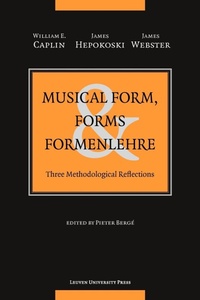
Musical Form, Forms, and Formenlehre
Three Methodological Reflections
1st Edition
Published on 15. April 2010
Book
Paperback/Softback
152 pages
978-90-5867-822-5 (ISBN)
Description
In Musical Form, Forms, and Formenlehre, three eminent music theorists reflect on the fundamentals of "musical form." They discuss how to analyze form in music and question the relevance of analytical theories and methods in general. They illustrate their basic concepts andc oncerns by offering some concrete analyses of works by Mozart (Idomeneo Overture, Jupiter Symphony) and Beethoven (First and Pastoral Symphony, Egmont Overture, and Die Ruinen von Athen Overture). The volume is divided into three parts, focusing on Caplin's "theory of formal functions," Hepokoski's concept of "dialogic form," and Webster's method of "multivalent analysis" respectively. Each part begins with a basic essay by one of the three authors. Subsequently, the two opposing authors comment on issues and analyses they consider to be problematic or underdeveloped, in a style that ranges from the gently critical to the overtly polemical. Finally, the author of the initial essay is given the opportunity to reply to the comments, and to further refine his own fundamental ideas on musical form.
Reviews / Votes
I highly recommend this book on all accounts for the reader interested in formenlehre.By Halvor Hosar (Norway), Amazon.com But perhaps the most captivating aspect of the book lies in the responses and rebuttals: each of the contributors was invited to venture comments on his collaborators' essays, and each in turn provides a short response to his colleague's comments. Thus, Hepokoski and Webster respond to Caplin's essay, and Caplin replies in turn, then Caplin and Webster to Hepokoski's, and forth. The exchanges are lively, and their result is to silhouette each analytical system against the others. For his having arranged to cast the book in this "dialogic form," students of the new American Formenlehre will long be in Berge's debt.
Nathan John Martin, Columbia University, Notes, March 2011 Besides its many other merits, 'Musical Form, Forms, and Formenlehre' demonstrates a novel format for cooperative engagement in music-theoretical writing. ... The result is a wonderfully rich and engaging book in which the personalities of the contributors are more evident than in most writing in our field.
Reviewed by Mitch Ohriner, Indiana Theory Review Volume 28
More details
Edition
01
Language
English
Place of publication
Leuven
Belgium
Target group
US School Grade: College Graduate Student and over
Product notice
Paperback (trade)
Dimensions
Height: 229 mm
Width: 154 mm
Thickness: 15 mm
Weight
266 gr
ISBN-13
978-90-5867-822-5 (9789058678225)
Copyright in bibliographic data and cover images is held by Nielsen Book Services Limited or by the publishers or by their respective licensors: all rights reserved.
Schweitzer Classification
Other editions
Additional editions
E-Book
04/2010
1st Edition
Leuven University Press
€27.99
Available for download
Persons
James Webster is the Goldwin Smith Professor of Music at Cornell University.
Content
Preface, Ludwig Holtmeier
Prologue
Considering Musical Form, Forms and Formenlehre, Pieter Berge
Part I. William E. Caplin & The Theory Of Formal Functions
What Are Formal Function, William E. Caplin
Comments on William E. Caplin's Essay, "What Are Formal Functions?, James Hepokoski
Comments on William E. Caplin's Essay, "What Are Formal Functions?", James Webster
Response to the Comments, William E. Caplin
Part II. James Hepokoski & The Concept Of Dialogic Form
Sonata Theory and Dialogic Form, James Hepokoski
Comments on James Hepokoski's Essay, "Sonata Theory and Dialogic Form", William E. Caplin
Comments on James Hepokoski's Essay "Sonata Theory and Dialogic Form", James Webster
Response to the Comments, James Hepokoski
Part III. James Webster & The Concept Of Multivalent Analysis
Formenlehre in Theory and Practice, James Webster
Comments on James Webster's Essay "Formenlehre in Theory and Practice", William E. Caplin
Comments on James Webster's Essay "Formenlehre in Theory and Practice", James Hepokoski
Response to the Comments, James Webster
Epilogue
The Future of Formenlehre, Pieter Berge
Bibliography
About the Authors
Prologue
Considering Musical Form, Forms and Formenlehre, Pieter Berge
Part I. William E. Caplin & The Theory Of Formal Functions
What Are Formal Function, William E. Caplin
Comments on William E. Caplin's Essay, "What Are Formal Functions?, James Hepokoski
Comments on William E. Caplin's Essay, "What Are Formal Functions?", James Webster
Response to the Comments, William E. Caplin
Part II. James Hepokoski & The Concept Of Dialogic Form
Sonata Theory and Dialogic Form, James Hepokoski
Comments on James Hepokoski's Essay, "Sonata Theory and Dialogic Form", William E. Caplin
Comments on James Hepokoski's Essay "Sonata Theory and Dialogic Form", James Webster
Response to the Comments, James Hepokoski
Part III. James Webster & The Concept Of Multivalent Analysis
Formenlehre in Theory and Practice, James Webster
Comments on James Webster's Essay "Formenlehre in Theory and Practice", William E. Caplin
Comments on James Webster's Essay "Formenlehre in Theory and Practice", James Hepokoski
Response to the Comments, James Webster
Epilogue
The Future of Formenlehre, Pieter Berge
Bibliography
About the Authors