

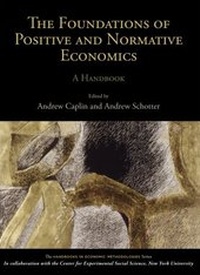
The Foundations of Positive and Normative Economics
A Handbook
Published on 25. April 2008
Book
Hardback
416 pages
978-0-19-532831-8 (ISBN)
Description
The Foundations of Positive and Normative Economics: A Handbook is the first book in a new series by Andrew Caplin and Andrew Schotter. There is currently no guide available on the rapidly changing methodological frontiers of the field of economics. This fact has left economists ill at ease, and has created a backlash against new methods. The series will debate these critical issues, allowing proponents of a particular research method to present proposals in a safe yet critical context, with alternatives being clarified. This first volume, written by some of the most prominent researchers in the discipline, reflects the challenges that are opened by new research opportunities. The goal of the current volume and the series it presages, is to formally open a dialog on methodology. The editors' conviction is that such a debate will rebound to the benefit of social science in general, and economics in particular. The issues under discussion strike to the very heart of the social scientific enterprise.
This work is of tremendous importance to all who are interested in the contributions that academic research can make not only to our scientific understanding, but also to matters of policy. In particular, economists have been introducing new theories and new sources of data at a remarkable rate in recent years, and there are widely divergent views both on how productive these expansions have been in the past, and how best to make progress in the future.
This work is of tremendous importance to all who are interested in the contributions that academic research can make not only to our scientific understanding, but also to matters of policy. In particular, economists have been introducing new theories and new sources of data at a remarkable rate in recent years, and there are widely divergent views both on how productive these expansions have been in the past, and how best to make progress in the future.
Reviews / Votes
A very important contribution to the methodological literature D. Wade Hands, History of Economic Ideas I greatly enjoyed the time I spent with the book. I finished it with...multiple pages of good ideas, quotes to insert into research papers, and a deeper understanding of why we do what we do. Rachel Croson, Journal of Pension Economics and Finance. Caplin and Schotter have managed to collect a number of thought-provoking contributions Ivan Moscati, Economics and PhilosophyMore details
Language
English
Place of publication
New York
United States
Target group
College/higher education
Professional and scholarly
Illustrations
19 line illustrations
Dimensions
Height: 260 mm
Width: 185 mm
Thickness: 25 mm
Weight
920 gr
ISBN-13
978-0-19-532831-8 (9780195328318)
Copyright in bibliographic data and cover images is held by Nielsen Book Services Limited or by the publishers or by their respective licensors: all rights reserved.
Schweitzer Classification
Other editions
Additional editions
Book
11/2010
Oxford University Press Inc
€73.20
Article exhausted; check different version
E-Book
04/2008
1st Edition
OUP eBook
€32.99
Available for download
Persons
Andrew Caplin is a professor of economics at New York University and the co-director of NYU's Center for Experimental Social Science. He serves on the Steering Committee of the Health and Retirement Survey, and as a Fellow of the Econometric Society. In addition to undertaking fundamental research in economic theory and in economics and psychology, he has written extensively on defects in the U.S. residential real estate finance market. Andrew Schotter is a professor of economics at New York University and the Director of NYU's Center for Experimental Social Science. He is the author of numerous books and articles including The Economic Theory of Social Institutions, Free Market Economics: A Critical Appraisal, and Microeconomics: A Modern Approach. His main area of research is in economic theory, game theory, and especially Experimental Economics.