

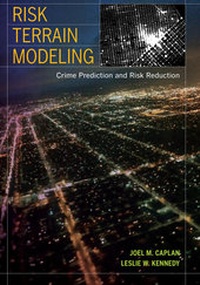
Risk Terrain Modeling
Crime Prediction and Risk Reduction
1st Edition
Published on 28. June 2016
Book
Paperback/Softback
240 pages
978-0-520-28293-3 (ISBN)
Description
Imagine using an evidence-based risk management model that enables researchers and practitioners alike to analyze the spatial dynamics of crime, allocate resources, and implement custom crime and risk reduction strategies that are transparent, measurable, and effective. Risk Terrain Modeling (RTM) diagnoses the spatial attractors of criminal behavior and makes accurate forecasts of where crime will occur at the microlevel. RTM informs decisions about how the combined factors that contribute to criminal behavior can be targeted, connections to crime can be monitored, spatial vulnerabilities can be assessed, and actions can be taken to reduce worst effects. As a diagnostic method, RTM offers a statistically valid way to identify vulnerable places.
More details
Edition
First Edition
Language
English
Place of publication
Berkerley
United States
Target group
Professional and scholarly
Product notice
Paperback (trade)
Illustrations
16 color illustrations, 15 tab
Dimensions
Height: 254 mm
Width: 178 mm
Thickness: 13 mm
ISBN-13
978-0-520-28293-3 (9780520282933)
Copyright in bibliographic data and cover images is held by Nielsen Book Services Limited or by the publishers or by their respective licensors: all rights reserved.
Schweitzer Classification
Other editions
Additional editions
E-Book
06/2016
1st Edition
University of California Press
€48.99
Available for download
Persons
Joel M. Caplan is Associate Professor at Rutgers University, School of Criminal Justice. Leslie W. Kennedy is University Professor at Rutgers University, School of Criminal Justice, where he served as Dean from 1998-2007.
Content
List of Figures List of Tables Preface Acknowledgments Prologue 1. Explaining the Contexts of Crime 2. Risk Terrain Modeling Methods 3. Crime Emergence, Persistence, and Exposure 4. Presence, Repeats, and Concentration: Exposures to Crime 5. The Theory of Risky Places 6. Event Contexts of Risky Places 7. Risk Management and RTM in ACTION 8. Risk Reduction Epilogue Glossary Notes References Index