

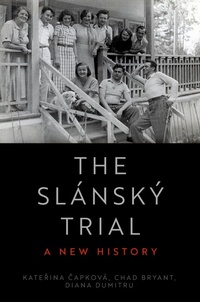
The Slansky Trial
A New History
Will be published approx. on 1. October 2026
Book
Hardback
368 pages
978-0-19-760408-3 (ISBN)
Description
In 1952, a Prague court tried Rudolf Slánský and thirteen other Communist leaders - eleven of them "of Jewish heritage" - of espionage and treason. Most of the defendants were executed days later. The trial, which was one of the most notorious Stalin-era show trials in Eastern Europe, has long been considered as an antisemitic Soviet export, directly orchestrated by Stalin. This collectively written book overturns that long-standing misinterpretation of the trial. Drawing on a vast array of archival sources, it uncovers the ways in which the trial emerged from political rivalries in Prague and beyond, fueled by personal ambitions and calculated attempts to capture Moscow's attention. The book traces the prewar and wartime formation of the Czechoslovak Communist elite, the mechanisms of postwar power consolidation, the role of ethnic cleansing, and the shifting use of antisemitism and "Zionism" in domestic politics. It demonstrates how factional maneuvering, coercive interrogations, and carefully curated information sent to Moscow shaped both the trial itself and the wave of related proceedings that continued even after Stalin's death. Beyond reconstructing the orchestration between Prague and Moscow, the book opens a window into the inner workings of the Communist Party of Czechoslovakia, revealing the rituals, hierarchies, and personal ties that bound its leaders to counterparts in the Soviet Union and across Eastern Europe. Situating the Slánský trial within the larger framework of Cold War geopolitics, the authors also examine its contested legacies, from the ways it has been remembered and forgotten to its enduring symbolic role in debates about authoritarianism and justice. By integrating political, social, and cultural history, this book offers a powerful new perspective on authoritarian rule, the porous boundaries between victim and perpetrator, and the local agency expressed through the choices that culminated in the Stalinist bloc's most infamous spectacle of justice.
More details
Language
English
Place of publication
Oxford
United Kingdom
Product notice
sewn/stitched
Cloth over boards
Weight
5 gr
ISBN-13
978-0-19-760408-3 (9780197604083)
Copyright in bibliographic data and cover images is held by Nielsen Book Services Limited or by the publishers or by their respective licensors: all rights reserved.
Schweitzer Classification
Persons
Kate%rina Čapková is a historian of East Central Europe at the Faculty of Arts, Charles University, specializing in modern Jewish history, in the history of Roma and Sinti, and refugee studies. Her book Czechs, Germans, Jews? won the Outstanding Academic Title from Choice magazine. Together with Hillel J. Kieval, she edited Prague and Beyond (2022), a history of Jews in the Bohemian lands, which was also published in German, Hebrew, and Czech. Čapková initiated and heads the Prague Center for Romani Histories (www.romanihistories.org)
Since 2025, she has been the principal investigator of the Advanced ERC grant Inclusive History of East-Central Europe. Chad Bryant is Professor of History at the University of North Carolina at Chapel Hill and adjunct professor in the Curriculum in Global Studies. He is a historian of Central and Eastern Europe, specializing in the lands of today's Czech Republic, with research interests that include the study of nationalism, the urban experience, and authoritarian regimes. He is the author of Prague: Belonging and the Modern City, co-winner of the Radomír Lu%za Prize and of Prague in Black: Nazi Rule and Czech Nationalism, winner of the Hans Rosenberg Book Prize. Diana Dumitru is a historian of Eastern Europe at Georgetown University, specializing in the Holocaust, Stalinism, and modern Jewish history. She is the author of The State, Antisemitism, and Collaboration in the Holocaust: The Borderlands of Romania and the Soviet Union, a finalist for the Yad Vashem International Book Prize. She is also the author of Soviet Jews under Late Stalinism: A Story from the Western Borderlands. She serves on the editorial boards of Holocaust and Genocide Studies, East European Jewish Affairs, and the Journal of Genocide Research.
Since 2025, she has been the principal investigator of the Advanced ERC grant Inclusive History of East-Central Europe. Chad Bryant is Professor of History at the University of North Carolina at Chapel Hill and adjunct professor in the Curriculum in Global Studies. He is a historian of Central and Eastern Europe, specializing in the lands of today's Czech Republic, with research interests that include the study of nationalism, the urban experience, and authoritarian regimes. He is the author of Prague: Belonging and the Modern City, co-winner of the Radomír Lu%za Prize and of Prague in Black: Nazi Rule and Czech Nationalism, winner of the Hans Rosenberg Book Prize. Diana Dumitru is a historian of Eastern Europe at Georgetown University, specializing in the Holocaust, Stalinism, and modern Jewish history. She is the author of The State, Antisemitism, and Collaboration in the Holocaust: The Borderlands of Romania and the Soviet Union, a finalist for the Yad Vashem International Book Prize. She is also the author of Soviet Jews under Late Stalinism: A Story from the Western Borderlands. She serves on the editorial boards of Holocaust and Genocide Studies, East European Jewish Affairs, and the Journal of Genocide Research.