

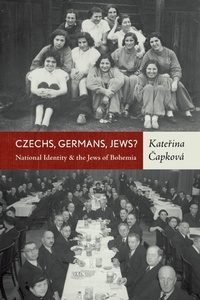
Czechs, Germans, Jews?
National Identity and the Jews of Bohemia
1st Edition
Published on 1. November 2014
Book
Paperback/Softback
298 pages
978-1-78238-679-7 (ISBN)
Description
The phenomenon of national identities, always a key issue in the modern history of Bohemian Jewry, was particularly complex because of the marginal differences that existed between the available choices. Considerable overlap was evident in the programs of the various national movements and it was possible to change one's national identity or even to opt for more than one such identity without necessarily experiencing any far-reaching consequences in everyday life. Based on many hitherto unknown archival sources from the Czech Republic, Israel and Austria, the author's research reveals the inner dynamic of each of the national movements and maps out the three most important constructions of national identity within Bohemian Jewry - the German-Jewish, the Czech-Jewish and the Zionist. This book provides a needed framework for understanding the rich history of German- and Czech-Jewish politics and culture in Bohemia and is a notable contribution to the historiography of Bohemian, Czechoslovak and central European Jewry.
Reviews / Votes
Choice Outstanding Academic Title 2012"In her well-researched volume, Capkova uses a broad range of archival and published sources and shows a mastery of the secondary literature, including theoretical materials... Subtly argued and effectively based in the real-life experience of individuals, this book is a fine contribution to the study and understanding of central European Jewry. Fluidly translated; 20 well-chosen illustrations. Highly recommended." * Choice
"Capkova manages skillfully to place Bohemian Jews not in-between Czechs and Germans, but defines them as active members of a society, which they shaped and influenced in many ways." * Jahrbuecher fuer Geschichte Osteuropas
"The complex and fluid identities of the Jews in Bohemia,,,[is] an extraordinarily interesting subject...[This book] provides important insight into the complexities of Jewish identity in a very interesting region of East Central Europe." * The Journal of Modern History
"Although there are a number of books dealing with the history of the Jews of the region, this book's contribution is in the deep analysis of national identity. It also raises issues and concepts that are very important for the understanding of modern European Jewish religious thought. The book is well documented, well translated, and well organized." * Religious Studies Review
"The book impresses with its great richness of material and detail. In addition to substantial secondary literature, the author used documents, letters, and memoirs from Czech, Austrian, and Israeli archives in Czech, German, Yiddish, Hebrew, and English language, complemented by texts in Slovak and Polish. It is widely taken for granted in historical research that identities, especially national identities, are constructs. Capkova shows in her important study how necessary it still is to explore these general premiss critically and in depth. Her results offer an important basis for future research into Czech(oslovak)-Jewish identity." * Zeitschrift fuer Ostmitteleuropa Forschung
"Terms such as identity or assimilation, which are often used without much thought, are shown by the author in their complexity. Although there are a number of books dealing with the history of the Jews of the region, this book's contribution is in the deep analysis of national identity. It also raises issues and concepts that are very important for the understanding of modern European Jewish religious thought. The book is well documented, well translated, and well organized." * Religious Studies Review
"Capkova's masterly work will long remain the standard work on interwar Bohemian Jews. The research is singularly impressive, drawing from an array of organizational records, newspapers, pamphlets, personal papers, government documents and other primary sources as well as vast bodies of secondary literature... [and] not only fills a gap in the literature but offers a new perspective on politics and nationality in interwar Czechoslovakia, a perspective informed by a strong sense of European history writ large. In this sense the book also suggests a number of opportunities. Capkova has wielded a powerful blow against the artificial barrier between "Bohemian/Czech" and "Jewish" history that still divides much of the scholarship in the Czech Republic. She also represents the best of a new generation of Czech scholars who look beyond the borders of Bohemian history while remaining rooted, and deeply committed, to the historical issues and debates related to this fascinating corner of Europe." * H-Soz-u-Kult
"...a fascinating study about the flexible, shifting, and overlapping ethnonational and ethnoreligious identities of Bohemian Jews... a fine, well-written book that should be read by anyone interested in the historiography of Bohemian, Czechoslovak, and central European Jewry and in issues of multiculturalism." * Slavic Review
"A masterful examination of the dynamics of Jewish integration in-and into-interwar Czechoslovakia, complicated by the dilemma of competing national identifications. Katerina Capkova skillfully interweaves the theoretical positions, social relations, and political conflicts involving the three main articulations of modern Jewish identity in this important region of Central Europe and traces their fortunes down to the dissolution of the Czechoslovak Republic under the impact of fascism...Simply put, it has no equal." * Hillel J. Kieval, Washington University in St. Louis
"Capkova's book is the first and so far the only comprehensive study on the history of the Jews in Bohemia in the era of the first Czechoslovak Republic. It is also the first systematic research on this topic in the post-communist era, which continues the broken tradition of Czech and German studies on Jewish history and culture in the Czech Lands, interrupted by the Nazi occupation and the communist domination of Czechoslovakia." * Otto Dov Kulka, The Hebrew University of Jerusalem
More details
Language
English
Place of publication
Oxford
United Kingdom
Target group
College/higher education
Professional and scholarly
Product notice
Paperback (trade)
Illustrations
25 Maps; 25 Figures; 25 Tables, unspecified
Dimensions
Height: 229 mm
Width: 152 mm
Thickness: 17 mm
Weight
435 gr
ISBN-13
978-1-78238-679-7 (9781782386797)
DOI
10.3167/9780857454744
Copyright in bibliographic data and cover images is held by Nielsen Book Services Limited or by the publishers or by their respective licensors: all rights reserved.
Schweitzer Classification
Other editions
Additional editions
E-Book
05/2012
1st Edition
Berghahn Books
from
€41.79
Available for download
E-Book
05/2012
1st Edition
Berghahn Books
€24.49
Available for download
Person
Katerina Capkova is a research fellow at the Institute of Contemporary History, Prague, and teaches Modern Jewish History at Charles University and NYU in Prague. With Michal Frankl she is the co-author of Nejiste utociste, a book about Czechoslovakia and refugees from Nazi Germany (2008, in German 2012).
Content
Illustrations
Acknowledgements
A note on personal and place names
Abbreviations
Map of Czechoslovakia and the Bohemian Lands
Introduction
Chapter 1. The basic features of the Jewish community in Prague and in Bohemia
Chapter 2. Jews as a national minority in the new republic
Chapter 3. German Jews
Chapter 4. Czech-Jews
Chapter 5. Zionists
Conclusion
Bibliography
Index
Acknowledgements
A note on personal and place names
Abbreviations
Map of Czechoslovakia and the Bohemian Lands
Introduction
Chapter 1. The basic features of the Jewish community in Prague and in Bohemia
Chapter 2. Jews as a national minority in the new republic
Chapter 3. German Jews
Chapter 4. Czech-Jews
Chapter 5. Zionists
Conclusion
Bibliography
Index