

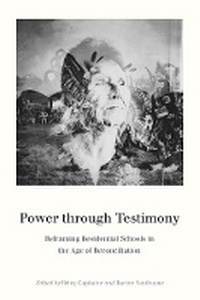
Power Through Testimony
Reframing Residential Schools in the Age of Reconciliation
Published on 1. April 2017
Book
Hardback
252 pages
978-0-7748-3389-9 (ISBN)
Description
Power through Testimony documents how survivors are remembering and reframing our understanding of residential schools in the wake of the 2007 Indian Residential Schools Settlement Agreement and the Truth and Reconciliation Commission (TRC), a forum for survivors, families, and communities to share their memories and stories with the Canadian public. The commission closed and reported in 2015, and this timely volume reveals what happened on the ground.
Drawing on field research during the commission and in local communities, the contributors document how residential schools have been understood and represented by various groups and individuals over time; how survivors are undermining colonial narratives about residential schools; and how the churches and former school staff are receiving or resisting the "new" residential school story.
Ultimately, Power through Testimony questions the power of the TRC to unsettle dominant colonial narratives about residential schools and transform the relationship between Indigenous people and Canadian society.
Drawing on field research during the commission and in local communities, the contributors document how residential schools have been understood and represented by various groups and individuals over time; how survivors are undermining colonial narratives about residential schools; and how the churches and former school staff are receiving or resisting the "new" residential school story.
Ultimately, Power through Testimony questions the power of the TRC to unsettle dominant colonial narratives about residential schools and transform the relationship between Indigenous people and Canadian society.
Reviews / Votes
Power Through Testimony provides a rich and nuanced exploration of the complex dynamics of 'reconciliation' that is indeed valuable in understanding the legacy of residential schools as it continues to unfold. - Tricie Lea-Scott, Heriot-Watt University, Dubai (British Journal of Canadian Studies) The contributors to Power through Testimony provide an important commentary on the work of the Truth and Reconciliation Commission of Canada and the limitations of its mandate.- Jon Reyhner, Department of Educational Specialties, Northern Arizona University (Canadian Journal of Native Studies)
More details
Language
English
Place of publication
Vancouver
Canada
Target group
Professional and scholarly
Product notice
sewn/stitched
Dimensions
Height: 229 mm
Width: 152 mm
Weight
500 gr
ISBN-13
978-0-7748-3389-9 (9780774833899)
Copyright in bibliographic data and cover images is held by Nielsen Book Services Limited or by the publishers or by their respective licensors: all rights reserved.
Schweitzer Classification
Persons
Brieg Capitaine is a professor of sociology at the School of Sociological and Anthropological Studies at the University of Ottawa. Karine Vanthuyne is an associate professor of anthropology at the School of Sociological and Anthropological Studies at the University of Ottawa.
Contributors: Janice Cindy Gaudet, Cheryl Gaver, Robyn Green, Jula Hughes, Lawrence Martin/Wapistan, Charles R. Menzies, Arie Molena, Ronald Niezen, Simone Poliandri, and Eric Taylor Woods
Contributors: Janice Cindy Gaudet, Cheryl Gaver, Robyn Green, Jula Hughes, Lawrence Martin/Wapistan, Charles R. Menzies, Arie Molena, Ronald Niezen, Simone Poliandri, and Eric Taylor Woods
Content
Foreword / Ronald Niezen
Introduction / Brieg Capitaine and Karine Vanthuyne
Part 1: The Truth and Reconciliation Commission in Action
1 On the Making of a National Tragedy: The Transformation of the Meaning of the Indian Residential Schools / Eric Taylor Woods
2 Telling a Story and Performing the Truth: The Indian Residential School as Cultural Trauma / Brieg Capitaine
3 Loving to Reconcile: Love as a Political Emotion at the Truth and Reconciliation Commission / Robyn Green
4 Learning through Conversation: An Inquiry into Shame / Janice Cindy Gaudet and Lawrence Martin/Wapistan
Part 2: Conflicting Memories and Paths of Action
5 Surviving as Mi'kmaq and First Nations People: The Legacies of the Shubenacadie Indian Residential School in Nova Scotia / Simone Poliandri
6 "National Memory" and Its Remainders: Labrador Inuit Counterhistories of Residential Schooling / Arie Molena
7 Remembering Residential Schools, Accounting for Decolonization through Development: Conflicting Viewpoints / Karine Vanthuyne
Part 3: (Un)reckoning with Historical Abuses
8 The New Victims: Perpetrators before the Canadian Truth and Reconciliation Commission / Jula Hughes
9 Residential Schools in Canada: Why the Message Is Not Getting Across / Cheryl Gaver
Epilogue / Charles R. Menzies
Index
Introduction / Brieg Capitaine and Karine Vanthuyne
Part 1: The Truth and Reconciliation Commission in Action
1 On the Making of a National Tragedy: The Transformation of the Meaning of the Indian Residential Schools / Eric Taylor Woods
2 Telling a Story and Performing the Truth: The Indian Residential School as Cultural Trauma / Brieg Capitaine
3 Loving to Reconcile: Love as a Political Emotion at the Truth and Reconciliation Commission / Robyn Green
4 Learning through Conversation: An Inquiry into Shame / Janice Cindy Gaudet and Lawrence Martin/Wapistan
Part 2: Conflicting Memories and Paths of Action
5 Surviving as Mi'kmaq and First Nations People: The Legacies of the Shubenacadie Indian Residential School in Nova Scotia / Simone Poliandri
6 "National Memory" and Its Remainders: Labrador Inuit Counterhistories of Residential Schooling / Arie Molena
7 Remembering Residential Schools, Accounting for Decolonization through Development: Conflicting Viewpoints / Karine Vanthuyne
Part 3: (Un)reckoning with Historical Abuses
8 The New Victims: Perpetrators before the Canadian Truth and Reconciliation Commission / Jula Hughes
9 Residential Schools in Canada: Why the Message Is Not Getting Across / Cheryl Gaver
Epilogue / Charles R. Menzies
Index