

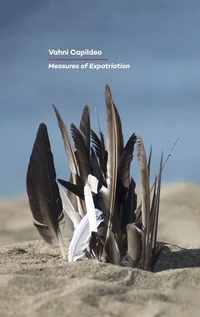
Measures of Expatriation
Published on 28. January 2016
Book
Paperback/Softback
128 pages
978-1-78410-168-8 (ISBN)
Description
Winner of the 2016 Poetry Book Society Choice
Winner of the 2016 Forward Prize for Best Collection
Short-listed for the 2016 T.S. Eliot Prize
'Expatriation: my having had a patria, a fatherland, to leave, did not occur to me until I was forced to invent one. [...] This luxury of inattention, invention, and final mismatch... a 'Trinidad' being created that did not take my Trinidad away (my Trinidad takes itself away, in reality, over time)... that is expatriation, no? An exile, a migrant, a refugee, would have been in more of a hurry, would have been more driven out or driven towards, would have been seeking and finding not.'
In Measures of Expatriation Vahni Capildeo's poems and prose-poems speak of the complex alienation of the expatriate, and address wider issues around identity in contemporary Western society. Born in Trinidad and resident in the UK, Capildeo rejects the easy depiction of a person as a neat, coherent whole - 'pure is a strange word' -embracing instead a pointilliste self, one grounded in complexity. In these texts sense and syntax are disrupted; languages rub and intersect; dream sequences, love poems, polylogues and borrowed words build into a precarious self-assemblage. 'Cliche', she writes, 'is spitting into the sea', and in this book poetry is still a place where words and names, with their power to bewitch and subjugate, may be disrupted, reclaimed. The politics of the body, and cultures of sexual objectification, gender inequality and casual racism, are the borders across which Capildeo homes, seeking the modest luxury of being 'looked at as if one is neutral ground'. In the end it is language itself, the determination to speak, to which the poet finds she belongs: 'Language is my home, I say; not one particular language.' Measures of Expatriation is in the vanguard of literature arising from the aftermath of Empire, with a fearless and natural complexity. 'Expatriation: my having had a patria, a fatherland, to leave, did not occur to me until I was forced to invent one. [...] This luxury of inattention, invention, and final mismatch... a 'Trinidad' being created that did not take my Trinidad away (my Trinidad takes itself away, in reality, over time)... that is expatriation, no? An exile, a migrant, a refugee, would have been in more of a hurry, would have been more driven out or driven towards, would have been seeking and finding not.'
Winner of the 2016 Forward Prize for Best Collection
Short-listed for the 2016 T.S. Eliot Prize
'Expatriation: my having had a patria, a fatherland, to leave, did not occur to me until I was forced to invent one. [...] This luxury of inattention, invention, and final mismatch... a 'Trinidad' being created that did not take my Trinidad away (my Trinidad takes itself away, in reality, over time)... that is expatriation, no? An exile, a migrant, a refugee, would have been in more of a hurry, would have been more driven out or driven towards, would have been seeking and finding not.'
In Measures of Expatriation Vahni Capildeo's poems and prose-poems speak of the complex alienation of the expatriate, and address wider issues around identity in contemporary Western society. Born in Trinidad and resident in the UK, Capildeo rejects the easy depiction of a person as a neat, coherent whole - 'pure is a strange word' -embracing instead a pointilliste self, one grounded in complexity. In these texts sense and syntax are disrupted; languages rub and intersect; dream sequences, love poems, polylogues and borrowed words build into a precarious self-assemblage. 'Cliche', she writes, 'is spitting into the sea', and in this book poetry is still a place where words and names, with their power to bewitch and subjugate, may be disrupted, reclaimed. The politics of the body, and cultures of sexual objectification, gender inequality and casual racism, are the borders across which Capildeo homes, seeking the modest luxury of being 'looked at as if one is neutral ground'. In the end it is language itself, the determination to speak, to which the poet finds she belongs: 'Language is my home, I say; not one particular language.' Measures of Expatriation is in the vanguard of literature arising from the aftermath of Empire, with a fearless and natural complexity. 'Expatriation: my having had a patria, a fatherland, to leave, did not occur to me until I was forced to invent one. [...] This luxury of inattention, invention, and final mismatch... a 'Trinidad' being created that did not take my Trinidad away (my Trinidad takes itself away, in reality, over time)... that is expatriation, no? An exile, a migrant, a refugee, would have been in more of a hurry, would have been more driven out or driven towards, would have been seeking and finding not.'
Reviews / Votes
'Tumbling, polyglottal collection of poems and prose-poems, Measures of Expatriation, tells stories of exile and migration by turns playful and ferocious.'Horatia Harrod, Financial Times 'The writing is done from word to word, following images, sounds, movement and sense-associations relentlessly, shifting focus every few words, heading for an unforeseen ending.'
?Peter Riley, Fortnightly Review 'Vahni Capildeo's Measures of Expatriation is a work that amazes. We found a vertiginous excitement in the way in which the book grasps its subject: the sense of never quite being at home. This is poetry that transforms. When people in the future seek to know what it's like to live between places, traditions, habits and cultures, they will read this. Here is the language for what expatriation feels like.'
Malika Booker, Chair of the 2016 Forward Prize judging panel 'So much of the world has been rendered familiar by the industries of interpretation (including the literary) that it takes a genius to recover its real intransigence. It is like being brought up hard against an unmoveable rock amidst all the torrents of counterfeited poetry when you catch hold of any poem by Capildeo.'
Rod Mengham 'This is a highly original collection in form and content, with blunted messages and sharp polished undertones. One to read slowly and savour.'
Poetry Salzberg Review 'This is a book to last, and one that I will keep reading. It is a collection in which new threads appear in every reading: a tapestry that refuses to be frozen.'
Stand Magazine Financial Times 2/7/2016 The Fortnightly Review 12/4/16
More details
Language
English
Place of publication
United Kingdom
Publishing group
Carcanet Press Ltd
Dimensions
Height: 217 mm
Width: 139 mm
Thickness: 13 mm
Weight
178 gr
ISBN-13
978-1-78410-168-8 (9781784101688)
Copyright in bibliographic data and cover images is held by Nielsen Book Services Limited or by the publishers or by their respective licensors: all rights reserved.
Schweitzer Classification
Other editions
Additional editions

Anthony V. Capildeo
Measures of Expatriation
E-Book
01/2016
Carcanet Poetry
€9.59
Available for download
Person
Anthony V. Capildeo FRSL is a Trinidadian Scottish writer of poetry and non-fiction. Currently Professor and Writer in Residence at the University of York, their site-specific word and visual art includes responses to Cornwall's former capital, Launceston, as the Causley Trust Poet in Residence (2022) and to the Ubatuba granite of the Henry Moore Institute in Leeds (2023), as well as to Scottish, Irish, and Caribbean built and natural environments. Their numerous books and pamphlets, from No Traveller Returns (Salt, 2003), Person Animal Figure (Landfill, 2005) onwards, are distinguished by deliberate engagement with independent and small presses. Their work has been recognized with the Cholmondeley Award (Society of Authors) and the Forward Poetry Prize for Best Collection. Their publications include Like a Tree, Walking (Carcanet, 2021) (Poetry Book Society Choice), and A Happiness (Intergraphia, 2022). Their interests include silence, translation theory, medieval reworkings, plurilingualism, collaborative work, and traditional masquerade. Recent commissions include research-based Windrush poems for Poet in the City and for the Royal Society of Literature. Capildeo served as a judge for the Jhalak Prize (2023).