


Immaterial Facts
Freud's Discovery of Psychic Reality and Klein's Development of His Work
1st Edition
Published on 18. November 1999
Book
Paperback/Softback
176 pages
978-0-415-22084-2 (ISBN)
Description
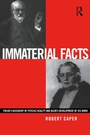
First published in 1999. Shows how Melanie Klien's studies of sexuality aggression, unconscious phantasy and identification in children extended and corrected Freud's theories of the development of the superego and early stages of the Oedipus complex.
More details
Language
English
Place of publication
London
United Kingdom
Publishing group
Taylor & Francis Ltd
Target group
College/higher education
Dimensions
Height: 234 mm
Width: 156 mm
Thickness: 10 mm
Weight
278 gr
ISBN-13
978-0-415-22084-2 (9780415220842)
Copyright in bibliographic data and cover images is held by Nielsen Book Services Limited or by the publishers or by their respective licensors: all rights reserved.
Schweitzer Classification
Other editions
Additional editions

Robert Caper
Immaterial Facts
Freud's Discovery of Psychic Reality and Klein's Development of His Work
E-Book
03/2014
1st Edition
Routledge
€55.49
Available for download
Robert Caper
Immaterial Facts
Freud's Discovery of Psychic Reality and Klein's Development of His Work
E-Book
03/2014
1st Edition
Routledge
€55.49
Available for download
Robert Caper
Immaterial Facts
Freud's Discovery of Psychic Reality and Klein's Development of His Work
Book
11/1999
1st Edition
Routledge
€200.89
Article not available at the moment
Person
Dr. Robert Caper is a graduate of Reed College and UCLA School of Medicine. He is a training and supervising psychoanalyst at the Psychoanalytic Centre of California, and the author of A Mind of One's Own, as well as numerous papers on psychoanalytic theory and technique.
Content
Part 1 Freud's Discovery of Psychic Reality; Chapter 1 Immaterial Facts; Chapter 2 Psychology without a Psyche; Chapter 3 The Discovery of Unconscious Fantasy; Chapter 4 The Structure of Dreams and Neurosis; Chapter 5 Transference and the Crystallization of the Psychoanalytic Method; Chapter 6 Gravitational Confinement; Chapter 7 A Specimen Case: Little Hans; Chapter 8 Identification and the Structure of the Inner World; Chapter 9 Anxiety and the Structure of the Inner World; Chapter 10 Beyond Eros; Part 2 Melanie Klein's Development of Freud's Work; Chapter 11 Melanie Klein's Place in Psychoanalysis; Chapter 12 The Method of Child Psychoanalysis; Chapter 13 The Child's Construction of Experience; Chapter 14 Instinct, Fantasy, and Early Psychic Processes; Chapter 15 Projective Identification and the Formation of the Inner World; Chapter 16 The Transformation of the Superego: Psychological Integration and Growth; Chapter 17 The Early Stages of the Oedipus Complex; Chapter 18 Envy and Gratitude, Splitting and Integration; Chapter 19 Psychoanalytic Knowledge; Chapter 20 Freud and Klein: A Summary;