

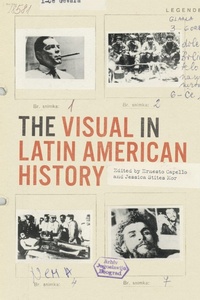
The Visual in Latin American History
Will be published approx. on 5. January 2027
Book
Hardback
364 pages
978-1-4773-3482-9 (ISBN)
Description
A collection of essays examining the role of visual materials in shaping Latin American lives, historical thought, and worldmaking.
Historians have long valued visual media as a source of documentation and illustration. More recently, scholars have also been turning to visual media for another purpose: to directly observe historical processes. Paintings, maps, visual narratives, graffiti, photography-these objects do not simply transmit information about events; they are events. They imbue the historical change we seek to understand.
The Visual in Latin American History is a collection of essays that applies cutting-edge visual-studies methodology to the history of Central and South America and the Caribbean. Contributors focus on the visual production of postcolonial national imaginaries across Latin America-mythologies that purposely omitted Indigenous groups, African diasporic communities, and new migrants from Europe and Asia. The essays range across a vast territory, including erasure in archeology and Afro-Colombian portraiture; image making in domestic spaces and social movements; the visual vocabularies of urban planning and agrarian reform; military "performance" and anti-imperial Cold War exchanges; and humanitarian documentary along the US border.Collectively, the authors show how visual methods can radically transform our understanding of power and culture in Latin America and beyond.
Historians have long valued visual media as a source of documentation and illustration. More recently, scholars have also been turning to visual media for another purpose: to directly observe historical processes. Paintings, maps, visual narratives, graffiti, photography-these objects do not simply transmit information about events; they are events. They imbue the historical change we seek to understand.
The Visual in Latin American History is a collection of essays that applies cutting-edge visual-studies methodology to the history of Central and South America and the Caribbean. Contributors focus on the visual production of postcolonial national imaginaries across Latin America-mythologies that purposely omitted Indigenous groups, African diasporic communities, and new migrants from Europe and Asia. The essays range across a vast territory, including erasure in archeology and Afro-Colombian portraiture; image making in domestic spaces and social movements; the visual vocabularies of urban planning and agrarian reform; military "performance" and anti-imperial Cold War exchanges; and humanitarian documentary along the US border.Collectively, the authors show how visual methods can radically transform our understanding of power and culture in Latin America and beyond.
More details
Language
English
Place of publication
Austin, TX
United States
Target group
Professional and scholarly
Dimensions
Height: 229 mm
Width: 152 mm
Weight
454 gr
ISBN-13
978-1-4773-3482-9 (9781477334829)
Copyright in bibliographic data and cover images is held by Nielsen Book Services Limited or by the publishers or by their respective licensors: all rights reserved.
Schweitzer Classification
Persons
Ernesto Capello is a professor of Latin American History at Macalester College and an affiliated researcher with the Facultad Latinoamericana de Ciencias Sociales (FLACSO-Ecuador).
Jessica Stites Mor is a professor of history at the University of British Columbia, Okanagan. She has also taught at Leibniz Universitaet in Germany, and the Universidad Nacional de las Artes in Argentina.
Jessica Stites Mor is a professor of history at the University of British Columbia, Okanagan. She has also taught at Leibniz Universitaet in Germany, and the Universidad Nacional de las Artes in Argentina.
Content
List of Illustrations
1. Latin American Visual Histories: Paradigms, Methods, Aporias (Jessica Stites Mor and Ernesto Capello)
2. Feeling My Way toward the Visual (Edward J. McCaughan)
3. The "Tajin Totonac" in and outside the Frame: Violence and Alterity in the Photographic Archive of Isabel?T. Kelly (Monica M. Salas Landa)
4. The Photographic Event against the Mechanics of Erasure in Late Nineteenth-Century Colombia (Luisa Fernanda Arrieta Fernandez)
5. Culinary Speculations: Women as Heritage Producers in 1930s Mexico City (Lesley A. Wolff)
6. The Revolutionary Photographic Archive in the Non-Aligned Movement (Jessica Stites Mor and Agustin Cosovschi)
7. Visualizing the Military Hemisphere: Technologies of Display in Latin America's Cold War (Katherine Zien)
8. Cold War Politics and the (Re)Making of the Chilean Farmland: The Visual Infrastructure of the Agrarian Reform (Angeles Donoso Macaya)
9. Havana's Cinematic Street: A Dialogical Blueprint for Revolutionary Urban Planning, 1959-1975 (Ernesto Capello)
10. Sensing Visualities: Latin American Feminist Art as Embodied Methodology for the Visual (Gabriela Aceves Sepulveda)
11. Cold War Cosmology: Raquel Forner's Paintings of Space (Grace Nelson)
12. Animating the Migrant Odyssey: Humanitarian Documentary in the US-Mexico Borderlands (Erica Toffoli)
Epilogue: Unpacking the Archive (Jens Andermann)
Acknowledgments
Contributors
Index
1. Latin American Visual Histories: Paradigms, Methods, Aporias (Jessica Stites Mor and Ernesto Capello)
2. Feeling My Way toward the Visual (Edward J. McCaughan)
3. The "Tajin Totonac" in and outside the Frame: Violence and Alterity in the Photographic Archive of Isabel?T. Kelly (Monica M. Salas Landa)
4. The Photographic Event against the Mechanics of Erasure in Late Nineteenth-Century Colombia (Luisa Fernanda Arrieta Fernandez)
5. Culinary Speculations: Women as Heritage Producers in 1930s Mexico City (Lesley A. Wolff)
6. The Revolutionary Photographic Archive in the Non-Aligned Movement (Jessica Stites Mor and Agustin Cosovschi)
7. Visualizing the Military Hemisphere: Technologies of Display in Latin America's Cold War (Katherine Zien)
8. Cold War Politics and the (Re)Making of the Chilean Farmland: The Visual Infrastructure of the Agrarian Reform (Angeles Donoso Macaya)
9. Havana's Cinematic Street: A Dialogical Blueprint for Revolutionary Urban Planning, 1959-1975 (Ernesto Capello)
10. Sensing Visualities: Latin American Feminist Art as Embodied Methodology for the Visual (Gabriela Aceves Sepulveda)
11. Cold War Cosmology: Raquel Forner's Paintings of Space (Grace Nelson)
12. Animating the Migrant Odyssey: Humanitarian Documentary in the US-Mexico Borderlands (Erica Toffoli)
Epilogue: Unpacking the Archive (Jens Andermann)
Acknowledgments
Contributors
Index