

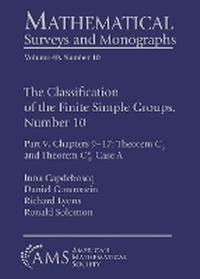
The Classification of the Finite Simple Groups, Number 10
Part V, Chapters 9-17: Theorem $C_6$ and Theorem $C^*_4$, Case a
Published on 31. December 2023
Book
Paperback/Softback
570 pages
978-1-4704-7553-6 (ISBN)
Description
This book is the tenth in a series of volumes whose aim is to provide a complete proof of the classification theorem for the finite simple groups based on a fairly short and clearly enumerated set of background results. Specifically, this book completes our identification of the simple groups of bicharacteristic type begun in the ninth volume of the series (see SURV/40.9). This is a fascinating set of simple groups which have properties in common with matrix groups (or, more generally, groups of Lie type) defined both over fields of characteristic 2 and over fields of characteristic 3. This set includes 11 of the celebrated 26 sporadic simple groups along with several of their large simple subgroups. Together with SURV/40.9, this volume provides the first unified treatment of this class of simple groups.
More details
Series
Language
English
Place of publication
Providence
United States
Target group
Professional and scholarly
Dimensions
Height: 254 mm
Width: 178 mm
Weight
484 gr
ISBN-13
978-1-4704-7553-6 (9781470475536)
Copyright in bibliographic data and cover images is held by Nielsen Book Services Limited or by the publishers or by their respective licensors: all rights reserved.
Schweitzer Classification
Persons
Inna Capdeboscq, University of Warwick, Coventry, United Kingdom.
Daniel Gorenstein, Richard Lyons, Rutgers University, Piscataway, NJ.
Ronald Solomon, The Ohio State University, Columbus, OH.
Daniel Gorenstein, Richard Lyons, Rutgers University, Piscataway, NJ.
Ronald Solomon, The Ohio State University, Columbus, OH.
Content
General group-theoretic lemmas
Theorem $\mathscr{C}_6$ and $\mathscr{C}_6^*$
Theorems $\mathscr{C}_4$ and $\mathscr{C}_4^*$: Introduction
Theorem $\mathscr{C}_4^*$: Stage A1. First steps
Theorem $\mathscr{C}_4^*$: Stage A2. Nonconstrained $p$-rank 3 centralizers
Theorem $\mathscr{C}_4^*$: Stage A3. $KM$-singularities
Theorem $\mathscr{C}_4^*$: Stage A4. Setups for recognizing $G$
Theorem $\mathscr{C}_4^*$: Stage A5. Recognition
Properties of $\mathscr{K}$-groups
Bibliography
Index
Theorem $\mathscr{C}_6$ and $\mathscr{C}_6^*$
Theorems $\mathscr{C}_4$ and $\mathscr{C}_4^*$: Introduction
Theorem $\mathscr{C}_4^*$: Stage A1. First steps
Theorem $\mathscr{C}_4^*$: Stage A2. Nonconstrained $p$-rank 3 centralizers
Theorem $\mathscr{C}_4^*$: Stage A3. $KM$-singularities
Theorem $\mathscr{C}_4^*$: Stage A4. Setups for recognizing $G$
Theorem $\mathscr{C}_4^*$: Stage A5. Recognition
Properties of $\mathscr{K}$-groups
Bibliography
Index