

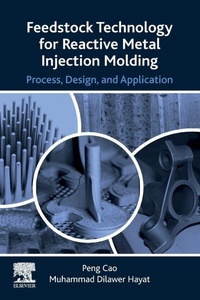
Feedstock Technology for Reactive Metal Injection Molding
Process, Design, and Application
Published on 17. June 2020
Book
Paperback/Softback
266 pages
978-0-12-817501-9 (ISBN)
Description
Feedstock Technology for Reactive Metal Injection Molding: Process, Design, and Application provides an authoritative guide on the basics of feedstock technology and the latest developments in binders for titanium metal injection moulding and their potential implications. In addition, the book presents challenges that MIM technology of reactive metals is currently facing and potential solutions for commercial success. As both commercial growth and research development are fundamentally driven by the economics of manufacture, this book presents the problems and potential solutions regarding reactive metals, making it a valuable resource for engineers intending to utilize MIM in commercial product design.
More details
Language
English
Place of publication
United States
Target group
Professional and scholarly
Researchers and engineers working in materials science. Graduate students and researchers in metallurgy and light alloys. Researchers and engineers in titanium industry
Product notice
Paperback (trade)
Dimensions
Height: 229 mm
Width: 152 mm
Thickness: 14 mm
Weight
364 gr
ISBN-13
978-0-12-817501-9 (9780128175019)
Copyright in bibliographic data and cover images is held by Nielsen Book Services Limited or by the publishers or by their respective licensors: all rights reserved.
Schweitzer Classification
Other editions
Additional editions
Peng Cao | Muhammad Dilawer Hayat
Feedstock Technology for Reactive Metal Injection Molding
Process, Design, and Application
E-Book
06/2020
Elsevier
€131.00
Available for download
Persons
Dr. Peng Cao is an associate professor of Materials Engineering in the Department of Chemical and Materials Engineering, the University of Auckland, New Zealand. His group focuses on developing titanium powder technologies and new energy-storage materials. He has published over 200 journal articles, and five edited/authored book. He has organized 10 international conferences, of which he chaired or co-chaired three, and delivered approximately 20 keynotes/invited talks. Dr Hayat received his master's degree in Materials Science from Chalmers University of Technology, Sweden in 2012 with a thesis on "Electric field Assisted Sintering of Metal Oxides?, a novel fabrication method for ceramics.
In the work related to his PhD study, he extensively studied water-soluble binder systems for titanium metal injection moulding and reported some interesting findings. These new findings shed new insight on the use of such binders in metal injection moulding industry and therefore has industrial applications. In addition, a new binder system was developed to reduce impurity uptake during processing.
Currently, he is working at the University of Auckland as a Research Fellow under the mentoring of A/Prof Peng Cao. Dr Hayat is one of the key researchers in the titanium powder metallurgy research programme and also mentors other postgraduates in the programme.
In the work related to his PhD study, he extensively studied water-soluble binder systems for titanium metal injection moulding and reported some interesting findings. These new findings shed new insight on the use of such binders in metal injection moulding industry and therefore has industrial applications. In addition, a new binder system was developed to reduce impurity uptake during processing.
Currently, he is working at the University of Auckland as a Research Fellow under the mentoring of A/Prof Peng Cao. Dr Hayat is one of the key researchers in the titanium powder metallurgy research programme and also mentors other postgraduates in the programme.
Content
Reactive powder metal injection molding
Design strategy of binder systems and feedstock chemistry
Binder system interactions and their effects
Impurity management in reactive metals injection molding
Potential feedstock compositions for metal injection molding of reactive metals
Outlook of reactive metals MIM
Design strategy of binder systems and feedstock chemistry
Binder system interactions and their effects
Impurity management in reactive metals injection molding
Potential feedstock compositions for metal injection molding of reactive metals
Outlook of reactive metals MIM