

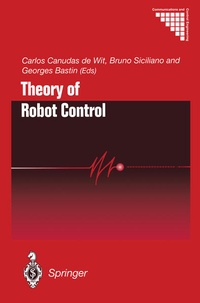
Theory of Robot Control
Published on 12. February 2012
Book
Paperback/Softback
XVI, 392 pages
978-1-4471-1503-8 (ISBN)
Description
The advent of new high-speed microprocessor technology together with the need for high-performance robots created substantial and realistic place for control theory in the field of robotics. Since the beginning of the 80's, robotics and control theory have greatly benefited from a mutual fertiliza tion. On one hand, robot models (inherently highly nonlinear) have been used as good case studies for exemplifying general concepts of analysis and design of advanced control theory; on the other hand, robot manipulator by using new control algorithms. Fur performance has been improved thermore, many interesting robotics problems, e. g. , in mobile robots, have brought new control theory research lines and given rise to the development of new controllers (time-varying and nonlinear). Robots in control are more than a simple case study. They represent a natural source of inspiration and a great pedagogical tool for research and teaching in control theory. Several advanced control algorithms have been developed for different types of robots (rigid, flexible and mobile), based either on existing control techniques, e. g. , feedback linearization and adaptive control, or on new control techniques that have been developed on purpose. Most of those results, although widely spread, are nowadays rather dispersed in different journals and conference proceedings. The purpose of this book is to collect some of the most fundamental and current results on theory of robot control in a unified framework, by editing, improving and completing previous works in the area.
More details
Series
Edition
Softcover reprint of the original 1st ed. 1996
Language
English
Place of publication
London
United Kingdom
Target group
Professional and scholarly
Research
Illustrations
XVI, 392 p.
Dimensions
Height: 235 mm
Width: 155 mm
Thickness: 23 mm
Weight
622 gr
ISBN-13
978-1-4471-1503-8 (9781447115038)
DOI
10.1007/978-1-4471-1501-4
Schweitzer Classification
Other editions
Additional editions
Carlos Canudas De Wit | Bruno Siciliano | Georges Bastin
Theory of Robot Control
E-Book
12/2012
Springer
€128.39
Available for download
Carlos Canudas De Wit | Bruno Siciliano | Georges Bastin
Theory of Robot Control
Book
06/1997
Springer
€85.55
Article exhausted; check different version
Persons
Content
I Rigid manipulators.- 1 Modelling and identification.- 2 Joint space control.- 3 Task space control.- 4 Motion and force control.- II Flexible manipulators.- 5 Elastic joints.- 6 Flexible links.- III Mobile robots.- 7 Modelling and structural properties.- 8 Feedback linearization.- 9 Nonlinear feedback control.- A Control background.- A.1 Lyapunov theory.- A. 1.1 Autonomous systems.- A.1.2 Nonautonomous systems.- A.1.3 Practical stability.- A.2 Singular perturbation theory.- A.3 Differential geometry theory.- A.3.1 Normal form.- A.3.2 Feedback linearization.- A.3.3 Stabilization of feedback linearizable systems.- A.4 Input-output.- A.4.1 Function spaces and operators.- A.4.2 Passivity.- A.4.3 Robot manipulators as passive systems.- A.4.4 Kalman-Yakubovich-Popov lemma.- A.5 Further reading.- References.