

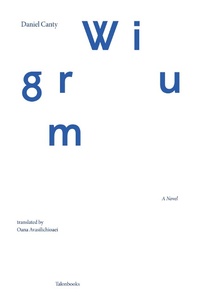
Wigrum
Description
It's October 1944. During a brief respite from the aerial bombardment of London, Sebastian Wigrum absconds from his small flat and disappears into the fog for a walk in the Unreal City. This is our first and only encounter with the enigmatic man we come to discover decades later through more than one hundred everyday objects he has left behind. Wigrum's bequest is a meticulously catalogued collection of the profoundly ordinary: a camera, some loose teeth, candies and keys, soap, bits of string, hazelnuts, and a handkerchief. Moving through the inventory artifact to artifact, story to story, we become immersed in a dreamlike narrative bricolage determined as much by the objects' museological presentation as by the tender and idiosyncratic mania of Wigrum's impulse to collect them.
With its traces of Jorge Luis Borges, Italo Calvino, and Georges Perec, Daniel Canty's graphically arresting Wigrum explores the limits of the postmodern novel. Having absorbed the logic of lists and the principles of classification systems, the Wigrumian narrative teeters on the boundary between fact and fiction, on the uncertain edge of the real and the unreal.
Readers venturing into Sebastian Wigrum's cabinet of curiosities must abide only the following maxim: If I can believe all the stories I am told, so can you.
More details
Other editions
Additional editions
Persons
Daniel Canty is a Montréal-based writer and film director who works in literature, film, theatre and design, and new media. Canty collaborated with the pioneering multimedia studio DNA Media in Vancouver, and directed the inaugural issues of Horizon Zero, the Banff New Media Institute's website on the digital arts in Canada.
Canty's first book, Êtres Artificiels (Liber, 1997), explores the cultural history of automatons in American literature. He is also the author of the genre-bending novel Wigrum (La Peuplade, 2011; translated by Oana Avasilichioaei, Talonbooks, 2013) and has devised several award-winning collaborative books: Cité selon (2006), La Table des Matières (2007), and Le Livre de Chevet (2009), reflecting on urban life, gastronomy, and sleep. From 2002 to 2005, he co-directed the poetry magazine C'est Selon.
His film work includes the oneiric Cinema for the Blind (2010) and Longuay (2012), which blends the gaze of an ancient French abbey with that of a tablet computer. He also conceives poetic interfaces for the web and live installations, including Bruire (2013), a voice-activated poetry-reciting machine, and the libretto for Operator (2012), an alphanumeric automaton by Mikko Hynninen.
Canty has held residencies at Green College (UBC), Passa Porta (Brussels), and Simon Fraser University. He currently teaches dramatic writing at the National Theatre School of Canada and event design at Université du Québec à Montréal.