

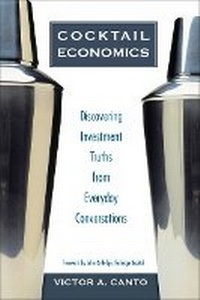
Cocktail Economics
Discovering Investment Truths from Everyday Conversations
Published on 17. May 2007
Book
Hardback
336 pages
978-0-13-243273-3 (ISBN)
Description
What can moonshine, mountain climbers, power plants, salmon, football players, and well-known celebrities teach you about investing? More than you ever imagined!
Through entertaining, easy-to-understand anecdotes, analogies, and examples, Canto reveals why the most successful investment strategies reflect a balance of active and passive approaches. You'll learn how to "read" economic cycles, identifying the specific asset classes most likely to outperform in tomorrow's business environment.
Construct and optimize your winning investment plan, step-by-step, from start to finish!
MAKE HAY WHILE THE SUN SHINES
The case for predicting, forecasting, and timing
PASSIVE INVESTING? ACTIVE INVESTING? NO. BOTH.
Why you need to take both sides in the never-ending debate
ELASTICITY: CATCH IT IF YOU CAN
Putting industry behavior to work for you
CALIFORNIA, FRANCE, AND THE "LOCATION EFFECT"
Investing internationally in the age of globalization
TURN "SMOKE" INTO "SIGNALS"
Making the most of publicly available price data
YOUR PORTFOLIO VS. THE GOVERNMENT
Anticipating and responding to regulations and taxation
TILT TOWARD SUCCESS, ONE STEP AT A TIME
Build your benchmark portfolio, then optimize it for changing environments
Victor Canto reveals exactly how the economy affects markets and how to "read" business cycles so you can profit from every shift in the business cycle. Among the topics covered: investing internationally in the age of globalization; transforming price data into usable market "signals"; anticipating the impact of regulations and taxation; and more. From start to finish, Canto's focus is practical, and his focus is simple: outstanding investment results.
Through entertaining, easy-to-understand anecdotes, analogies, and examples, Canto reveals why the most successful investment strategies reflect a balance of active and passive approaches. You'll learn how to "read" economic cycles, identifying the specific asset classes most likely to outperform in tomorrow's business environment.
Construct and optimize your winning investment plan, step-by-step, from start to finish!
MAKE HAY WHILE THE SUN SHINES
The case for predicting, forecasting, and timing
PASSIVE INVESTING? ACTIVE INVESTING? NO. BOTH.
Why you need to take both sides in the never-ending debate
ELASTICITY: CATCH IT IF YOU CAN
Putting industry behavior to work for you
CALIFORNIA, FRANCE, AND THE "LOCATION EFFECT"
Investing internationally in the age of globalization
TURN "SMOKE" INTO "SIGNALS"
Making the most of publicly available price data
YOUR PORTFOLIO VS. THE GOVERNMENT
Anticipating and responding to regulations and taxation
TILT TOWARD SUCCESS, ONE STEP AT A TIME
Build your benchmark portfolio, then optimize it for changing environments
Victor Canto reveals exactly how the economy affects markets and how to "read" business cycles so you can profit from every shift in the business cycle. Among the topics covered: investing internationally in the age of globalization; transforming price data into usable market "signals"; anticipating the impact of regulations and taxation; and more. From start to finish, Canto's focus is practical, and his focus is simple: outstanding investment results.
Reviews / Votes
A straightforward plan for managing your investment portfolio.Canto calls his brand of investment theory "cocktail economics" because it is conversational and filled with entertaining anecdotes. But there is no mistaking the seriousness of his intent-to generate above-average returns on your investments. His plan "specifically is concerned with the big picture, with the broad macro worldwide forces that act on all investments"-based on the principle that for every economic action there is a predictable market reaction, and that investments can be timed to the swings in asset classes. It is no mystery that assets-be they small caps, large caps, value or growth stocks, international or domestic shares, bonds or T-bills-react to economic shocks and trends (for example, monetary-policy changes, shifts in inflation and GDP growth) in ways that can be inferred. Using a combination of class benchmarks, macroeconomic forecasting and passive/aggressive strategies, Canto generates specific, reliable investment suggestions-for instance, that inelastic industries respond to positive economic shocks with below-average employment increases and above-average profit gains.
A sound and intelligible blueprint for investment. --Kirkus Business & Personal Finance Newsletter (May 2007)
Read Cocktail Economics. It educates and entertains (there is no shortage of anecdotes and real-world examples) while offering simple-to-follow instructions on how to do better than the average investor. It's also an excellent primer on how to argue like a supply-sider - which is not a bad thing if you like winning arguments.
--Larry Kudlow, NRO's Economics Editor, is host of CNBC's Kudlow & Company and author of the daily web blog, Kudlow's Money Politic$ (7/2007)
More details
Language
English
Place of publication
Upper Saddle River
United States
Publishing group
Pearson Education (US)
Target group
Professional and scholarly
Dimensions
Height: 159 mm
Width: 235 mm
Thickness: 27 mm
Weight
667 gr
ISBN-13
978-0-13-243273-3 (9780132432733)
Copyright in bibliographic data and cover images is held by Nielsen Book Services Limited or by the publishers or by their respective licensors: all rights reserved.
Schweitzer Classification
Person
VICTOR A. CANTO is Chairman and Founder of La Jolla Economics, an economic consulting firm located in La Jolla, California. He served as tenured Associate Professor of Finance and Business Economics at the University of Southern California (USC), and as Visiting Professor at both the Universidad Central del Este (Dominican Republic) and UCLA.
Dr. Canto has been published in The Wall Street Journal and Investor's Business Daily, and in many leading economic journals, including Economic Inquiry, Journal of Macroeconomics, The International Journal, Journal of Business and Economic Statistics, The Southern Economic Journal, Applied Economics, Weltwirstchaftliches Archiv, The CATO Journal, Public Finance, and The Journal of International Money and Finance. His series on portfolio strategy appeared in the Financial Analysts Journal.
He holds a M.A. and Ph.D. in Economics from the University of Chicago (1974, 1977).
Dr. Canto has been published in The Wall Street Journal and Investor's Business Daily, and in many leading economic journals, including Economic Inquiry, Journal of Macroeconomics, The International Journal, Journal of Business and Economic Statistics, The Southern Economic Journal, Applied Economics, Weltwirstchaftliches Archiv, The CATO Journal, Public Finance, and The Journal of International Money and Finance. His series on portfolio strategy appeared in the Financial Analysts Journal.
He holds a M.A. and Ph.D. in Economics from the University of Chicago (1974, 1977).
Content
Foreword xii
Preface xvii
Introduction: The Above-Average Opportunity xxi
Chapter 1: The Buy-and-Hold Connection: Investing Fundamentals, Courtesy of the American Homeowner, the American Dream-or Reality? 1
Chapter 2: Leaping the Transaction-Cost Hurdle: Sometimes It's Easy, Other Times It's Not 19
Chapter 3: Dressing Appropriately for the Stock Market: The Potential Payoffs of a Switching Strategy 31
Chapter 4: Catch Elasticity If You Can: An Introduction to Industry Behavior 47
Chapter 5: Putting High-Beta to Work: Industry-Based Portfolio Strategies 67
Chapter 6: California Is a Country: An Introduction to the Location Effect 83
Chapter 7: ...And France Is a State: How to Invest Internationally in the Age of Globalization 99
Chapter 8: Pipelines to Our Investment Returns: How We Get What We Want, in the Amount We Want, and When We Want It 113
Chapter 9: Who Are You? Investor Profiles and the Case for Asset Allocation 131
Chapter 10: Your Benchmark Portfolio. . .and Beyond 145
Chapter 11: Turning Smoke into Signals: How to Make the Most Out of Price Data 157
Chapter 12: Making Hay While the Sun Shines: The Case for Predicting, Forecasting, and Timing 173
Chapter 13: The Fight Is On: How to Invest Properly Relative to Regulations, Inflation, and Taxation 195
Chapter 14: Ending the Never-Ending Debate: Active vs. Passive Investing and Why You Can Take Both Sides 217
Chapter 15: A Rational Walk Down Wall Street: Darting Between Passive and Active When the Odds Are in Your Favor 233
Chapter 16: Alpha Bets: The Case for Hedge Funds and a Greek Letter You'll Want in Your Portfolio 247
Chapter 17: Tilting Toward Success: A Step-by-Step Guide to Above-Average Asset Allocation 265
Index 291
Preface xvii
Introduction: The Above-Average Opportunity xxi
Chapter 1: The Buy-and-Hold Connection: Investing Fundamentals, Courtesy of the American Homeowner, the American Dream-or Reality? 1
Chapter 2: Leaping the Transaction-Cost Hurdle: Sometimes It's Easy, Other Times It's Not 19
Chapter 3: Dressing Appropriately for the Stock Market: The Potential Payoffs of a Switching Strategy 31
Chapter 4: Catch Elasticity If You Can: An Introduction to Industry Behavior 47
Chapter 5: Putting High-Beta to Work: Industry-Based Portfolio Strategies 67
Chapter 6: California Is a Country: An Introduction to the Location Effect 83
Chapter 7: ...And France Is a State: How to Invest Internationally in the Age of Globalization 99
Chapter 8: Pipelines to Our Investment Returns: How We Get What We Want, in the Amount We Want, and When We Want It 113
Chapter 9: Who Are You? Investor Profiles and the Case for Asset Allocation 131
Chapter 10: Your Benchmark Portfolio. . .and Beyond 145
Chapter 11: Turning Smoke into Signals: How to Make the Most Out of Price Data 157
Chapter 12: Making Hay While the Sun Shines: The Case for Predicting, Forecasting, and Timing 173
Chapter 13: The Fight Is On: How to Invest Properly Relative to Regulations, Inflation, and Taxation 195
Chapter 14: Ending the Never-Ending Debate: Active vs. Passive Investing and Why You Can Take Both Sides 217
Chapter 15: A Rational Walk Down Wall Street: Darting Between Passive and Active When the Odds Are in Your Favor 233
Chapter 16: Alpha Bets: The Case for Hedge Funds and a Greek Letter You'll Want in Your Portfolio 247
Chapter 17: Tilting Toward Success: A Step-by-Step Guide to Above-Average Asset Allocation 265
Index 291