

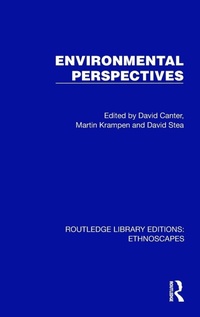
Environmental Perspectives
1st Edition
Published on 7. November 2024
Book
Hardback
322 pages
978-1-032-81616-6 (ISBN)
Description
Originally published in 1988, reissued now with a new series introduction, Environmental Perspectives was the first in a trilogy of books to open the series Ethnoscapes: Current Challenges in the Environmental Social Sciences. These three titles brought together specially commissioned contributions that cover much of the range of topics that the series as a whole would cover. Although the following volumes would not have the same format, the opening trilogy gave an overview of what was to come, while also providing a broad base for the future authors to build upon.
The first of these volumes focuses, essentially, on theory. It brings together papers covering our growing understanding of the ways in which human actions are integrated within our knowledge of the places in which those actions occur. The contributors also explore the social historical antecedents that give meaning to our everyday surroundings, as well as the psychological underpinnings to aesthetic experience.
The first of these volumes focuses, essentially, on theory. It brings together papers covering our growing understanding of the ways in which human actions are integrated within our knowledge of the places in which those actions occur. The contributors also explore the social historical antecedents that give meaning to our everyday surroundings, as well as the psychological underpinnings to aesthetic experience.
More details
Series
Language
English
Place of publication
London
United Kingdom
Publishing group
Taylor & Francis Ltd
Target group
College/higher education
Adult education, General, and Postgraduate
Dimensions
Height: 240 mm
Width: 161 mm
Thickness: 22 mm
Weight
655 gr
ISBN-13
978-1-032-81616-6 (9781032816166)
Copyright in bibliographic data and cover images is held by Nielsen Book Services Limited or by the publishers or by their respective licensors: all rights reserved.
Schweitzer Classification
Other editions
Additional editions
David Canter | Martin Krampen | David Stea
Environmental Perspectives
Book
approx. 02/2026
1st Edition
Routledge
€54.00
Not yet published
David Canter | Martin Krampen | David Stea
Environmental Perspectives
E-Book
11/2024
1st Edition
Routledge
€41.99
Available for download
David Canter | Martin Krampen | David Stea
Environmental Perspectives
E-Book
11/2024
1st Edition
Routledge
€41.99
Available for download
Persons
David Canter is Emeritus Professor at The University of Liverpool, UK. Having set up the first MSc in Environmental Psychology at The University of Surrey in 1972, he went on to establish the Journal of Environmental Psychology in 1980, editing it for 20 years. Soon after he founded the International Association of People-Environment Studies (IAPS). David has published widely on many aspects of human interactions with their surroundings; his 1977 book The Psychology of Place, being one of the most cited publications in the area.
Martin Krampen (1928-2015) was a leading German semiotician. He worked in the field of visual semiotics and environmental perception, as well as being a professional artist. Over the course of his career Krampen held position at universities across North America and Europe teaching courses in social psychology, semiotics, and the psychology of design. He was the University of Waterloo's first full-time research associate, where he worked alongside Professor George Soulis to study the influence of design on industry. Krampen taught Visual Communication at Hochschule der Kuenste from 1977 until his retirement in 1993.
David Stea is Professor Emeritus of Geography and International Studies at Texas State University and Research Associate with the Center for Global Justice in Mexico. As Carnegie Interdisciplinary Fellow at Brown University from 1964 to 1966, he developed the new field of Environmental Psychology and the related study of spatial and geographic cognition. David is a member of the editorial boards of a number of journals, the co-author or co-editor of several books and author of some 150 articles and book chapters on various subjects, including sustainable development and environmental issues in Latin America. In 1987 he was nominated for the Right Livelihood Prize (also known as the "alternative Nobel") for his international work with indigenous peoples.
Martin Krampen (1928-2015) was a leading German semiotician. He worked in the field of visual semiotics and environmental perception, as well as being a professional artist. Over the course of his career Krampen held position at universities across North America and Europe teaching courses in social psychology, semiotics, and the psychology of design. He was the University of Waterloo's first full-time research associate, where he worked alongside Professor George Soulis to study the influence of design on industry. Krampen taught Visual Communication at Hochschule der Kuenste from 1977 until his retirement in 1993.
David Stea is Professor Emeritus of Geography and International Studies at Texas State University and Research Associate with the Center for Global Justice in Mexico. As Carnegie Interdisciplinary Fellow at Brown University from 1964 to 1966, he developed the new field of Environmental Psychology and the related study of spatial and geographic cognition. David is a member of the editorial boards of a number of journals, the co-author or co-editor of several books and author of some 150 articles and book chapters on various subjects, including sustainable development and environmental issues in Latin America. In 1987 he was nominated for the Right Livelihood Prize (also known as the "alternative Nobel") for his international work with indigenous peoples.
Content
New Series Introduction to the Reissue David Canter and David Stea. New Directions in Environmental Research. Editors' Introduction David Canter, David Stea and Martin Krampen. Section One: Perspectives on Actions and Places 1. Action and Place: An Existential Dialectic David Canter 2. Environmental Perception: An Ecological Perspective Klaus Landwehr 3. Home and the Theory of Place Vittoria Giuliani, Mirilia Bonnes, Flora Amoni and Yvonne Bernard 4. Cultural Aspects of Place Consciousness and Environmental Identity Boyowa A. Chokor Section Two: Social Histories of Built Form 5. Cultural Production and Reproduction Anthony King 6. Urban Social History Gilles Barbey 7. Socio-Cultural Aspects of Built Form Rena Papageorgiou-Sefertzi and Aristie Papadopolou 8. Building a House or a Social Universe? Catherine Mougenot 9. Urban Open Space Perla Korosec-Serfaty 10. Social Architecture - William Morris our Contemporary Alan Lipman and Howard Harris 11. The 'Environmental Psychology' of Theatres and Movie Palaces Ross Thorne Section Three: Aesthetics and Meaning in Architecture 12. Meaning in Architecture: Post-Modernism, Hustling and the Big Sell Paul Harries, Alan Lipman and Stephen Purden 13. Complexity, Order and an Architectural Aesthetic Peter Smith 14. Contextual Compatibility in Architecture Linda Groat 15. Explorations in Ecoanalysis Arie Peled 16. The Significance of Imagination and Its Place in Architectonic Creation Klaus Peter Walcher. Brief Biographies of Contributors. Index.