

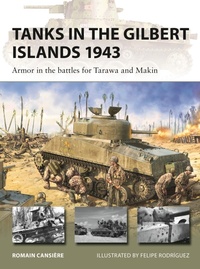
Tanks in the Gilbert Islands 1943
Armor in the battles for Tarawa and Makin
Will be published approx. on 19. November 2026
Book
Paperback/Softback
48 pages
978-1-4728-7100-8 (ISBN)
Description
Fully illustrated, this examines how the Gilberts invasion proved the importance and difficulty of using armor in the Pacific, and laid the groundwork for America's island campaign.
The capture of the heavily fortified Gilbert Islands was intended to secure air bases for the Marshall Islands campaign. The garrison commander General Keiji Shibazaki claimed that "a thousand men in a hundred years couldn't take Tarawa".
Simultaneously, the Marine Corps landed on Tarawa and the Army on Makin, in the first opposed landings of the Pacific War, with armor supporting the assault waves. But as is often the case with pioneering operations, things didn't go according to plan. Reefs, low tides, strong Japanese opposition, lack of communication, and absence of suitable doctrine lead to a near-disaster on Tarawa.
In this book, illustrated with superb new tank profiles and previously unpublished photos, armor historian Romain Cansiere examines how the battles for Tarawa and Makin highlighted the difficulties of providing armored support in the Pacific landings. Studying the roles of tanks in both operations, how inexperienced armor crews overcame the difficulties of combat, and the role of Japanese tanks in both battles, this book offers the first account of how armor performed in this 'proving ground' operation, and what lessons were learned for future landings in the Pacific.
The capture of the heavily fortified Gilbert Islands was intended to secure air bases for the Marshall Islands campaign. The garrison commander General Keiji Shibazaki claimed that "a thousand men in a hundred years couldn't take Tarawa".
Simultaneously, the Marine Corps landed on Tarawa and the Army on Makin, in the first opposed landings of the Pacific War, with armor supporting the assault waves. But as is often the case with pioneering operations, things didn't go according to plan. Reefs, low tides, strong Japanese opposition, lack of communication, and absence of suitable doctrine lead to a near-disaster on Tarawa.
In this book, illustrated with superb new tank profiles and previously unpublished photos, armor historian Romain Cansiere examines how the battles for Tarawa and Makin highlighted the difficulties of providing armored support in the Pacific landings. Studying the roles of tanks in both operations, how inexperienced armor crews overcame the difficulties of combat, and the role of Japanese tanks in both battles, this book offers the first account of how armor performed in this 'proving ground' operation, and what lessons were learned for future landings in the Pacific.
More details
Series
Language
English
Place of publication
United Kingdom
Publishing group
Bloomsbury Publishing PLC
Product notice
Paperback (trade)
Unsewn / adhesive bound
Illustrations
Illustrated throughout with 40 photos and 8 pages of colour illustrations
Dimensions
Height: 248 mm
Width: 184 mm
Thickness: 25 mm
Weight
454 gr
ISBN-13
978-1-4728-7100-8 (9781472871008)
Copyright in bibliographic data and cover images is held by Nielsen Book Services Limited or by the publishers or by their respective licensors: all rights reserved.
Schweitzer Classification
Persons
A native of southeastern France, Romain V. Cansiere has been interested in the history of the US Marine Corps since his teenage years, Romain is the co-author of Tanks in Hell - A Marine Corps Tank Company on Tarawa, winner of the 2016 General Wallace M. Greene Jr. Award for distinguished non-fiction.
Felipe Rodriguez is a distinguished digital illustrator specializing in historical tank reconstructions.
Felipe Rodriguez is a distinguished digital illustrator specializing in historical tank reconstructions.
Content
INTRODUCTION
THE JAPANESE IN THE GILBERTS
The Americans in Operation Galvanic
The US Army in Operation Galvanic
The US Marines
TECHNICAL FACTORS
Tanks and half-tracks
Special equipment
TARAWA
D-Day, November 20
D+1, November 21
D+2, November 22
D+3, November 23
MAKIN
D-Day, November 20
D+1, November 21
D+2, November 22
D+2, November 22
AFTERMATH
Lessons learned?
FURTHER READING
INDEX
THE JAPANESE IN THE GILBERTS
The Americans in Operation Galvanic
The US Army in Operation Galvanic
The US Marines
TECHNICAL FACTORS
Tanks and half-tracks
Special equipment
TARAWA
D-Day, November 20
D+1, November 21
D+2, November 22
D+3, November 23
MAKIN
D-Day, November 20
D+1, November 21
D+2, November 22
D+2, November 22
AFTERMATH
Lessons learned?
FURTHER READING
INDEX