

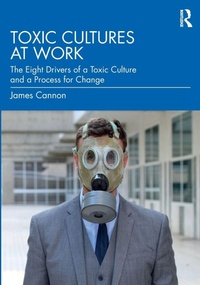
Toxic Cultures at Work
The Eight Drivers of a Toxic Culture and a Process for Change
1st Edition
Published on 30. September 2022
Book
Paperback/Softback
194 pages
978-1-032-30935-4 (ISBN)
Description
Around the world and across industries, toxic workplaces are in the news. Taking a holistic approach, this book gives a succinct summary of how toxic cultures develop and shows how they can be remedied with practical takeaways for organisations.
Existing books on toxic culture either skim the surface of the latest scandal or take a theoretical approach of limited use to practitioners trying to improve their organisations. Now, organisational development expert James Cannon presents an all-in-one resource based on organisational and individual psychology research that offers actionable suggestions for required change. Cannon provides a framework to understand the complexities of a toxic culture, identifying eight drivers: power, leadership personalities, values, organisation design, formal and informal systems, relations with the external environment and individual systems of motivation and reward. The book also offers a comprehensive toolkit with questionnaires and checklists to manage and achieve cultural change.
Professionals and students in organisational psychology, business, and change management, as well as those with an interest in the political and social issues raised by toxic cultures, will appreciate this guide on how to tackle a problem that is much discussed but seldom solved.
Existing books on toxic culture either skim the surface of the latest scandal or take a theoretical approach of limited use to practitioners trying to improve their organisations. Now, organisational development expert James Cannon presents an all-in-one resource based on organisational and individual psychology research that offers actionable suggestions for required change. Cannon provides a framework to understand the complexities of a toxic culture, identifying eight drivers: power, leadership personalities, values, organisation design, formal and informal systems, relations with the external environment and individual systems of motivation and reward. The book also offers a comprehensive toolkit with questionnaires and checklists to manage and achieve cultural change.
Professionals and students in organisational psychology, business, and change management, as well as those with an interest in the political and social issues raised by toxic cultures, will appreciate this guide on how to tackle a problem that is much discussed but seldom solved.
More details
Language
English
Place of publication
London
United Kingdom
Publishing group
Taylor & Francis Ltd
Illustrations
15 s/w Abbildungen, 15 s/w Zeichnungen, 12 s/w Tabellen
12 Tables, black and white; 15 Line drawings, black and white; 15 Illustrations, black and white
Dimensions
Height: 254 mm
Width: 178 mm
Thickness: 11 mm
Weight
402 gr
ISBN-13
978-1-032-30935-4 (9781032309354)
Copyright in bibliographic data and cover images is held by Nielsen Book Services Limited or by the publishers or by their respective licensors: all rights reserved.
Schweitzer Classification
Other editions
Additional editions
Book
09/2022
1st Edition
Routledge
€204.90
Shipment within 10-20 days
E-Book
09/2022
1st Edition
Routledge
€72.49
Available for download
E-Book
09/2022
1st Edition
Routledge
€72.49
Available for download
Person
James Cannon, PhD, specialises in organisation design and development, and has consulted with organisations around the world. He has run an extensive range of training courses for the Chartered Institute of Personnel and Development (CIPD) in the UK and has served as a visiting lecturer at Geneva University. He has been a fellow of the CIPD and the Chartered Management Institute (CMI) and a Manpower Society prize-winner, as well as honoured by the UK government for his work in leadership development. He served at director level in human resources, information technology, and organisation development, and has been an independent consultant for over 30 years.
Content
Introduction Part A: Culture 1. What is a toxic culture? 2. Organisational diagnosis Part B: Leadership - power, personality, and values 3. The toxic effect of power imbalance 4. Leadership: the dark triad - personality and the toxic individual 5. Values Part C: Organisation 6. Organisational design: the toxic impact of structure and process 7. The informal organisation 8. Relations with the external environment Part D: The individual 9. Motivation and communication 10. Reward Part E: Solutions 11. Fixing toxic cultures: a strategy for change