

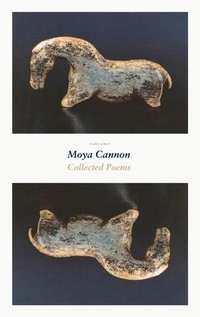
Collected Poems
Published on 25. February 2021
Book
Paperback/Softback
344 pages
978-1-80017-032-2 (ISBN)
Description
An Irish Times Best Poetry Books of 2021.
In Collected Poems one of Ireland's best-loved contemporary poets brings together poems from her six principal collections, Oar (1990), The Parchment Boat (1997), Carrying the Songs (1907), Hands (2011), Keats Lives (2015) and Donegal Tarantella (2019) - more than three decades' work - a poetry of individual poems which compose a memorable, unpredictable sequence of discovery. The immediacy of our response to the beauty of our exploited planet inspire many of Moya Cannon's poems. The perfection of very early cave art she sees as testimony to the centrality of art in our evolution as humans. Geology, archaeology, history and music figure as gateways to a deeper understanding of our relationship with our past and the natural world.
'Whatever inspiration is,' she quotes Wislawa Szymborska as saying, 'it is born from a continuous 'I don't know',' from the confusion of adolescence to the very different confusions of adult life. There are dark confusions and those which are luminous and filled with joy - desperation and rapture are their extremes. Each poem makes a space in which the readers share experience and discover something uniquely their own as well. She regards herself as fortunate in having developed in a culture rapidly changing, in which the poetries of the world were becoming available, in which the situation of women was radically changing. She was at once a beneficiary and an agent of change and these poems retain that enabling agency.
In Collected Poems one of Ireland's best-loved contemporary poets brings together poems from her six principal collections, Oar (1990), The Parchment Boat (1997), Carrying the Songs (1907), Hands (2011), Keats Lives (2015) and Donegal Tarantella (2019) - more than three decades' work - a poetry of individual poems which compose a memorable, unpredictable sequence of discovery. The immediacy of our response to the beauty of our exploited planet inspire many of Moya Cannon's poems. The perfection of very early cave art she sees as testimony to the centrality of art in our evolution as humans. Geology, archaeology, history and music figure as gateways to a deeper understanding of our relationship with our past and the natural world.
'Whatever inspiration is,' she quotes Wislawa Szymborska as saying, 'it is born from a continuous 'I don't know',' from the confusion of adolescence to the very different confusions of adult life. There are dark confusions and those which are luminous and filled with joy - desperation and rapture are their extremes. Each poem makes a space in which the readers share experience and discover something uniquely their own as well. She regards herself as fortunate in having developed in a culture rapidly changing, in which the poetries of the world were becoming available, in which the situation of women was radically changing. She was at once a beneficiary and an agent of change and these poems retain that enabling agency.
Reviews / Votes
'These wonderful poems lay down not just a landscape and a history, but a music which is all their own, through which the reader can enter a unique dialogue between elegy and celebration.' - Eavan BolandMore details
Language
English
Place of publication
Manchester
United Kingdom
Dimensions
Height: 136 mm
Width: 215 mm
Thickness: 30 mm
Weight
430 gr
ISBN-13
978-1-80017-032-2 (9781800170322)
Copyright in bibliographic data and cover images is held by Nielsen Book Services Limited or by the publishers or by their respective licensors: all rights reserved.
Schweitzer Classification
Other editions
Additional editions
Person
Moya Cannon is an Irish poet with six published collections, the most recent being Donegal Tarantella (Carcanet). The mountains, the shoreline and our primal and enduring responses to the beauty of the endangered earth are the inspiration for many of her poems. Archaeology and geology figure too as gateways to deeper understanding of our mysterious relationship with the natural world and our past.
Music, particularly traditional Irish music, has always been a deep interest and is a constant theme. She has received the Brendan Behan Award and the O'Shaughnessy Award and was 2011 Heimbold Professor of Irish Studies at Villanova University. She was born in Co. Donegal and now lives in Dublin.
Music, particularly traditional Irish music, has always been a deep interest and is a constant theme. She has received the Brendan Behan Award and the O'Shaughnessy Award and was 2011 Heimbold Professor of Irish Studies at Villanova University. She was born in Co. Donegal and now lives in Dublin.