

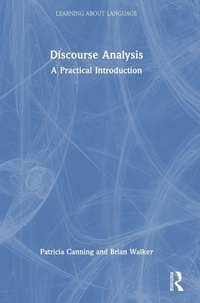
Discourse Analysis
A Practical Introduction
1st Edition
Published on 31. January 2024
Book
Hardback
326 pages
978-1-138-04708-2 (ISBN)
Description
Discourse Analysis provides an essential and practical introduction for students studying modules on the analysis of language in use. It explores the ways in which language is used and organised in written and spoken texts to generate meanings and takes into account the social contexts of production, and the social roles and identities of those involved.
Investigating the ways in which language varies according to subject, social setting, and communicative purpose, this book examines various forms of speaking and writing, including casual conversation, speeches, parliamentary debate, computer-mediated communication, and mass media articles. It discusses topics including how we convey more than we actually say or write, the role of politeness and impoliteness in communication, and what makes texts cohesive and coherent. It also shows how particular aspects of discourse analysis can be assisted by corpus methods and tools.
Taking students through a step-by-step guide on how to do discourse analysis that includes the collection of data and presentation of results, the book also documents a text analysis project from start to finish. Featuring a range of examples and interactive activities, as well as additional online support material, this book is key reading for those studying discourse analysis modules.
Investigating the ways in which language varies according to subject, social setting, and communicative purpose, this book examines various forms of speaking and writing, including casual conversation, speeches, parliamentary debate, computer-mediated communication, and mass media articles. It discusses topics including how we convey more than we actually say or write, the role of politeness and impoliteness in communication, and what makes texts cohesive and coherent. It also shows how particular aspects of discourse analysis can be assisted by corpus methods and tools.
Taking students through a step-by-step guide on how to do discourse analysis that includes the collection of data and presentation of results, the book also documents a text analysis project from start to finish. Featuring a range of examples and interactive activities, as well as additional online support material, this book is key reading for those studying discourse analysis modules.
More details
Series
Language
English
Place of publication
London
United Kingdom
Publishing group
Taylor & Francis Ltd
Target group
College/higher education
Undergraduate
Illustrations
15 s/w Photographien bzw. Rasterbilder, 40 s/w Zeichnungen, 55 s/w Abbildungen, 41 s/w Tabellen
41 Tables, black and white; 40 Line drawings, black and white; 15 Halftones, black and white; 55 Illustrations, black and white
Dimensions
Height: 250 mm
Width: 175 mm
Thickness: 23 mm
Weight
780 gr
ISBN-13
978-1-138-04708-2 (9781138047082)
Copyright in bibliographic data and cover images is held by Nielsen Book Services Limited or by the publishers or by their respective licensors: all rights reserved.
Schweitzer Classification
Other editions
Additional editions
E-Book
01/2024
1st Edition
Routledge
€53.99
Available for download
Book
01/2024
1st Edition
Routledge
€62.30
Shipment within 10-20 days
E-Book
01/2024
1st Edition
Routledge
€53.99
Available for download
Persons
Patricia Canning is an assistant professor at Northumbria University, Newcastle (UK). Her recent publications include journal articles on the linguistic construction of domestic abuse police reports (2022; and with Nick Lynn, 2021). She is co-author of an independent report into what went wrong at the Champions League Final in Paris (2022) and has published research on the narrative evidence following the Hillsborough Football Stadium disaster (2018; 2021; 2023). She is author of Style in the Renaissance: Language and Control in Early Modern England (2011).
Brian Walker is a visiting scholar in the School of Arts, English and Languages at Queen's University Belfast, Belfast (UK). His published research focuses on corpus stylistics and using corpus linguistic approaches in the analysis of discourse.
Brian Walker is a visiting scholar in the School of Arts, English and Languages at Queen's University Belfast, Belfast (UK). His published research focuses on corpus stylistics and using corpus linguistic approaches in the analysis of discourse.
Content
1.Why do discourse analysis?2.Analysing dialogic interactions3.Semantics in discourse - how meanings can alter depending on their context in a discourse4.Meaning and Context (pragmatics)5Politeness (PC) banter and use of emoji for impoliteness (mock impoliteness)6.Figurative meaning7.Linguistic forms and functions.8.Analysing discourse structure / information structure (micro and macro structure)9.Presentation of other people's speech, writing and thought in discourse10.DA and Corpus linguistics11.Getting Forensic with the analysis of discourse12.Bringing it all together13.Concluding remarks