

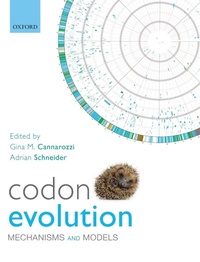
Codon Evolution
Mechanisms and Models
1st Edition
Published on 23. February 2012
Book
Hardback
298 pages
978-0-19-960116-5 (ISBN)
Description
Codon-based models of evolution are a relatively new addition to the toolkit of computational biologists, and in recent years remarkable progress has been made in this area. The study of evolution at the codon level captures information contained in both amino acid and synonymous DNA substitutions. By combining these two types of information, codon analyses are more powerful than those of either amino acid or DNA evolution alone. This is a clear benefit for most evolutionary analyses, including phylogenetic reconstruction, detection of selection, ancestral sequence reconstruction, and alignment of coding DNA. Despite the theoretical advantages of codon based models, their relative complexity delayed their widespread use. Only in recent years, when large-scale sequencing projects produced sufficient genomic data and computational power increased, did their usage become more common.
In Codon Evolution, leading researchers in the field of molecular evolution provide the latest insights from codon-based analyses of genetic sequences. The first part of the book provides comprehensive coverage of the developments of various types of codon substitution models such as parametric and empirical models used in maximum likelihood as well as Bayesian frameworks. Subsequent chapters examine the use of codon models to infer selection and other applications of codon models to biological systems. The second part of the book focuses on codon usage bias. Both the underlying mechanisms as well as current methods to analyse codon usage bias are presented.
In Codon Evolution, leading researchers in the field of molecular evolution provide the latest insights from codon-based analyses of genetic sequences. The first part of the book provides comprehensive coverage of the developments of various types of codon substitution models such as parametric and empirical models used in maximum likelihood as well as Bayesian frameworks. Subsequent chapters examine the use of codon models to infer selection and other applications of codon models to biological systems. The second part of the book focuses on codon usage bias. Both the underlying mechanisms as well as current methods to analyse codon usage bias are presented.
More details
Language
English
Place of publication
Oxford
United Kingdom
Target group
College/higher education
This advanced research level text is suitable for graduate students and researchers in molecular evolution, population genetics, computer science, and evolutionary bioinformatics. Newcomers to the field will benefit from clear background introductions as well as boxes explaining key concepts and important terms.
Illustrations
50 illustrations
Dimensions
Height: 260 mm
Width: 208 mm
Thickness: 21 mm
Weight
866 gr
ISBN-13
978-0-19-960116-5 (9780199601165)
Copyright in bibliographic data and cover images is held by Nielsen Book Services Limited or by the publishers or by their respective licensors: all rights reserved.
Schweitzer Classification
Persons
Gina Cannarozzi was a Senior Scientific Researcher in the Computer Science Department at the ETH Zurich, Switzerland from 2000-2010 and currently holds the same position in the Biology Department at the University of Bern. She obtained her Ph.D. in Physical Chemistry from the University of California, San Diego in 1995 and has been interested in molecular evolution, protein structure and the origins of life since working with Prof. Steven A. Benner at the University of Florida in 1996-1998. Her current research focuses are: codon models of evolution, codon bias as well as phylogeny and ancestral reconstruction. She is on the Editorial Board of Trends in Evolutionary Biology.
Adrian Schneider received his Ph.D. in 2009 from the ETH Zurich, Switzerland for his thesis on codon-based models of evolution and Mammalian phylogeny. Afterwards, he worked as a post-doctoral researcher at the Institute of Evolutionary Biology at the University of Edinburgh, Scotland and is currently a post-doctoral researcher at the University of Utrecht, Netherlands. His current work includes the development of new semi-empirical codon models.
Adrian Schneider received his Ph.D. in 2009 from the ETH Zurich, Switzerland for his thesis on codon-based models of evolution and Mammalian phylogeny. Afterwards, he worked as a post-doctoral researcher at the Institute of Evolutionary Biology at the University of Edinburgh, Scotland and is currently a post-doctoral researcher at the University of Utrecht, Netherlands. His current work includes the development of new semi-empirical codon models.
Content
PART I: MODELING CODON EVOLUTION; PART II: CODON USAGE BIAS