

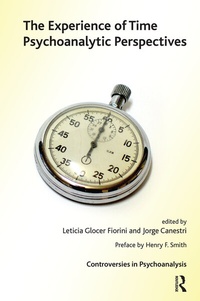
The Experience of Time
Psychoanalytic Perspectives
1st Edition
Published on 5. July 2019
Book
Hardback
230 pages
978-0-367-10674-4 (ISBN)
Description
In contemporary psychoanalysis, the concepts of time and history have become increasingly complex. It is evident that this trend offers us an opportunity to think about the intercrossing of the different temporal dimensions imbuing the subject, an inevitable aspect of the analytic process. History is time past but what is recovered is now the working through of the subject history, which carries the mark of both passing time and re-signifying time. It is precisely the notion of history that gains different dimensions when a purely deterministic analysis is disassembled. Continuities and breaks are found between subjective time and chronological time; between the inevitable decrepitude of the biological body with the passing of time and the timelessness of the unconscious; between linear, circular times and retroactive re-signification; between facts, screen memories, memory and the work of constructing history; between the times of repetition and the times of difference; between reversible and irreversible time; between the timelessness of the unconscious and the temporalities of the ego.
More details
Series
Language
English
Place of publication
London
United Kingdom
Publishing group
Taylor & Francis Ltd
Target group
College/higher education
Professional and scholarly
Professional Practice & Development
Dimensions
Height: 229 mm
Width: 152 mm
Weight
590 gr
ISBN-13
978-0-367-10674-4 (9780367106744)
Copyright in bibliographic data and cover images is held by Nielsen Book Services Limited or by the publishers or by their respective licensors: all rights reserved.
Schweitzer Classification
Other editions
Additional editions
E-Book
03/2018
1st Edition
Routledge
€47.49
Available for download
E-Book
03/2018
Routledge
€47.49
Available for download
Book
12/2009
Karnac Books
€65.20
Shipment within 15-20 days
Persons
Jorge Canestri
Content
This book's hypothesis is that psychoanalysis revolutionizes the common conception of time, similar to the revolution in physics. While it does not ignore the 'psychological time arrow' no doubt distinguishing past, present and future, psychoanalysis reveals that in analytic experience, time acquires diverse formations in which these distinctions become more complex and fade until they take the shape of what Andre Green, in a felicitous expression, calls 'le temps eclate' ['exploded time'].