

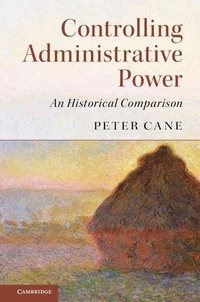
Controlling Administrative Power
An Historical Comparison
Published on 31. March 2016
Book
Hardback
608 pages
978-1-107-14635-8 (ISBN)
Description
This wide-ranging comparative account of the legal regimes for controlling administrative power in England, the USA and Australia argues that differences and similarities between control regimes may be partly explained by the constitutional structures of the systems of government in which they are embedded. It applies social-scientific and historical methods to the comparative study of law and legal systems in a novel and innovative way, and combines accounts of long-term and large-scale patterns of power distribution with detailed analysis of features of administrative law and the administrative justice systems of three jurisdictions. It also proposes a new method of analysing systems of government based on two different models of the distribution of public power (diffusion and concentration), a model which proves more illuminating than traditional separation-of-powers analysis.
Reviews / Votes
'An important and original contribution to administrative law and comparative government in a simple and very clear style.' Susan Rose-Ackerman, Henry R. Luce Professor of Jurisprudence, Yale Law School and Yale Department of Political Science 'Cane's greatest achievement in this book is his demonstration of extraordinary 'fluency' in the subtleties of the English, US and Australian systems of administrative law and governance. He is at his absolute best in comparative legal analysis, informed by a strong sense of the historical development of the administrative state in each country.' Peter L. Lindseth, Olimpiad S. Ioffe Professor of International and Comparative Law and Director, International Programs, School of Law, University of Connecticut 'The book - which presents an extensive and detailed study - seeks to demonstrate the core thesis by discussion of the control regimes in three systems of government: Australia, the UK, and the US General historical accounts of the systems of government in each of these jurisdictions are set out, before the book goes on to look at various aspects of the control regimes (each of the chapters can be read as a free-standing work). The closing chapter offers some methodological reflections that arose from the author's experience of the project.' Joe Tomlinson, I-CONnect 'Peter Cane's book forces one to think hard about the relationship of political structure and legal doctrine, and the lessons that can be learned in relation to comparative administrative law. It is an important issue, especially because 'this view of the cathedral' has been relatively neglected in scholarly debate. He has brought considerable scholarship to this field. It will generate further debate about his central thesis, as well as stimulating further work of this genre.' Paul Craig, Oxford Journal of Legal StudiesMore details
Language
English
Place of publication
Cambridge
United Kingdom
Target group
Professional and scholarly
Dimensions
Height: 235 mm
Width: 157 mm
Thickness: 37 mm
Weight
1019 gr
ISBN-13
978-1-107-14635-8 (9781107146358)
Copyright in bibliographic data and cover images is held by Nielsen Book Services Limited or by the publishers or by their respective licensors: all rights reserved.
Schweitzer Classification
Other editions
Additional editions
E-Book
04/2016
Cambridge University Press
€38.49
Available for download
Book
03/2016
Cambridge University Press
€52.50
Shipment within 15-20 days
E-Book
03/2016
Cambridge University Press
€31.99
Available for download
Person
Peter Cane is Distinguished Professor and Associate Dean (Research) at the ANU College of Law, Australian National University, Canberra. He has taught and researched administrative law for almost forty years, and is also well known for his research on the interface between public and private law.
Content
1. Introduction: concepts and methodology; 2. The English system of government; 3. The US system of government; 4. The Australian system of government; 5. The development and institutional structure of control regimes; 6. Administrative interpretation; 7. Administrative fact-finding and policy-making; 8. Administrative rule-making; 9. Administrative adjudication; 10. Private law controls; 11. Controlling information; 12. The new public management; 13. Controlling the controllers; 14. Concluding reflections on methodology and themes.