

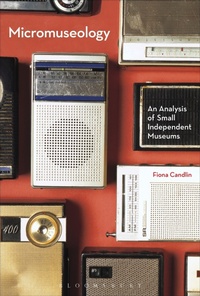
Micromuseology
An Analysis of Small Independent Museums
Published on 5. November 2015
Book
Hardback
240 pages
978-1-4742-5495-3 (ISBN)
Description
How would our understanding of museums change if we used the Vintage Wireless Museum or the Museum of Witchcraft as examples - rather than the British Museum or the Louvre? Although there are thousands of small, independent, single-subject museums in the UK, Europe and North America, the field of museum studies remains focused almost exclusively on major institutions.
In this ground-breaking new book, Fiona Candlin reveals how micromuseums challenge preconceived ideas about what museums are and how they operate. Based on extensive fieldwork and analysis of more than fifty micromuseums, she shows how they offer dramatically different models of curation, interpretation and visitor experience, and how their analysis generates new perspectives on subjects such as display, objects, collections, architecture, and the public sphere.
The first-ever book dedicated to the subject, Micromuseology provides a platform for radically rethinking key debates within museum studies. Destined to transform the field, it is essential reading for students and researchers in museum studies, anthropology, material culture studies, and visual culture.
In this ground-breaking new book, Fiona Candlin reveals how micromuseums challenge preconceived ideas about what museums are and how they operate. Based on extensive fieldwork and analysis of more than fifty micromuseums, she shows how they offer dramatically different models of curation, interpretation and visitor experience, and how their analysis generates new perspectives on subjects such as display, objects, collections, architecture, and the public sphere.
The first-ever book dedicated to the subject, Micromuseology provides a platform for radically rethinking key debates within museum studies. Destined to transform the field, it is essential reading for students and researchers in museum studies, anthropology, material culture studies, and visual culture.
Reviews / Votes
We can declare Candlin's experiment in the relevance of micromuseums a success. -- Jack David Eller * Anthropology Review Database * Don't let the modest title fool you. Candlin does not just provide 'an analysis of small independent museums', she prods Museum Studies to rethink its primary object of study. Part travel literature, part ethnography, Candlin's book offers both a new object - what she dubs 'the micromuseum' - and a highly innovative method for its scholarly study, 'micromuseology'. After Micromuseology, one might ask: 'What was Museum Studies?'. -- Raiford Guins, Stony Brook University, USAMore details
Language
English
Place of publication
London
United Kingdom
Publishing group
Bloomsbury Publishing PLC
Target group
College/higher education
Illustrations
60 bw illus
Dimensions
Height: 240 mm
Width: 161 mm
Thickness: 18 mm
Weight
529 gr
ISBN-13
978-1-4742-5495-3 (9781474254953)
Copyright in bibliographic data and cover images is held by Nielsen Book Services Limited or by the publishers or by their respective licensors: all rights reserved.
Schweitzer Classification
Other editions
Additional editions
E-Book
11/2015
1st Edition
Bloomsbury Academic
€42.99
Available for download
Person
Fiona Candlin is Senior Lecturer in Museum Studies at Birkbeck, University of London, UK
Content
Micromuseology: An Introduction
1. Open House: Rethinking the 'Public' Museum
2. Vital Objects: How to Keep Museum Exhibits Alive
3. Partisans Reviewed: The Problematic Ethics of Multi-Perspectival Exhibitions
4. Caring for the Dead: Small-Scale Philanthropy and its Motivations
5. Choosing Clutter: Curiosity and the History of Museums
6. Other Worlds: The Distinct Traits of Micromuseums
Notes
Bibliography
Index
1. Open House: Rethinking the 'Public' Museum
2. Vital Objects: How to Keep Museum Exhibits Alive
3. Partisans Reviewed: The Problematic Ethics of Multi-Perspectival Exhibitions
4. Caring for the Dead: Small-Scale Philanthropy and its Motivations
5. Choosing Clutter: Curiosity and the History of Museums
6. Other Worlds: The Distinct Traits of Micromuseums
Notes
Bibliography
Index