

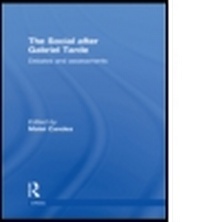
The Social after Gabriel Tarde
Debates and Assessments
1st Edition
Published on 15. February 2010
Book
Hardback
304 pages
978-0-415-54339-2 (ISBN)
Description
The social sciences and humanities are now being swept by a Tardean revival, a rediscovery and reappraisal of the work of this truly unique thinker, for whom 'everything is a society and every science a sociology'. Tarde is being brought forward as the misrecognised forerunner of a post-Durkheimian era. Reclaimed from a century of near-oblivion, his sociology has been linked to Foucaultian microphysics of power, to Deleuze's philosophy of difference, and most recently to the spectrum of approaches related to Actor Network Theory. In this connection, Bruno Latour hailed Tarde's sociology as "an alternative beginning for an alternative social science". This volume asks what such an alternative social science might look like.
More details
Series
Language
English
Place of publication
London
United Kingdom
Publishing group
Taylor & Francis Ltd
Target group
College/higher education
Product notice
Paper over boards
Illustrations
6 s/w Zeichnungen, 3 s/w Photographien bzw. Rasterbilder, 9 s/w Abbildungen
6 Line drawings, black and white; 3 Halftones, black and white; 9 Illustrations, black and white
Dimensions
Height: 234 mm
Width: 156 mm
Weight
590 gr
ISBN-13
978-0-415-54339-2 (9780415543392)
Copyright in bibliographic data and cover images is held by Nielsen Book Services Limited or by the publishers or by their respective licensors: all rights reserved.
Schweitzer Classification
Other editions
New editions
Book
12/2015
2nd Edition
Routledge
€267.85
Shipment within 10-20 days
Additional editions
Book
02/2012
1st Edition
Routledge
€89.43
Article exhausted; check for reprint
Person
Matei Candea is a lecturer in social anthropology at Durham University, UK, and previously Sigrid Rausing Lecturer in collaborative anthropology at the University of Cambridge, UK. He received his doctorate from Cambridge in 2006 for work on difference, knowledge and relationality in Corsica, and has published a number of articles on this topic and on the subject of ethnographic method and anthropological theory. A book entitled Corsican Fragments: Difference, Knowledge and Fieldwork is forthcoming with Indiana University Press in 2010. His post-doctoral research focuses on the interplay of engagement and detachment in everyday relations between behavioural biologists and the animals they study.
Content
Introduction: Revisiting Tarde's House, Matei Candea Part 1: 'The Distance that lay Between': The Tarde-Durkheim Debate Reconsidered 1. The Debate, Gabriel Tarde & Emile Durkheim 2. Imitation: Returning to the Tarde-Durkheim Debate, Bruno Karsenti 3. The Value of a Beautiful Memory: Imitation as Borrowing in Serious Play at Making Mortuary Sculptures in New Ireland, Karen Sykes 4. Tarde and Durkheim and the Non-Sociological Ground of Sociology, David Toews 5. If There is No Such Thing as Society, Is Ritual Still Special? On Using The Elementary Forms after Tarde, Joel Robbins 6. One or Three: Issues of Comparison, Timothy Jenkins 7. The Height, Length and Width of Social Theory, Alberto Corsin Jimenez 8. Faith, Reason and the Ethic of Craftsmanship: Creating Contingently Stable Worlds, Penny Harvey & Soumhya Venkatesan Part 2: Quantifying, Tracing, Relating: Fragments of Tardean Method 9. Tarde's idea of Quantification, Bruno Latour 10. Gabriel Tarde and Statistical Movement, Emmanuel Didier 11. Tarde's Method: Between Statistics and Experimentation, Andrew Barry 12. Intervening with the Social? Ethnographic Practice and Tarde's Image of Relations Between Subjects, James Leach 13. Tarde on Drugs, or Measures Against Suicide, Eduardo Viana Vargas 14. On Tardean Relations: Temporality and Ethnography, Georgina Born 15. Pass It On: Towards a Political Economy of Propensity, Nigel Thrift Afterword, Marilyn Strathern