

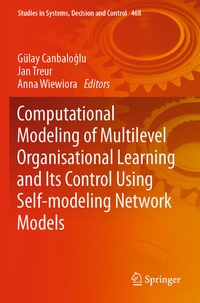
Computational Modeling of Multilevel Organisational Learning and Its Control Using Self-modeling Network Models
Published on 18. June 2024
Book
Paperback/Softback
XI, 515 pages
978-3-031-28737-4 (ISBN)
Description
Although there is much literature on organisational learning, mathematical formalisation and computational simulation, there is no literature that uses mathematical modelling and simulation to represent and explore different facets of multilevel learning. This book provides an overview of recent work on mathematical formalisation and computational simulation of multilevel organisational learning by exploiting the possibilities of self-modeling network models to address it.
- This is the first book addressing mathematical formalisation and computational modeling of multilevel organisational learning in a systematic, principled manner.
- A self-modeling network modeling approach from AI and Network Science is used where in a reflective manner some of the network nodes (called self-model nodes) represent parts of the network's own network structure characteristics.
- This is supported by a dedicated software environment allowing to design and implement (higher-order) adaptive network models by specifying them in a conceptual manner at a high level of abstraction in a standard table format, without any need of algorithmic specification or programming.
- This modeling approach allows to model the development of knowledge in an organisational setting in a neatly structured manner at three different levels for the usage, adaptation and control, respectively, of the underlying mental models.
- Several examples of realistic cases of multilevel organisational learning are used to illustrate the approach.
- Crucial concepts such as the aggregation of mental models to form shared mental models out of individual mental models are addressed extensively.
- It is shown how to model context-sensitive control of organisational learning taking into account a wide variety of context factors, for example relating to levels of expertise of individuals or to leadership styles of managers involved.
- Mathematical equilibrium analysis of models of organisational learning is also addressed, among others allowing verification of correctness of the implemental models in comparison to their conceptual design.
- Chapters in this book also contribute to the Management and Business Sciences research by demonstrating how computational modeling can be used to capture complex management phenomena such as multilevel organizational learning.
- This book has a potential implication for practice by demonstrating how computational modeling can be used to capture learning scenarios, which then provide a basis for more informed managerial decisions.
More details
Series
Edition
2023 ed.
Language
English
Place of publication
Cham
Switzerland
Publishing group
Springer International Publishing
Target group
Professional and scholarly
Illustrations
278 farbige Abbildungen, 7 s/w Abbildungen
XI, 515 p. 285 illus., 278 illus. in color.
Dimensions
Height: 235 mm
Width: 155 mm
Thickness: 27 mm
Weight
887 gr
ISBN-13
978-3-031-28737-4 (9783031287374)
DOI
10.1007/978-3-031-28735-0
Schweitzer Classification
Other editions
Additional editions
Gülay Canbaloglu | Jan Treur | Anna Wiewiora
Computational Modeling of Multilevel Organisational Learning and Its Control Using Self-modeling Network Models
Book
06/2023
Springer
€192.59
Shipment within 15-20 days
Content
On Computational Analysis and Simulation for Multilevel Organizational Learning.- Multilevel Organisational Learning.- Modeling Dynamics, Adaptivity and Control by Self-Modeling Networks.- Modeling Mental Models: their Use, Adaptation and Control.- From Conceptual to Computational Mechanisms for Multilevel Organisational Learning.- Using Self-Modeling Networks to Model Organisational Learning.