

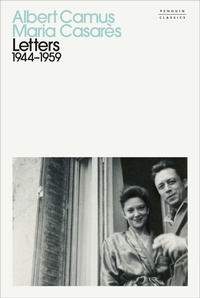
Letters
1944-1959
Will be published approx. on 2. July 2026
Book
Hardback
1200 pages
978-0-241-40042-5 (ISBN)
Description
A bestseller in France, this is the first English translation of Albert Camus and Maria Casares' fascinating, impassioned letters - a record of one of the great love affairs of the twentieth century
You and I met and fell in love passionately, impatiently, dangerously. I regret nothing and I feel that these last days I've lived are enough to justify a life. - Albert Camus to Maria Casares, 1st July 1944
Their affair began in wartime Paris. Maria Casares, a young Spanish actress, was starring in a production of the great writer's play The Misunderstanding, and at an after-party hosted by Simone de Beauvoir and Jean-Paul Sartre, they embarked on a brief but passionate relationship. Separated by the end of the Occupation and the return of Camus's wife to Paris, the couple were reunited by chance one day on the boulevard Saint-Germain, and from that day forward - until the fatal car crash that took Camus's life in 1960 - they were inseparable.
Their correspondence, uninterrupted for over a decade, is testimony to the depth of their connection while also offering a vivid portrait of artistic life in post-war Europe. Camus and Casares debate books and politics; describe encounters with Colette, Cocteau, Gide and Picasso; discuss stardom and everyday life, their love of the sea and nature, their doubts and dreams. Above all, they describe a relationship that feels like an impossible gift.
Translated into English for the first time by Sandra Smith and Cory Stockwell, these 865 letters reveal the intimate personal lives of two extraordinary artists, and record one of the great love affairs of the twentieth century.
You and I met and fell in love passionately, impatiently, dangerously. I regret nothing and I feel that these last days I've lived are enough to justify a life. - Albert Camus to Maria Casares, 1st July 1944
Their affair began in wartime Paris. Maria Casares, a young Spanish actress, was starring in a production of the great writer's play The Misunderstanding, and at an after-party hosted by Simone de Beauvoir and Jean-Paul Sartre, they embarked on a brief but passionate relationship. Separated by the end of the Occupation and the return of Camus's wife to Paris, the couple were reunited by chance one day on the boulevard Saint-Germain, and from that day forward - until the fatal car crash that took Camus's life in 1960 - they were inseparable.
Their correspondence, uninterrupted for over a decade, is testimony to the depth of their connection while also offering a vivid portrait of artistic life in post-war Europe. Camus and Casares debate books and politics; describe encounters with Colette, Cocteau, Gide and Picasso; discuss stardom and everyday life, their love of the sea and nature, their doubts and dreams. Above all, they describe a relationship that feels like an impossible gift.
Translated into English for the first time by Sandra Smith and Cory Stockwell, these 865 letters reveal the intimate personal lives of two extraordinary artists, and record one of the great love affairs of the twentieth century.
Reviews / Votes
[B]oth a major literary document on one of the greatest authors of our times as well as - thanks to the personality of his correspondent, an extraordinary actress - on the entire artistic life of their era, [and a] testimony to a mad love. Totally romantic, jubilant and agonized, but ending in tragedy * Livres Hebdo * Incandescent ... Until now, this collection has remained a fantasy object for Albert Camus specialists. Since, at home, the letter writer rivalled, in his clarity, the novelist * Le Monde des Livres * Fabulous ... This correspondence, fired up by radiant love, transports us to the end * Liberation * Some of the greatest love letters since those of Abelard and Heloise ... As we read, we realize that whatever we are learning from these long-dead lovers pales against what we can learn about ourselves. Read this book as a guide to loving and a guide to writing. Read it for sustenance after, as Casares puts it, "one of those days when the heart weeps, despite all the hopes and joys that might be promised to it". A dazzling correspondence from long ago, revived in ardent English. * Kirkus *More details
Language
English
Place of publication
London
United Kingdom
Publishing group
Penguin Books Ltd
Dimensions
Height: 240 mm
Width: 156 mm
Thickness: 40 mm
Weight
750 gr
ISBN-13
978-0-241-40042-5 (9780241400425)
Copyright in bibliographic data and cover images is held by Nielsen Book Services Limited or by the publishers or by their respective licensors: all rights reserved.
Schweitzer Classification
Other editions
Additional editions
E-Book
approx. 07/2026
Penguin Books Ltd
€14.99
Not yet available
Persons
Albert Camus (Author)
Albert Camus (1913-60) grew up in a working-class neighbourhood in Algiers. He studied philosophy at the University of Algiers, and became a journalist. His most important works include The Outsider, The Myth of Sisyphus, The Plague and The Fall. After the occupation of France by the Germans in 1941, Camus became one of the intellectual leaders of the Resistance movement. He was killed in a road accident, and his last unfinished novel, The First Man, appeared posthumously.
Maria Casares (Author)
Maria Casares (1922-1996) was a Spanish-born French actress celebrated for her commanding presence on stage and screen. In 1942, she played the lead role on stage in Deirdre of the Sorrows by J. M. Synge and soon after launched her film career in Marcel Carne's cinematic masterpiece Les Enfants du paradis. She went on to star in Robert Bresson's Les Dames du Bois de Boulogne and gave perhaps her most memorable performance, as Death, in Jean Cocteau's Orphee (1950).
Albert Camus (1913-60) grew up in a working-class neighbourhood in Algiers. He studied philosophy at the University of Algiers, and became a journalist. His most important works include The Outsider, The Myth of Sisyphus, The Plague and The Fall. After the occupation of France by the Germans in 1941, Camus became one of the intellectual leaders of the Resistance movement. He was killed in a road accident, and his last unfinished novel, The First Man, appeared posthumously.
Maria Casares (Author)
Maria Casares (1922-1996) was a Spanish-born French actress celebrated for her commanding presence on stage and screen. In 1942, she played the lead role on stage in Deirdre of the Sorrows by J. M. Synge and soon after launched her film career in Marcel Carne's cinematic masterpiece Les Enfants du paradis. She went on to star in Robert Bresson's Les Dames du Bois de Boulogne and gave perhaps her most memorable performance, as Death, in Jean Cocteau's Orphee (1950).