

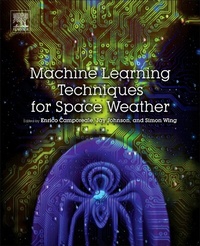
Machine Learning Techniques for Space Weather
Published on 22. May 2018
Book
Paperback/Softback
454 pages
978-0-12-811788-0 (ISBN)
Description
Machine Learning Techniques for Space Weather provides a thorough and accessible presentation of machine learning techniques that can be employed by space weather professionals. Additionally, it presents an overview of real-world applications in space science to the machine learning community, offering a bridge between the fields. As this volume demonstrates, real advances in space weather can be gained using nontraditional approaches that take into account nonlinear and complex dynamics, including information theory, nonlinear auto-regression models, neural networks and clustering algorithms.
Offering practical techniques for translating the huge amount of information hidden in data into useful knowledge that allows for better prediction, this book is a unique and important resource for space physicists, space weather professionals and computer scientists in related fields.
Offering practical techniques for translating the huge amount of information hidden in data into useful knowledge that allows for better prediction, this book is a unique and important resource for space physicists, space weather professionals and computer scientists in related fields.
More details
Language
English
Place of publication
United States
Target group
Professional and scholarly
Space physicists, space weather professionals, computer scientists in related fields, information and data scientists in related fields
Dimensions
Height: 235 mm
Width: 191 mm
Weight
1090 gr
ISBN-13
978-0-12-811788-0 (9780128117880)
Copyright in bibliographic data and cover images is held by Nielsen Book Services Limited or by the publishers or by their respective licensors: all rights reserved.
Schweitzer Classification
Other editions
Additional editions
Enrico Camporeale | Simon Wing | Jay Johnson
Machine Learning Techniques for Space Weather
E-Book
05/2018
Elsevier
€122.00
Available for download
Persons
Enrico Camporeale earned his PhD in Space Plasma Physics at the Queen Mary University of London, and had postdoctoral experience at the Los Alamos National Laboratory. He is currently a staff member at Centrum Wiskunde & Informatica (CWI), the national research center for Mathematics and Computer Science in The Netherlands. His research activity covers a broad range of topics in plasma, space physics, and space weather, with emphasis on state-of-the-art numerical models. At CWI, he is leading a research group focused on machine learning techniques for space weather applications. Simon Wing has more than 20 years' experience in space physics and space weather. He has authored and co-authored
over 100 papers and over 300 talks, and developed the Wing Kp Model that runs at several space weather centers around
the world. He also developed a technique for imaging plasma sheet ion properties from ionospheric observations. He is
currently a Principal Staff Physicist at the Johns Hopkins University Applied Physics Laboratory. Jay Johnson earned his Ph.D. degree in physics from the Massachusetts Institute of Technology and has held research positions at University of Alaska, Massachusetts Institute of Technology, and Princeton Plasma Physics Laboratory, where he served as Principal Research Physicist, co-director of the Princeton Center for Heliophysics, and Head of Space Physics from 2005-2016. He is currently a professor in the Department of Engineering and Computer Science at Andrews University, Michigan. He has published over 70 papers on theoretical plasma physics with emphasis on applications to space plasmas.
over 100 papers and over 300 talks, and developed the Wing Kp Model that runs at several space weather centers around
the world. He also developed a technique for imaging plasma sheet ion properties from ionospheric observations. He is
currently a Principal Staff Physicist at the Johns Hopkins University Applied Physics Laboratory. Jay Johnson earned his Ph.D. degree in physics from the Massachusetts Institute of Technology and has held research positions at University of Alaska, Massachusetts Institute of Technology, and Princeton Plasma Physics Laboratory, where he served as Principal Research Physicist, co-director of the Princeton Center for Heliophysics, and Head of Space Physics from 2005-2016. He is currently a professor in the Department of Engineering and Computer Science at Andrews University, Michigan. He has published over 70 papers on theoretical plasma physics with emphasis on applications to space plasmas.
Editor
Scientific Staff Member, Multiscale Dynamics Group, Dutch National Center for Mathematics and Computer Science
Principal Staff Physicist, Johns Hopkins University Applied Physics Laboratory; Adjunct Associate Professor, University of Maryland University College, MD, USA
Department of Engineering and Computer Science, Andrews University
Content
Space Weather
1. Societal and Economic Importance of Space Weather
2. Data Availability and Forecast Products for Space Weather
Machine Learning
3. Information Theory
4. Regression
5. Classification
Applications
6. Geo-effectiveness of Solar Wind Parameter: An Information Theory Approach
7. Emergence of Dynamical Complexity in the Earth's Magnetosphere
8. Applications of NARMAX in Space Weather
9. Many Hours Ahead Prediction of Geomagnetic Storms with Gaussian Processes
10. Prediction of Mev Electron Fluxes with Autoregressive Models
11. Forecast of Solar Wind Parameters Using Kalman Filter
12. Artificial Neural Networks for Determining Magnetospheric Conditions
13. Reconstruction of Plasma Electron Density from Satellite Measurements via Artifical Neural Networks
14. Classification of Magnetospheric Particle Distributions via NN
15. Automated Solar Flare Prediction
16. Coronal Holes Detection using Supervised Classification
17. CME Classification via k-means Clustering Algorithm
1. Societal and Economic Importance of Space Weather
2. Data Availability and Forecast Products for Space Weather
Machine Learning
3. Information Theory
4. Regression
5. Classification
Applications
6. Geo-effectiveness of Solar Wind Parameter: An Information Theory Approach
7. Emergence of Dynamical Complexity in the Earth's Magnetosphere
8. Applications of NARMAX in Space Weather
9. Many Hours Ahead Prediction of Geomagnetic Storms with Gaussian Processes
10. Prediction of Mev Electron Fluxes with Autoregressive Models
11. Forecast of Solar Wind Parameters Using Kalman Filter
12. Artificial Neural Networks for Determining Magnetospheric Conditions
13. Reconstruction of Plasma Electron Density from Satellite Measurements via Artifical Neural Networks
14. Classification of Magnetospheric Particle Distributions via NN
15. Automated Solar Flare Prediction
16. Coronal Holes Detection using Supervised Classification
17. CME Classification via k-means Clustering Algorithm