

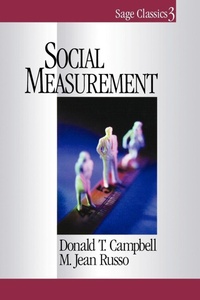
Social Measurement
1st Edition
Published on 2. April 2001
Book
Paperback/Softback
528 pages
978-0-7619-0407-6 (ISBN)
Description
This book provides researchers, evaluators, and graduate students with a user-friendly presentation of Campbell's essential work (including his latest thoughts on some of his classic works) in social measurement. The book includes Campbell's arguments as to why qualitative approaches belong with quantitative ones as the assumptive background to relevant quantitative measures, his debate with deconstructionists and social constructionists on measurement validity, and an expansion and further explanation of his multitrait-multimethod matrix. By including overviews for each part and article as well as provide social scientists with useful insights into Campbell's papers in a format accessible to advanced undergraduate and graduate students.
Reviews / Votes
"This book is a cause for celebration for social scientists of all stripes." -- Charles S. ReichardtMore details
Edition
First Edition
Language
English
Place of publication
Thousand Oaks
United States
Target group
Professional and scholarly
Dimensions
Height: 229 mm
Width: 152 mm
Thickness: 31 mm
Weight
848 gr
ISBN-13
978-0-7619-0407-6 (9780761904076)
Copyright in bibliographic data and cover images is held by Nielsen Book Services Limited or by the publishers or by their respective licensors: all rights reserved.
Schweitzer Classification
Other editions
Additional editions
Donald T. Campbell | M. .. Jean Russo
Social Measurement
Book
04/2001
1st Edition
SAGE Publications Inc
€265.70
Shipment within 15-20 days
Persons
The annual Campbell Prizes, which honor the memory of distinguished social scientist Donald T. Campbell, recognize outstanding social science research conducted by Lehigh students. Donald T. Campbell passed away on May 6, 1996, leaving a legacy of high standards for social science inquiry to Lehigh University and the national and international social science community.
He was University Professor of Social Relations, Psychology, and Education at Lehigh University until he retired in 1994. Campbell received his A.B. and Ph.D. from the University of California at Berkeley, and he held teaching positions at Northwestern University, Syracuse University, University of Chicago, and Ohio State University. During his career, he also lectured at Oxford, Harvard, and Yale Universities.
He served as president of the American Psychological Association and was a member of the National Academy of Sciences. Campbell received numerous honorary degrees and awards. He wrote more than 235 articles in the areas of social psychology, sociology, anthropology, education, and philosophy, covering a broad scope of topics from social science methodology to philosophy of science.
The Campbell Prize honors this aspiration for excellence. The prize of $500 is awarded for social science papers of high quality, methodological originality, and societal significance, as embodied in the work of the late Donald T. Campbell.
Donald Campbell and his remarkable career earned a New York Times obituary and a Lehigh University faculty memorial resolution.
He was University Professor of Social Relations, Psychology, and Education at Lehigh University until he retired in 1994. Campbell received his A.B. and Ph.D. from the University of California at Berkeley, and he held teaching positions at Northwestern University, Syracuse University, University of Chicago, and Ohio State University. During his career, he also lectured at Oxford, Harvard, and Yale Universities.
He served as president of the American Psychological Association and was a member of the National Academy of Sciences. Campbell received numerous honorary degrees and awards. He wrote more than 235 articles in the areas of social psychology, sociology, anthropology, education, and philosophy, covering a broad scope of topics from social science methodology to philosophy of science.
The Campbell Prize honors this aspiration for excellence. The prize of $500 is awarded for social science papers of high quality, methodological originality, and societal significance, as embodied in the work of the late Donald T. Campbell.
Donald Campbell and his remarkable career earned a New York Times obituary and a Lehigh University faculty memorial resolution.
Content
Introduction
PART ONE: VALIDITY OF ATTITUDE AND PERSONALITY TESTS
Types of Validity
Construct, Trait, or Discriminant Validity
Multitrait-Multimethod Validity Matrix
Does the method of Measurement Add Irrelevancies or Does It Dilute?
The Current Status of Research on the Multitrait-Multimethod Validity Matrix
The Contemporary Philosophy of Science Appropriate to the Multitrait-Multimethod Validity Matrix
Biases in Attitude and personality Scales
PART TWO: INDIRECT MEASURES
Fifteen Validity Issues Affecting All Measures
Indirect Attitude Measures
Seating Patterns as an Attitude Index
PART THREE: QUALITATIVE AND ETHNOGRAPHIC APPROACHES
Qualitative Research Methods in Program Evaluation
The Qualitative Case Study
Using the Anthropologist's Informants
The Translation of Personality and Attitude Tests
Field-Manual Anthropology
PART FOUR: THE USE OF ADMINISTRATIVE RECORDS
Administrative Records as Ontinuous Experimental Laboratories for Experimental Innovations
Welfare Recipients and Social Workers as Judges of the Effectiveness of the Program
PART FIVE: ETHICS AND RIGHTS OF SUBJECTS
Preserving Confidentiality
Protection of Research Participants
PART ONE: VALIDITY OF ATTITUDE AND PERSONALITY TESTS
Types of Validity
Construct, Trait, or Discriminant Validity
Multitrait-Multimethod Validity Matrix
Does the method of Measurement Add Irrelevancies or Does It Dilute?
The Current Status of Research on the Multitrait-Multimethod Validity Matrix
The Contemporary Philosophy of Science Appropriate to the Multitrait-Multimethod Validity Matrix
Biases in Attitude and personality Scales
PART TWO: INDIRECT MEASURES
Fifteen Validity Issues Affecting All Measures
Indirect Attitude Measures
Seating Patterns as an Attitude Index
PART THREE: QUALITATIVE AND ETHNOGRAPHIC APPROACHES
Qualitative Research Methods in Program Evaluation
The Qualitative Case Study
Using the Anthropologist's Informants
The Translation of Personality and Attitude Tests
Field-Manual Anthropology
PART FOUR: THE USE OF ADMINISTRATIVE RECORDS
Administrative Records as Ontinuous Experimental Laboratories for Experimental Innovations
Welfare Recipients and Social Workers as Judges of the Effectiveness of the Program
PART FIVE: ETHICS AND RIGHTS OF SUBJECTS
Preserving Confidentiality
Protection of Research Participants