

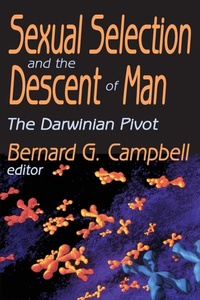
Sexual Selection and the Descent of Man
The Darwinian Pivot
1st Edition
Published on 15. April 2006
Book
Paperback/Softback
390 pages
978-0-202-30845-6 (ISBN)
Description
Just over one hundred and thirty years ago Charles Darwin, in The Descent of Man and Selection in Relation to Sex (1871), developed remarkably accurate conclusions about man's ancestry, based on a review of general comparative anatomy and psychology in which he regarded sexual selection as a necessary part of the evolutionary process. But the attention of biologists turned to the more general concept of natural selection, in which sexual selection plays a complex role that has been little understood. This volume significantly broadens the scope of modern evolutionary biology by looking at this important and long neglected concept of great importance.
In this book, which is the first full discussion of sexual selection since 1871, leading biologists bring modern genetic theory and behavior observation to bear on the subject. The distinguished authors consider many aspects of sexual selection in many species, including man, within the context of contemporary evolutionary theory and research. The result is a remarkably original and well-rounded view of the whole concept that will be invaluable especially to students of evolution and human sexual behavior. The lucid authority of the contributors and the importance of the topic will interest all who share in man's perennial fascination with his own history.
The book will be of central importance to a wide variety of professionals, including biologists, anthropologists, and geneticists. It will be an invaluable supplementary text for courses in vertebrate biology, theory of evolution, genetics, and physical anthropology. It is especially important with the emergence of alternative explanations of human development, under the rubric of creationism and doctrines of intelligent design.
In this book, which is the first full discussion of sexual selection since 1871, leading biologists bring modern genetic theory and behavior observation to bear on the subject. The distinguished authors consider many aspects of sexual selection in many species, including man, within the context of contemporary evolutionary theory and research. The result is a remarkably original and well-rounded view of the whole concept that will be invaluable especially to students of evolution and human sexual behavior. The lucid authority of the contributors and the importance of the topic will interest all who share in man's perennial fascination with his own history.
The book will be of central importance to a wide variety of professionals, including biologists, anthropologists, and geneticists. It will be an invaluable supplementary text for courses in vertebrate biology, theory of evolution, genetics, and physical anthropology. It is especially important with the emergence of alternative explanations of human development, under the rubric of creationism and doctrines of intelligent design.
More details
Language
English
Place of publication
Somerset
United States
Publishing group
Taylor & Francis Inc
Target group
College/higher education
Professional and scholarly
Dimensions
Height: 229 mm
Width: 152 mm
Thickness: 21 mm
Weight
566 gr
ISBN-13
978-0-202-30845-6 (9780202308456)
Copyright in bibliographic data and cover images is held by Nielsen Book Services Limited or by the publishers or by their respective licensors: all rights reserved.
Schweitzer Classification
Other editions
Additional editions
Book
07/2017
1st Edition
Routledge
€207.40
Shipment within 10-20 days
E-Book
07/2017
Routledge
€64.49
Available for download
E-Book
07/2017
Routledge
€64.49
Available for download
Person
Bernard Campbell is professor of anthropology at the University of California, Los Angeles. Born in Weybridge, England, he received his Ph.D. from the University of Cambridge in 1957, and has been a lecturer in anthropology at Cambridge and Harvard Universities. Among his many contributions to the field of anthropology is Human Evolution: an Introduction to Man's Adaptations (Aldine 1966).
Content
I: Theoretical Orientations; 1: Symbolic Interactionism: Themes and Variations; 2: Social Exchange Theory; 3: Reference Groups and Social Evaluations; 4: Social Roles; II: Socialization; 5: Socialization Processes Over the Life Course; 6: Contexts of Socialization; 7: Talk and Social Control; III: Social Interaction; 8: Attraction in Interpersonal Relationships; 9: Situated Activity and Identity Formation; 10: Expectation States and Interpersonal Behavior; 11: Small Groups; IV: Society and Social Behavior; 12: Attitudes and Behavior; 13: Intergroup Relations; 14: Collective Behavior: The Elementary Forms; 15: Collective Behavior: Social Movements; 16: The Sociology of Deviance and Social Control; V: Society and Personality; 17: Social Structure and Personality; 18: The Sociology of Sentiments and Emotion; 19: The Self-Concept: Social Product and Social Force; 20: Group Movements, Sociocultural Change, and Personality; 21: Mass Communications and Public Opinion: Strategies for Research