

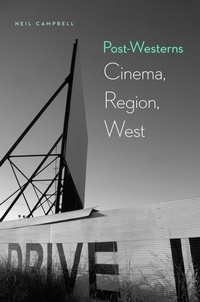
Post-Westerns
Cinema, Region, West
Published on 1. October 2013
Book
Hardback
432 pages
978-0-8032-3476-5 (ISBN)
Description
During the post-World War II period, the Western, like America's other great film genres, appeared to collapse as a result of revisionism and the emergence of new forms. Perhaps, however, as theorists like Gilles Deleuze suggest, it remains, simply "maintaining its empty frame." Yet this frame is far from empty, as Post-Westerns shows us: rather than collapse, the Western instead found a new form through which to scrutinize and question the very assumptions on which the genre was based. Employing the ideas of critics such as Deleuze, Jacques Derrida, and Jacques Ranciere, Neil Campbell examines the haunted inheritance of the Western in contemporary U.S. culture. His book reveals how close examination of certain postwar films-including Bad Day at Black Rock, The Misfits, Lone Star, Easy Rider, Gas Food Lodging, Down in the Valley, and No Country for Old Men-reconfigures our notions of region and nation, the Western, and indeed the West itself.
Campbell suggests that post-Westerns are in fact "ghost-Westerns," haunted by the earlier form's devices and styles in ways that at once acknowledge and call into question the West, both as such and in its persistent ideological framing of the national identity and values.
Campbell suggests that post-Westerns are in fact "ghost-Westerns," haunted by the earlier form's devices and styles in ways that at once acknowledge and call into question the West, both as such and in its persistent ideological framing of the national identity and values.
Reviews / Votes
"Readers of western history and literature and, of course, fans of the Western will find Campbell's insights and interpretations a compelling reason to revisit the post-Westerns he analyzes so well."-Leonard Engel, Western Historical Quarterly "This is the work of a mature, well-informed scholar very much at the top of his game."-James F. Scott, Western American Literature "Post-Westerns is distinguished by its theoretical sophistication, its brilliant close readings of the form and content of a diversity of modern and contemporary films, and its close meditation on the potential politics associated with such films [as they] address the intersection of memory, identity, and history."-Stephen Tatum, author of In the Remington MomentMore details
Series
Language
English
Place of publication
Lincoln
United States
Target group
College/higher education
Product notice
Cloth over boards
Illustrations
index
Dimensions
Height: 236 mm
Width: 152 mm
Thickness: 33 mm
Weight
771 gr
ISBN-13
978-0-8032-3476-5 (9780803234765)
Copyright in bibliographic data and cover images is held by Nielsen Book Services Limited or by the publishers or by their respective licensors: all rights reserved.
Schweitzer Classification
Other editions
Additional editions
E-Book
04/2020
1st Edition
University of Nebraska Press
€80.49
Available for download
Person
Neil Campbell is professor of American studies and senior research fellow at the University of Derby, England. He is the author of The Rhizomatic West: Representing the West in the Global, Media Age (Nebraska, 2008) and the editor of, most recently, Photocinema: The Creative Edges of Photography and Film.
Content
Acknowledgments
Introduction: Big Hats, Horses, and Dust: The Visible and Invisible West
1. Dead Westerns: The Posthumous and the Post-Western
2. Mourning in America: The Lusty Men (1952) and Bad Day at Black Rock (1954)
3. "You and Your God's Country": The Misfits (1961)
4. "We Keep Heading West": Dennis Hopper and the Post-Western
5. Exile and Dislocation in the Urban Post-Western: The Exiles (1961) and Fat City (1972)
6. Post-Western Genealogies: John Sayles's Lone Star (1996) and Silver City (2004)
7. "Opened from the Inside Out": Wim Wenders's Don't Come Knocking (2005)
8. The Idioms of Living: Donna Deitch and Allison Anders
9. The Schizo-West: Down in the Valley (2005)
10. Spook Country: The Pensive West of No Country for Old Men (2007)
Conclusion: Is There a Politics of the Post-Western?
Notes
Index
Introduction: Big Hats, Horses, and Dust: The Visible and Invisible West
1. Dead Westerns: The Posthumous and the Post-Western
2. Mourning in America: The Lusty Men (1952) and Bad Day at Black Rock (1954)
3. "You and Your God's Country": The Misfits (1961)
4. "We Keep Heading West": Dennis Hopper and the Post-Western
5. Exile and Dislocation in the Urban Post-Western: The Exiles (1961) and Fat City (1972)
6. Post-Western Genealogies: John Sayles's Lone Star (1996) and Silver City (2004)
7. "Opened from the Inside Out": Wim Wenders's Don't Come Knocking (2005)
8. The Idioms of Living: Donna Deitch and Allison Anders
9. The Schizo-West: Down in the Valley (2005)
10. Spook Country: The Pensive West of No Country for Old Men (2007)
Conclusion: Is There a Politics of the Post-Western?
Notes
Index