

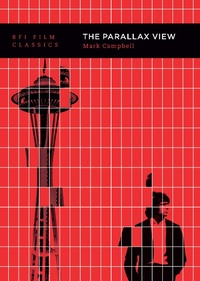
The Parallax View
Published on 14. November 2024
Book
Paperback/Softback
104 pages
978-1-83902-630-0 (ISBN)
Description
Alan J. Pakula's The Parallax View (1974) is a renowned example of the paranoid conspiracy thriller, a genre that was a marker of the 1970s. The period was haunted by the murders of John F Kennedy (1963), Malcolm X (1965), Martin Luther King (1968), and Robert Kennedy (1968), together with the crimes of the Manson family, Altamont, the Vietnam War, and the Watergate scandal.
Mark Campbell's study of the film situates it within this historical moment of increasing paranoia and conspiracy, analyzing the ways in which it not only reflected, but also actively constructed, this febrile worldview. He contextualizes the film as an adaptation of Loren Singer's 1970 pulp novel by the same name, and highlights the role of influential cinematographer, Gordon Willis, in constructing the visual style that was essential to the filmic representation of paranoia.
Focusing on the film itself, Campbell provides a detailed analysis of key scenes, particularly the central six-minute brainwashing sequence which featured imagery drawn from pop culture, advertising slogans, and violent imagery. He examines Pakula's use of the film-within-a-film visual trope, and how the scene refers to the then widely-held suspicion that television and mass media were tools of psychological "conditioning", highlighting how this concern was reflective of new anxieties about corporate and media power.
Mark Campbell's study of the film situates it within this historical moment of increasing paranoia and conspiracy, analyzing the ways in which it not only reflected, but also actively constructed, this febrile worldview. He contextualizes the film as an adaptation of Loren Singer's 1970 pulp novel by the same name, and highlights the role of influential cinematographer, Gordon Willis, in constructing the visual style that was essential to the filmic representation of paranoia.
Focusing on the film itself, Campbell provides a detailed analysis of key scenes, particularly the central six-minute brainwashing sequence which featured imagery drawn from pop culture, advertising slogans, and violent imagery. He examines Pakula's use of the film-within-a-film visual trope, and how the scene refers to the then widely-held suspicion that television and mass media were tools of psychological "conditioning", highlighting how this concern was reflective of new anxieties about corporate and media power.
More details
Series
Language
English
Place of publication
United Kingdom
Publishing group
Bloomsbury Publishing PLC
Target group
College/higher education
Illustrations
60 colour illus
Dimensions
Height: 186 mm
Width: 133 mm
Thickness: 7 mm
Weight
172 gr
ISBN-13
978-1-83902-630-0 (9781839026300)
Copyright in bibliographic data and cover images is held by Nielsen Book Services Limited or by the publishers or by their respective licensors: all rights reserved.
Schweitzer Classification
Other editions
Additional editions
Person
Mark Campbell is a Professor of Architecture at Southeast University, Nanjing, China and Senior Tutor in Architecture at the Royal College of Art, London, UK. He is a member of the UK Arts and Humanities Research Council and has served on the editorial board of the Journal of Architecture and as Managing Editor of Grey Room. His book publications include: Paradise Lost (2016), and the forthcoming contracted works, Bernard Berenson and the Art Market (2023) and Double Standards: The Post-Architectural Landscape of the United States (2026).
Content
Acknowledgments
Introduction
1.Sight Lines
2.Origin event
3.Murder most foul
4.Just sit back and relax
5.Corporate politics
Notes
Credits
Introduction
1.Sight Lines
2.Origin event
3.Murder most foul
4.Just sit back and relax
5.Corporate politics
Notes
Credits