

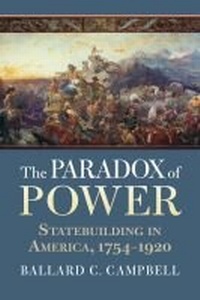
The Paradox of Power
Statebuilding in America, 1754-1920
Published on 30. November 2021
Book
Paperback/Softback
392 pages
978-0-7006-3256-5 (ISBN)
Description
America's political history is a fascinating paradox. The United States was born with the admonition that government posed a threat to liberty. This apprehension became the foundation of the nation's civic ideology and was embedded in its constitutional structure. Yet the history of public life in the United States records the emergence of an enormously powerful national state during the nineteenth century. By 1920, the United States was arguably the most powerful country in the world. In The Paradox of Power Ballard C. Campbell traces this evolution and offers an explanation for how it occurred.
Campbell argues that the state in America is rooted in the country's colonial experience and analyzes the evidence for this by reviewing governance at all levels of the American polity-local, state, and national-between 1754 and 1920. Campbell poses five critical causal references: war, geography, economic development, culture and identity (including citizenship and nationalism), and political capacity. This last factor embraces law and constitutionalism, administration, and political parties. The Paradox of Power makes a major contribution to our understanding of American statebuilding by emphasizing the fundamental role of local and state governance to successfully integrate urban, state, and national governments to create a composite and comprehensive portrait of how governance evolved in America.
Campbell argues that the state in America is rooted in the country's colonial experience and analyzes the evidence for this by reviewing governance at all levels of the American polity-local, state, and national-between 1754 and 1920. Campbell poses five critical causal references: war, geography, economic development, culture and identity (including citizenship and nationalism), and political capacity. This last factor embraces law and constitutionalism, administration, and political parties. The Paradox of Power makes a major contribution to our understanding of American statebuilding by emphasizing the fundamental role of local and state governance to successfully integrate urban, state, and national governments to create a composite and comprehensive portrait of how governance evolved in America.
Reviews / Votes
The myth of a weak American state in the eighteenth and nineteenth centuries is resilient and persistent despite a deep and distinguished scholarly effort to dislodge it. In this accessibly written book, Ballard Campbell draws on this literature, including his own important contributions to it, to make a compelling argument about the power of American government at all levels and why the myth has been hard to shake. Both scholars and general readers will profit from engaging with Campbell's book." - Paula Baker, associate professor of history, Ohio State University"Synthesizing wide-ranging scholarship, Campbell traces the evolution of governance and the growth of the state in the United States during the long nineteenth century. He posits a paradox between the limited-government antistatist ideology prevalent throughout American history and the inexorable growth in the power, scope, and expense of government at all levels. He argues that the expansion of government found increasing public acceptance because of a growing perception of government's role in remedying problems arising from either crises or long-term economic and social change. Campbell's expertise in the history of state and local governance adds a dimension to the story that other scholars often overlook." - Charles W. Calhoun, author of The Presidency of Ulysses S. Grant
"Despite a pronounced anti-statist tradition in the United States, the state grew in functional scope, financial commitment, capacity, and power during the long nineteenth century. In this engaging and accessible book, historians, political scientists, and general readers are offered a rich and careful examination of the growth of governance not only at the national level but also, crucially, at the municipal and state levels. Looking at the major engines of state-building, Campbell finds that most decisions to use governmental power were practical actions undertaken in response to problems and demands, which built public acceptance of civic interventions." - Carol Nackenoff, Richter Professor of Political Science, Swarthmore College, and coauthor of American by Birth: Wong Kim Ark and the Battle for Citizenship
More details
Language
English
Place of publication
Kansas
United States
Target group
Professional and scholarly
Dimensions
Height: 229 mm
Width: 152 mm
Thickness: 22 mm
Weight
530 gr
ISBN-13
978-0-7006-3256-5 (9780700632565)
Copyright in bibliographic data and cover images is held by Nielsen Book Services Limited or by the publishers or by their respective licensors: all rights reserved.
Schweitzer Classification
Other editions
Additional editions
E-Book
10/2021
University Press of Kansas
€36.99
Available for download
Person
Ballard C. Campbell is professor of history and public policy emeritus, Northeastern University.