

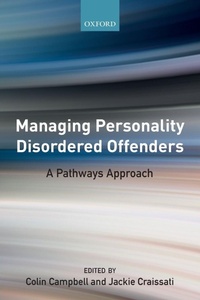
Managing Personality Disordered Offenders
A Pathways Approach
Published on 24. September 2018
Book
Paperback/Softback
236 pages
978-0-19-879187-4 (ISBN)
Description
The UK Government's Offender Personality Disorder (OPD) Strategy is one of the most significant developments in mental health and criminal justice in recent years. The challenges presented by personality disorder offenders are not unique to the UK and this book also provides a useful overview of developments in the UK for those working with this population in countries where health service provision and legal frameworks pose different challenges.
Managing Personality Disordered Offenders: A Pathways Approach describes how the OPD Strategy has been implemented by a consortium of mental health trusts in the UK, in collaboration with the National Probation Service and the Prison Service. This volume covers the broad range of key tasks in developing and delivering an OPD service. This includes reviewing the political and clinical context and how it aims to address some of the criticisms levelled at previous initiatives developed to meet the needs of this population. In each chapter, the authors review the existing literature and discuss the various options that were considered during the development of each of the services. Through this lens, the reader gains a better understanding of the direction taken, followed by a detailed, practical "how to do it" guide.
Managing Personality Disordered Offenders: A Pathways Approach describes how the OPD Strategy has been implemented by a consortium of mental health trusts in the UK, in collaboration with the National Probation Service and the Prison Service. This volume covers the broad range of key tasks in developing and delivering an OPD service. This includes reviewing the political and clinical context and how it aims to address some of the criticisms levelled at previous initiatives developed to meet the needs of this population. In each chapter, the authors review the existing literature and discuss the various options that were considered during the development of each of the services. Through this lens, the reader gains a better understanding of the direction taken, followed by a detailed, practical "how to do it" guide.
More details
Language
English
Place of publication
Oxford
United Kingdom
Target group
Professional and scholarly
Dimensions
Height: 234 mm
Width: 156 mm
Thickness: 13 mm
Weight
365 gr
ISBN-13
978-0-19-879187-4 (9780198791874)
Copyright in bibliographic data and cover images is held by Nielsen Book Services Limited or by the publishers or by their respective licensors: all rights reserved.
Schweitzer Classification
Other editions
Additional editions
E-Book
09/2018
1st Edition
OUP eBook
€29.99
Available for download
E-Book
09/2018
1st Edition
OUP eBook
€30.49
Available for download
Persons
Colin Campbell is a Consultant Forensic Psychiatrist at South London and Maudsley NHS Foundation Trust and King's College London, UK.
Jackie Craissati is a Consultant Forensic and Clinical Psychologist at Psychological Approaches CIC, London, UK.
Jackie Craissati is a Consultant Forensic and Clinical Psychologist at Psychological Approaches CIC, London, UK.
Content
1: Colin Campbell and Jackie Craissati: Introduction
2: Chantal Scaillet and Celia Taylor: Staff selection and training
3: Phil Minoudis and Jake Shaw: Case identification and formulation
4: Jackie Craissati and Rob Halsey: Intervening in the community
5: Colin Campbell and Pamela Attwell: Intervening in secure settings
6: Nikki Jeffcote, Karen Van Gerko, and Emma Nicklin: Meaningful service user participation in the pathway
7: Mick Burns, Colin Campbell, and Jackie Craissati: The offender personality disorder pathway: Modelling collaborative commissioning in the NHS and Criminal Justice System
8: Jackie Craissati and Colin Campbell: Making an impact: Have we got it right yet?
2: Chantal Scaillet and Celia Taylor: Staff selection and training
3: Phil Minoudis and Jake Shaw: Case identification and formulation
4: Jackie Craissati and Rob Halsey: Intervening in the community
5: Colin Campbell and Pamela Attwell: Intervening in secure settings
6: Nikki Jeffcote, Karen Van Gerko, and Emma Nicklin: Meaningful service user participation in the pathway
7: Mick Burns, Colin Campbell, and Jackie Craissati: The offender personality disorder pathway: Modelling collaborative commissioning in the NHS and Criminal Justice System
8: Jackie Craissati and Colin Campbell: Making an impact: Have we got it right yet?